Necessary Intervention: On India’s Conservation Ethos
Relevance: GS3 - Conservation
(Source: The Hindu, 08/11/2023)
Click here for Daily Current Affairs
Why in the news?
- The Wildlife Institute of India and the National Tiger Conservation Authority, responsible for the quadrennial 'tiger census' reports, have released updated estimates for tiger numbers.
- Madhya Pradesh stands out with a significant tiger count and a successful approach to managing their population.
Table of Contents

Increase in Tiger Population
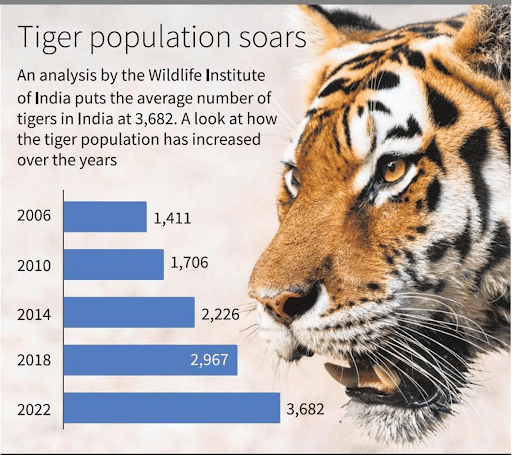
- India’s tiger population increased to 3,682 in 2022, up from 2,967 in 2018, which is an annual rise of 6 per cent.
- Madhya Pradesh (M.P.) has achieved a significant 50% increase in its tiger population. It reported a remarkable 785 tigers, constituting a fifth of the national total.
- The state has witnessed a 50% surge in tiger numbers since the previous census, outperformed only by Bihar despite having fewer tigers.
- India has 53 tiger reserves, with Madhya Pradesh accounting for six of them.
- The key to this success lies in the state's strategy of actively managing both predator (tiger) and prey populations.
Madhya Pradesh’s Strategy
- Balancing prey and predators: It has honed a strategy to actively relocate both tigers and prey within the state, ensuring a balanced predator-prey ratio.
- New species introduced: Successful reintroduction of species like barasingha and gaur to new habitats, coupled with translocations of prey like chital, showcase this approach.
- For example: M.P. has reintroduced species such as barasingha (swamp deer) to new habitats such as Satpuda and Bandhavgarh, and the Gaur to the Bandhavgarh and Sanjay-Dubri tiger reserves.
- Chital (spotted deer), a crucial prey species, has been effectively augmented in several key locations, including Satpuda and Sanjay tiger reserves, Nauradehi, Kuno, and Gandhisagar wildlife sanctuaries. This achievement is attributed to strategic translocations from high-density areas like Pench and Bandhavgarh.
- Community involvement: It has worked to build positive relationships with local communities and involve them in conservation efforts.
What are the Challenges?
- Amendments to Forest Conservation Act: Recent amendments to the Forest Conservation Act have allowed for more forest land to be diverted for industrial purposes.
- This leads to greater habitat fragmentation within wildlife reserves, making it challenging to maintain connected forest landscapes.
- Such fragmentation can disrupt animal movement and migration patterns.
- Natural Restoration: Relying solely on nature for predator-prey balance is unrealistic due to habitat fragmentation and human activities. Active intervention is necessary for maintaining healthy wildlife populations.
- Habitat improvement: Shifting from mere carnivore counting to consistent habitat enhancement is crucial. Degraded habitats can have a more profound impact on wildlife than population numbers alone.
Decline of Tigers in Other States
- Arunachal Pradesh saw an alarming dip of 68% in its tiger population reporting nine big cats in 2022 down from 29 in 2018.
- Mizoram, which had six tigers in 2006, has none now.
- In Odisha, the number of tigers dropped from 28 to 20.
- In Jharkhand, it declined from five to one, from 19 to 17 in Chhattisgarh; and from 26 to 21 in Telangana.
Tiger Reserves in India
Project Tiger
National Tiger Conservation Authority (NTCA)
|
Way Forward
- To maintain India's rich biodiversity and promote harmonious coexistence, a shift from a numbers-based approach to sustained habitat improvement and active prey management is essential.
- Investment should be made in scientific research to understand tiger behavior, population dynamics, and habitat requirements.
- Awareness should be raised about the importance of tiger conservation. Education initiatives can foster a sense of ownership and responsibility among citizens.
(*Click this link to read prelims specific weekly current affairs articles)
FAQs
Question: What is Project Tiger?
Answer:
Project Tiger was established in 1973. It was one of the most significant conservation efforts launched in India to protect tigers. It was the first project of its kind in India to maintain the population of tigers and protect them from poaching and other threats.
Question: What is the status of tigers in India?
Answer:
India’s tiger population increased to 3,682 in 2022, up from 2,967 in 2018, which is an annual rise of 6 per cent. Madhya Pradesh (M.P.) has achieved a significant 50% increase in its tiger population. It reported a remarkable 785 tigers, constituting a fifth of the national total.
Question: Where is Sanjay-Dubri tiger reserve?
Answer:
Sanjay-Dubri Tiger Reserve is wildlife paradise located in Sidhi district of Madhya Pradesh. The National park was established in 1975.
MCQs
Question: Consider the following statements: (UPSC 2014)
- Animal Welfare Board of India was established under the Environment (Protection) Act, 1986.
- The National Tiger Conservation Authority is a statutory body.
- The National Ganga River Basin Authority is chaired by the Prime Minister.
Which of the statements given above is/are correct?
(a) 1 only
(b) 2 and 3 only
(c) 2 only
(d) 1, 2 and 3
Answer: (b) See the Explanation
- The Animal Welfare Board of India was established in 1962 under Section 4 of The Prevention of Cruelty to Animals Act, 1960.
- The National Tiger Conservation Authority is set up under the Chairmanship of the Minister for Environment and Forests and is a statutory body.
- National Ganga River Basin Authority was established by the Central Government of India, on 20 February 2009. The Prime Minister is the chair of the Authority.
Therefore, option (b) is the correct answer.
Question: The term ‘M-STRIPES’ is sometimes seen in the news in the context of (UPSC 2017)
(a) Captive breeding of Wild Fauna
(b) Maintenance of Tiger Reserves
(c) Indigenous Satellite Navigation System
(d) Security of National Highways
Answer: (b) See the Explanation
National Tiger Conservation Authority (NTCA) is planning to implement a new computerized tiger monitoring protocol in all tiger reserves of the country known as Monitoring System for Tiger, Intensive Patrolling and Ecological Status (M-STRIPES). Therefore, option (b) is the correct answer.
Question: Match List I (National Park/Sanctuary) with List II (State) and select the correct answer using the codes given below: (UPSC 2004)
| List-I | List-II |
|---|---|
| A. Kanger Ghati National Park |
|
| B. Nagerhole National Park |
|
| C. Kugti Wildlife Sanctuary |
|
| D. Sultanpur Bird Sanctuary |
|
Codes:
(a) A-3; B-2; C-1; D-4
(b) A-1; B-4; C-3; D-2
(c) A-3; B-4; C-1; D-2
(d) A-1; B-2; C-3; D-4
Answer: (b) See the Explanation
National Park/ Sanctuary
- Kanger Ghati National Park - Chhattisgarh
- Nagerhole National Park - Karnataka
- Kugti Wildlife Sanctuary – Himachal Pradesh
- Sultanpur Bird Sanctuary – Haryana
Therefore, option (b) is the correct answer.
Download the PREPP App and attempt FREE IAS Exam Mock Tests and get complete study material!

Full Test - 04: UPSC CSE Prelims CSAT (Paper-II)
Full Test - 03: UPSC CSE Prelims CSAT (Paper-II)
UPSC CSE Prelims 2026 GS Paper 1 Question Paper (24-May-2026)
UPSC CSE Prelims 2026 CSAT Paper 2 Question Paper (24-May-2026)

17 February 2025 | The Hindu Must Read Articles | Current Affairs

16 February 2026 | The Hindu Must Read Articles | Current Affairs

13 February 2026 | The Hindu Must Read Articles | Current Affairs









Comments