Amazon Nations To Jointly Fight Deforestation
Relevance: GS 3- Conservation, environmental pollution and degradation, environmental impact assessment, GS2 - Bilateral, regional and global groupings and agreements involving India and/or affecting India’s interests, Effect of policies and politics of developed and developing countries on India’s interests, Prelims
(Source: The Hindu, The Hindu, 08/10/2023)
Click here for Daily Current Affairs
Why in the news?
- Recently, the members of the Amazon Cooperation Treaty Organization adopted a new shared agenda to save the rainforest, which acted as a buffer against climate change.
- The Belem Declaration aims to promote sustainable development and end deforestation and the organized crime that fuels the destruction of the region’s ecosystem.
- According to the Living Amazon Report 2022 by the World Wildlife Fund, around 35% of the rainforest is either totally lost or highly degraded while 18% has been converted for other uses.
Table of Contents
What is the Belem Declaration?
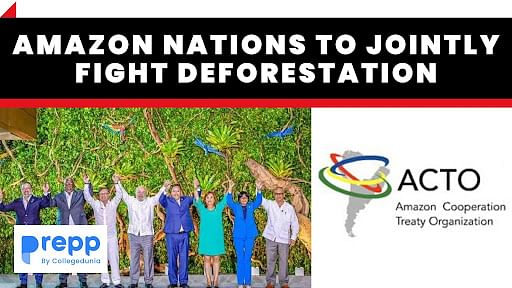
- The Belem Declaration is the official statement of the Amazon Cooperation Treaty Organization that met in Belem, Brazil.
- Aim: It sought to develop a common approach to tackling climate change as a united stance would give them more heft in global talks.
- The summit was also attended by representatives from Norway and Germany, the largest contributors to Brazil’s Amazon Fund for sustainable development, Indonesia, the Republic of Congo, and the Democratic Republic of Congo.
Major provisions
- Condemns the proliferation of protectionist trade barriers.
- These barriers adversely impact sustainable development, harms poor farmers in developing nations, and the promotion of indigenous products from the Amazon region.
- Urges industrialized nations to fulfill their obligations to financially support developing nations in combating climate change.
- Brazil has sought international financial support for forest protection to enhance efforts against deforestation which has dropped by 42% in the country since January 2023.
- Recommends improved cooperation in law enforcement through exchanging best practices and intelligence about illicit activities like deforestation, human rights violations, wildlife trafficking, and the sale and smuggling of mercury(which is used in illegal gold mining but clogs waterways).
- The countries vowed to fight deforestation and prevent the Amazon rainforest, also known as the lungs of the world, from reaching the point of no return.
Other proposals
- Affluent nations should swap foreign debt owed by Amazon countries for climate action, which would create enough investment to power the Amazon region’s economy.
- Formation of a military alliance similar to NATO which will be mandated to protect the Amazon and tackle organized crime.
- Policing of border areas and international cooperation in the region has been poor but drug seizures have increased over the past decade according to the UNODC.
Criticism
- It did not accept the demand of indigenous activists and environmentalists for all members to adopt Brazil and Colombia’s pledge to end deforestation by 2030.
- Forest protection commitments among the countries of the region have been uneven, even in the past.
- There is a lack of alignment among members on key matters as meetings are not held regularly.
- All the Amazon countries have ratified the Paris climate accord which requires signatories to set targets for reducing greenhouse gas emissions.
- However cross-border cooperation has been impaired by low trust, ideological differences, and the lack of government presence.
- Colombia has pledged to stop new oil exploration in order to achieve “decarbonized prosperity” but other countries like Brazil, who are major oil producers are more ambivalent.
- Brazil’s state-run oil major, Petrobras has sought permission to explore for oil near the mouth of the Amazon.
- Environmentalist organizations such as the Climate Observatory, Greenpeace, and the Nature Conservancy criticized the lack of detailed pledges, practical solutions, or timelines for implementation in the Declaration.
- The agreement signed by the invited countries also lacked concrete goals while mostly criticizing developed nations for failing to provide promised vast climate financing.
How have other organizations responded?
- The Confederation of Indigenous Organisations of the Amazon Basin (COICA), which is the umbrella organization of indigenous groups in the Amazon praised the Declaration for fulfilling two of their primary requests.
- It acknowledged the rights of the indigenous peoples to traditional territories
- It established a mechanism within the ACTO for the formal participation of Indigenous peoples.
- The World Wildlife Fund (WWF) supported the Declaration for recognizing the dangers faced by the Amazon but claimed that a common and united approach is necessary to end deforestation.
- The Rainforest Foundation, Norway, stated that the declaration is an opportunity for the Amazonian nations to protect their rainforests and reaffirmed their demand for financial support from the developed world.
What is the ACTO?
- The Amazon Cooperation Treaty Organization (ACTO) is an international organization that aims to promote the sustainable development of the Amazon Basin.
- It was established in 1995 with its headquarters in Brasilia, Brazil to strengthen the provisions of the Amazon Cooperation Treaty (ACT), which was signed on 3 July 1978, and amended in 1998.
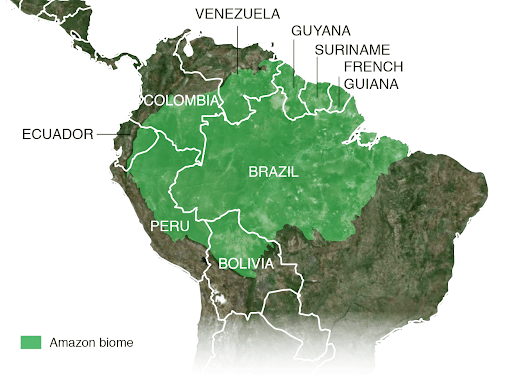
- Members: Brazil, Bolivia, Colombia, Ecuador, Guyana, Peru, Suriname, and Venezuela.
- However, a major criticism of the ACTO is that it has only met 4 times in the last 45 years.
Why is deforestation in the Amazon a major concern?
- According to scientists, the destruction of 20 - 25% of the rainforest will lead to
- Decline in rainfall
- Transformation of more than half of the rainforest into tropical savannah
- Immense biodiversity loss.
- This means that the Amazon is losing its ability to bounce back from the damage caused by droughts, fires, and deforestation.
- As a result the rainforest, which stores around one-third of the carbon stored by forests worldwide, could transform into a major carbon source.
- This is accompanied by a loss of biodiversity, indigenous tribes, and knowledge, and an increase in zoonotic diseases.
- The Amazon has been the victim of capitalism in which agriculture spread indiscriminately along with the exploitation of natural resources.
- Industrialized nations were responsible for the majority of historic greenhouse gas emissions.
- Therefore, the responsibility of protecting the Amazon should be shared among them as well instead of the burden being placed upon the poor and developing economies of the region.
Conclusion
- Despite disagreements and ambiguities in the positions of the member countries, the revival of the ACTO indicates increased regional cooperation and growing global recognition of the Amazon’s importance in arresting climate change.
- It must be provided with more adequate funding so that it can act as the collective voice of the region ahead of the COP climate conference.
Amazon Rainforest
|
(*Click this link to read prelims specific weekly current affairs articles)
FAQs
Question: What is deforestation?
Answer:
Deforestation is the indiscriminate felling of trees caused by urbanization, industrialization, mining, wood procurement for domestic and other purposes As a result, deforestation has resulted in the conversion of forest land to non-forest lands such as farms, mines, etc.
Question: What is protectionism?
Answer:
Protectionism is characterized by government policies that restrict international trade in order to help domestic industries. Examples of tools of protectionist policy are tariffs, import quotas, product standards, and subsidies. It is also known as de-globalization.
MCQs
Question: Which of the following countries is not a member of the Amazon Cooperation Treaty Organization (ACTO)?
(a) Brazil
(b) Ecuador
(c) Venezuela
(d) Madagascar
Answer: (d) See the Explanation
- The Amazon Cooperation Treaty Organization is a grouping of 8 South American countries that was formed to strengthen the provisions of the Amazon Cooperation Treaty.
- Madagascar is an African island country.
Therefore, option (d) is the correct answer.
Question: Consider the following statements:
- The majority of the Amazon rainforest lies in Colombia.
- It is bordered by the Andes mountains in the east and the Pacific Ocean in the west.
Which of the above statements is/are correct?
(a) 1 only
(b) 2 only
(c) Both 1 and 2
(d) None of the above
Answer: (d) See the Explanation
- 60% of the Amazon rainforest lies in Brazil. Hence statement 1 is incorrect.
- The Amazon rainforest is bordered by the Andes mountains in the west and the Atlantic Ocean in the east. Hence statement 2 is incorrect.
Therefore, option (d) is the correct answer.
Download the PREPP App and attempt FREE IAS Exam Mock Tests and get complete study material!

Full Test - 04: UPSC CSE Prelims CSAT (Paper-II)
Full Test - 03: UPSC CSE Prelims CSAT (Paper-II)
UPSC CSE Prelims 2026 GS Paper 1 Question Paper (24-May-2026)
UPSC CSE Prelims 2026 CSAT Paper 2 Question Paper (24-May-2026)

17 February 2025 | The Hindu Must Read Articles | Current Affairs

16 February 2026 | The Hindu Must Read Articles | Current Affairs

13 February 2026 | The Hindu Must Read Articles | Current Affairs









Comments