India Takes First Step To Remove Animals From Drug-Testing Process
Relevance: GS 2 - Government policies and interventions for development in various sectors and issues arising out of their design and implementation. GS 3 - Science and Technology- developments and their applications and effects in everyday life. GS 4- Ethics and Human Interface
(Source: The Hindu, 08/10/23)
Click here for Daily Current Affairs
Why in the news?
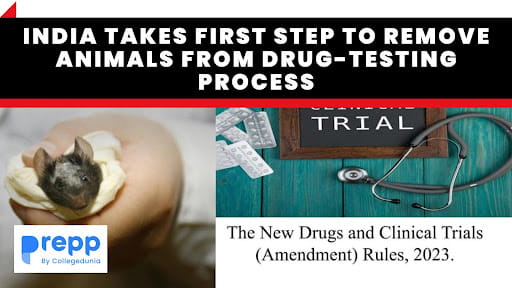
- Recently, an amendment to the New Drugs and Clinical Trial Rules (2023) passed by the Government of India, aims to replace the use of animals in research, especially in drug testing.
- The amendment authorises researchers to instead use non-animal and human-relevant methods, including technologies like 3D organoids, organs-on-chip, and advanced computational methods, to test the safety and efficacy of new drugs.
Table of Contents
What is the reason behind shifting to Alternative testing modes?
- The drug development journey involves rigorous testing to assess the efficacy and unintended effects.
- The first step of this process has been to test the candidate molecule in at least two animal species: a rodent (mouse or rat) and a non-rodent, such as canines and primates
- Lack of accuracy: Human response is influenced by factors like genetics and diet, leading to a significant mismatch between animal models and human responses.
- This mismatch contributes to the high failure rate during human clinical trials, highlighting the need for more accurate testing methods.
- Animals cannot consent to their own participation in research.
- Welfare of animals: Critics argue that animal testing can cause suffering and harm to animals. Animals are held in sterile, isolated cages, forced to suffer disease and injury, and typically euthanized at the end of each study.
What are Alternative testing modes?
- Organoids: These technologies encompass three-dimensional cellular structures, known as "organoids" or "mini-organs," which closely replicate the functions of specific body organs at a miniature scale.
- Organ-on-a-chip: The "organ-on-a-chip" technology employs small chips with human cells and microchannels to simulate physiological processes.
- organ-on-a-chip are AA-battery-sized chips lined with human cells connected to microchannels, to mimic blood flow inside the body.
- Additive manufacturing: 3D bioprinters use human cells as 'bio-ink' to build tissues. This could help make personalized drug tests and change how we create drugs.
What are Global regulatory frameworks that have adopted non-animal methods to test the effect and potential side-effects of new drug candidates?
- European Union: In 2021, the European Union adopted a resolution for an action plan promoting non-animal technologies in research, regulatory testing, and education.
- USA: The U.S. passed the FDA Modernization Act 2.0 in December 2022, permitting the use of these methods for drug safety and efficacy testing.
- South Korea: South Korea introduced a Bill for advancing alternatives to animal testing in December 2022.
- Canada: In June 2023, Canada amended its Environmental Protection Act to minimize vertebrate animal use in toxicity testing.
India
- In March 2023, the Indian government incorporated non-animal alternatives for drug testing and development into the drug development process by modifying the New Drugs and Clinical Trials Rules 2019.
- This step followed public input and consultation with the Drug Technical Advisory Board, which advises governments on drug-related technical issues at both the Central and State levels.
What are the challenges with these alternate methods?
- Multidisciplinary: Developing an organ-on-a-chip system requires multidisciplinary knowledge in the fields of cell biology, materials science, fluid dynamics, electronics, engineering, and pharmacology/toxicology to accurately replicate organ behavior and assess drug effects.
- At present there is a lack of focused training and expertise in India.
- Dependence of Imports: Most of the reagents, cell-culture related materials, and instruments for these technologies are currently imported from the U.S., Europe, and Japan.
- Managing Complexity: Researchers simplify recreating human tissues in the lab by minimizing components for disease simulation.
- No universal approach due to disease-specific variations; for example, a liver-on-a-chip won't fit all liver diseases.
- Variability arises from differences in lab protocols, expertise, and specific research goals. Regulators express concerns about data consistency due to these variations.
Suggestions
- Establishment of specialized institutes: Recently, a meeting organized by the Centre for Predictive Human Model Systems and Humane Society International India called for the need of specialized institutes similar to the Wyss Institute.
- Wyss Insitute in Boston is a dedicated center that focuses on innovations that emulate human biology.
- The dedicated institute will facilitate effective communication and collaboration across various fields.
- Promoting innovation: Developing a comprehensive and self-sustaining ecosystem in India to address this gap in the fields of cell culture, material science, and electronics.
- Guidelines: Urgent need for guidelines establishing minimal quality criteria and standards for these systems.
- Existing guidelines on animal testing requirements need re-evaluation and updating to accommodate advancements in cell-based and gene-editing therapies.
(*Click this link to read prelims specific weekly current affairs articles)
FAQs
Question: What is CDSCO?
Answer:
The Central Drugs Standard Control Organization (CDSCO) is the Central Drug Authority for discharging functions assigned to the Central Government under the Drugs and Cosmetics Act. Its functions include regulatory control over the import of drugs, approval of new drugs and clinical trials, meetings of Drugs Consultative Committee (DCC) and Drugs Technical Advisory Board (DTAB), approval of certain licenses as Central License Approving Authority.
Question: What is an Organoid?
Answer:
An organoid is a self-organized 3D tissue that is typically derived from stem cells (pluripotent, fetal or adult), and which mimics the key functional, structural and biological complexity of an organ
Question: What are Stem Cells?
Answer:
Stem cells are the body's raw materials — cells from which all other cells with specialized functions are generated. Under the right conditions in the body or a laboratory, stem cells divide to form more cells called daughter cells.
MCQ
Question: “3D printing” has applications in which of the following? (UPSC-2018)
(1) Preparation of confectionery items
(2) Manufacture of bionic ears
(3) Automotive industry
(4) Reconstructive surgeries
(5) Data processing technologies
Select the correct answer using the code given below :
(a) 1, 3 and 4 only
(b) 2, 3 and 5 only
(c) 1 and 4 only
(d) 1, 2, 3, 4 and 5
Answer: (d) See the Explanation
- 3D printing or additive manufacturing is the construction of a three-dimensional object from a CAD model or a digital 3D model.It can be done in a variety of processes in which material is deposited, joined or solidified under computer control,with material being added together (such as plastics, liquids or powder grains being fused), typically layer by layer.
- 3D printing offers a wide range of applications, including the creation of artificial limbs, stents, dental crowns, automobile parts, consumer goods, etc.
- Therefore, option (d) is the correct answer.
Download the PREPP App and attempt FREE IAS Exam Mock Tests and get complete study material!

Full Test - 04: UPSC CSE Prelims CSAT (Paper-II)
Full Test - 03: UPSC CSE Prelims CSAT (Paper-II)
UPSC CSE Prelims 2026 GS Paper 1 Question Paper (24-May-2026)
UPSC CSE Prelims 2026 CSAT Paper 2 Question Paper (24-May-2026)

17 February 2025 | The Hindu Must Read Articles | Current Affairs

16 February 2026 | The Hindu Must Read Articles | Current Affairs

13 February 2026 | The Hindu Must Read Articles | Current Affairs









Comments