J&K Constitution Limited Executive Powers Of Union Of India, Says Supreme Court
Relevance: GS2 - Indian Constitution—historical underpinnings, evolution, features, amendments, significant provisions and basic structure.
(Source: The Hindu, 08/10/2023)
Click here for Daily Current Affairs
Why in the news?
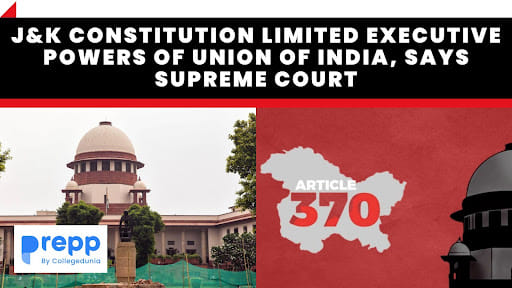
- Recently, the Supreme Court of India began hearing the constitutional challenge to 2019 abrogation of Article 370 of the Constitution which granted special status to Jammu and Kashmir.
- The Supreme Court noted that the powers and provisions enshrined in the Constitution of India cannot be restricted by the erstwhile Jammu & Kashmir Constitution.
- It raised questions why efforts were never made regarding the integration of the Constitution of Jammu and Kashmir into the Indian Constitution.
- The unique Constitution of Jammu and Kashmir, enacted in 1957, had limited the executive powers of the Union of India and curtailed the legislative authority of the Parliament over the years.
Table of Contents
About Jammu and Kashmir’s Constitution
- Jammu and Kashmir (J&K) was the only State to have a separate Constitution.
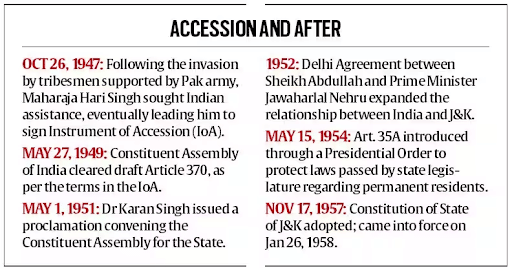
- The 1954 Constitution Order added Article 35A to the Indian Constitution, granting the Jammu and Kashmir State Legislature the power to determine 'permanent residents' and provide them special rights in areas like jobs, property, and scholarships.
- Its constitution was framed by a Constituent Assembly of its own, adopted on 17th November 1957 and came into force on the 26th January, 1957.
- It was abrogated by the President on August 5, 2019.
What is Article 370?
- Article 370 is in Part XXI of the Constitution, titled “Temporary, Transitional and Special Provisions”.
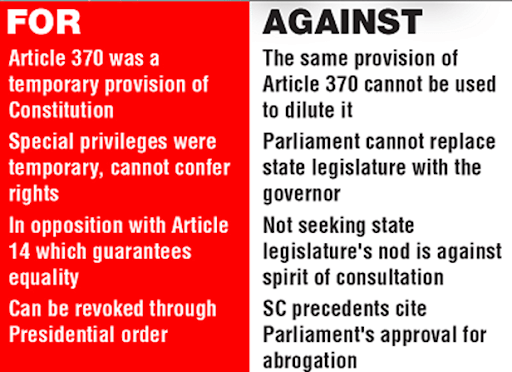
- It was a temporary provision that granted special autonomy to the region of Jammu and Kashmir.
- It allowed Jammu and Kashmir to have its own Constitution, a separate flag, and considerable autonomy over internal matters except defense, foreign affairs, finance, and communications.
- Clause 3 of the article 370 gives the President of India the power to amend its provisions and scope.
Removal of Special Status of J&K
- Article 370(3) permits deletion of special status of J&K by a Presidential Order.
- Such an order, however, is to be preceded by the concurrence of J&K’s Constituent Assembly.
- The erstwhile State’s Constituent Assembly was dissolved on January 26, 1957, and it is viewed that special status cannot be removed.
- But the other view is that it can be done, only with the concurrence of the State Assembly.
- In 2019, the Constitution (Application to Jammu and Kashmir) Order 2019, issued by the President, withdrew the special status of J&K and extended all provisions of the Indian Constitution to J&K.
- The J&K (Reorganization) Act 2019 bifurcated J&K into two UTs - Jammu and Kashmir was an UT with a Legislative Assembly; Ladakh was without an Assembly.
- Recently, the Supreme Court of India began hearing the petitions challenging the 2019 abrogation of Article 370.
Removal of Special Status of J&K Challenged in the SC
How has the J&K Constitution over the years, limited the executive powers of the Union of India?
- Special Status under Article 370: Article 370 of the Indian Constitution granted special autonomy to Jammu and Kashmir. As a result, many provisions of the Indian Constitution did not automatically apply to the state.
- Control over Internal Affairs: The J&K Constitution provided the state government with control over many internal matters, including legislation related to policing, public order, and other local issues. This restricted the authority of the Union government to intervene directly in these areas without the state government's consent.
- Limitation on Property Ownership: Article 35A, a provision inserted into the Indian Constitution through a Presidential Order in 1954, allowed the J&K State Legislature to define 'permanent residents' and grant them exclusive rights to own property and access government jobs.
- Separate Flag and Constitution: Jammu and Kashmir had its own flag alongside the national flag of India, and its own Constitution coexisted with the Indian Constitution. This further emphasized the state's distinctive identity and autonomy.
(*Click this link to read prelims specific weekly current affairs articles)
FAQs
Question: Which Article gives special status to Jammu and Kashmir?
Answer:
Jammu and Kashmir's special status is defined by Article 370 of the Indian Constitution. Temporary, Transitional, and Special Provisions were added to Part XXI of the Constitution. The Part was intended to be a temporary provision, as indicated by its title, and its application was expected to last until the State's Constitution was drafted and adopted.
Question: What is Article 35A?
Answer:
It was introduced through a Presidential Order in 1954, on the recommendation of the J&K Constituent Assembly. Article 35A empowers the Jammu & Kashmir legislature to define the permanent residents of the state, and their special rights and privileges. It appears in Appendix I of the Constitution.
Question: Which is the highest judicial court in India?
Answer:
The Supreme Court of India is the highest judicial court in India and the final court of appeal under the Indian Constitution. Also, It is the highest constitutional court having judicial review power.
UPSC Mains Practice Question:
|
Download the PREPP App and attempt FREE IAS Exam Mock Tests and get complete study material!

Full Test - 04: UPSC CSE Prelims CSAT (Paper-II)
Full Test - 03: UPSC CSE Prelims CSAT (Paper-II)
UPSC CSE Prelims 2026 GS Paper 1 Question Paper (24-May-2026)
UPSC CSE Prelims 2026 CSAT Paper 2 Question Paper (24-May-2026)

17 February 2025 | The Hindu Must Read Articles | Current Affairs

16 February 2026 | The Hindu Must Read Articles | Current Affairs

13 February 2026 | The Hindu Must Read Articles | Current Affairs









Comments