Kerala Assembly Passes Resolution Urging Centre To Change State Name To Keralam
(Source: The Hindu, 08/10/2023)
Click here for Daily Current Affairs
Why in the news?
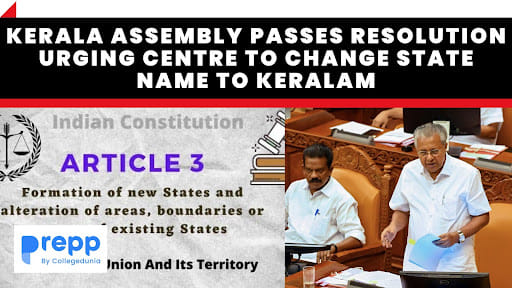
Recently, Kerala Assembly passed a resolution urging the Central Government to officially change the name of the State from Kerala to Keralam.
Table of Contents
What does the resolution say?
- It states that the State's name in Malayalam is "Keralam," and its formation on November 1, 1956, was rooted in linguistic principles.
- The significance of uniting Malayalam-speaking communities for Kerala's development was apparent during the national freedom movement.
- Despite this, the State's name is currently registered as "Kerala" in the Constitution's First Schedule.
- The assembly has requested the Union government to take steps to amend it to Keralam under Article 3 of the Constitution.
Origin of the Names
- Kerala: The earliest known reference to Kerala can be found in Emperor Asoka's Rock Edict II from 257 BC. In this ancient inscription, a local ruler is referred to as "Keralaputra," which translates in Sanskrit to "son of Kerala." The ruler is also linked to the Chera dynasty, signifying the historical connection of the name with this prominent dynasty of the region.
- Keralam: Regarding ‘Keralam’, scholars believe it could have originated from ‘Cheram’. Cheram is regarded as the region between Gokarnam and Kanyakumari. The origin of the term relates to the root ‘cher’, which means to join.
Procedure of Renaming the State
- Constitutional and legal provisions:
- Article 3: It gives the Indian Parliament the power to reorganize the territories of the states and to alter their boundaries, by passing a bill for this purpose.
- State Reorganization Act of 1956: It provides a framework for the reorganization of states in India, including the changing of names of states.
- The procedure of renaming of the state can be initiated by either the Parliament or the State Legislator.
- The renaming of a state requires Parliamentary approval under Article 3 and 4 of the Constitution.
- A bill for renaming a state may be introduced in the Parliament on the recommendation of the President.
- Before the introduction of the bill, the President shall send the bill to the respective state assembly for expressing their views within a stipulated time.
- When the period expires, the bill will be sent to the Parliament for deliberation.
- The bill in order to take the force of a law must be passed by a simple majority.
- The bill is then sent for approval to the President. After the approval, the bill becomes a law and the name of the state stands modified.
Formation of the State of Kerala
- After India gained independence in 1947, there was a push to reorganize the states based on linguistic and cultural lines to ensure better governance and representation.
- The States Reorganization Act of 1956 played a pivotal role in this process.
- Kerala came into being on November 1, 1956. It was formed through the merger of the princely states of Travancore and Cochin with the Malabar district of Madras Presidency.
- The formation was a result of linguistic and cultural considerations, as Malayalam was the primary language spoken in the region.
(*Click this link to read prelims specific weekly current affairs articles)
FAQs
Question: What is Article 3?
Answer:
Article 3 deals with the formation of new States and alteration of areas, boundaries or names of existing States.
Question: What is the States Reorganization Act of 1956?
Answer:
The States Reorganisation Act, 1956 was a major reform of the boundaries of India's states and territories, organising them along linguistic lines.
Question: Which was the first State in India to be created on a linguistic basis?
Answer:
The State of Andhra was the first state in India to be created on a linguistic basis.
MCQs
Question: Under which Schedule of the Constitution of India can the transfer of tribal land to private parties for mining be declared null and void? (UPSC 2019)
(a) Third Schedule
(b) Fifth Schedule
(c) Ninth Schedule
(d) Twelfth Schedule
Answer: (b) See the Explanation
Indian Constitution provides autonomy to tribal areas in matters of governance under the Fifth and Sixth Schedules. Based on the Fifth Schedule the transfer of tribal land to private parties for mining was held null and void by courts.
Therefore, option (b) is the correct answer.
Download the PREPP App and attempt FREE IAS Exam Mock Tests and get complete study material!

Full Test - 04: UPSC CSE Prelims CSAT (Paper-II)
Full Test - 03: UPSC CSE Prelims CSAT (Paper-II)
UPSC CSE Prelims 2026 GS Paper 1 Question Paper (24-May-2026)
UPSC CSE Prelims 2026 CSAT Paper 2 Question Paper (24-May-2026)

17 February 2025 | The Hindu Must Read Articles | Current Affairs

16 February 2026 | The Hindu Must Read Articles | Current Affairs

13 February 2026 | The Hindu Must Read Articles | Current Affairs









Comments