Can Small Modular Nuclear Reactors Help India Achieve Net-Zero?
Relevance: GS3 - Infrastructure: Energy GS2 - Government policies and interventions for development in various sectors and issues arising out of their design and implementation.
(Source: The Hindu, 08/09/2023)
Click here for Daily Current Affairs
Why in the news?
- Decarbonization of the power sector is a crucial factor in achieving Sustainable Development Goal 7 which aims to secure affordable, reliable, sustainable, and modern energy for all.
- The world is still dependent on fossil fuels for 82% of its energy supply with the share of electricity in final energy consumption expected to increase by 80-150% by 2050.
- Small Modular Nuclear Reactors can be a major driver in the transition as they are simpler, safer, and more cost-effective than conventional nuclear reactors.
- SMRs were also included in the U.S.-India joint statement after the meeting between Indian Prime Minister Narendra Modi and U.S. President Joe Biden in June 2023.
Table of Contents
What are the challenges associated with decarbonization?
- Inadequate sources: Solar and Wind energy will not suffice to meet the demands for reliable and affordable energy as the world transitions to cleaner energy sources from fossil fuel-based sources.
- Scarcity of minerals: According to the International Energy Agency, critical minerals like lithium, nickel, cobalt, and rare earth elements which are required for clean-energy production technologies are likely to see demand increase 3.5 times by 2030.
- Capital investment: The development of new mines and processing facilities involves large capital investments which can be unaffordable for emerging economies.
- Environmental effects: Mines and critical mineral processing plants have several environmental and social impacts associated with them such as land degradation, water contamination, etc.
- Monopoly: The top three mineral-producing and -processing nations control 50-100% of the current global extraction and processing capacities which could lead to geopolitical risks.
Pros and Cons of Nuclear Power
Pros
- Nuclear power plants generate 10% of the world’s electricity.
- This leads to savings of around 180 billion cubic meters in natural gas demand and 1.5 billion tonnes of CO2 emissions per annum.
- Nuclear power plants are efficient users of land and have lower grid integration costs than those associated with variable renewable energy (VRE) sources.
- This is because NPPs can generate power throughout the day in all kinds of weather.
- Other benefits associated with nuclear power include upskilling of the population, generation of jobs in technology, increased manufacturing, and enhanced operations.
Cons
- However, conventional NPPs suffer from time and cost overruns which has forced several countries to develop small modular reactors (SMRs) in addition to conventional nuclear power plants.
- There is an increased risk of accidents and production of radioactive waste which can have a negative impact on the environment.
- Nuclear energy is generated using exhaustible materials raising questions about sustainability.
- There is a general perception that commercial nuclear power is dangerous and unstable.
How are SMRs more advantageous?
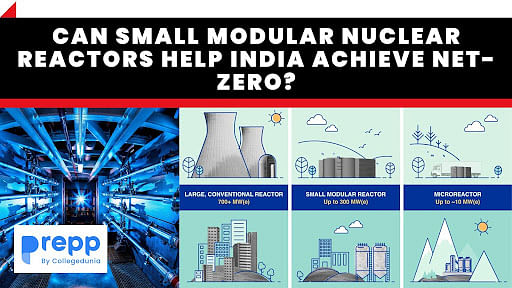
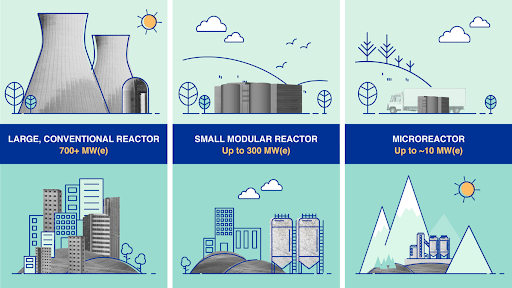
- Small Modular Nuclear Reactors are reactors with a maximum capacity of 300 MW.
- Safer: They are designed with a smaller core damage frequency, i.e. the likelihood that an accident will damage the nuclear fuel, and source term, i.e. a measure of radioactive contamination compared to conventional Nuclear Plants.
- They also have enhanced seismic isolation for better safety.
- They include several passive safety features and a lower potential for the uncontrolled release of radioactive materials into the environment.
- Simpler: The designs of SMRs are much simpler than those of conventional NPPs.
- Achieving Net Zero: Unlike critical mineral resources, uranium resources are more widely available and distributed.
- SMR designs make use of low-enriched uranium, which can be supplied by all countries possessing uranium mines and enrichment facilities.
- This ensures the availability of a reliable fuel source and will help in achieving India’s energy security and net-zero targets.
- Fuel-effective: A SMR project also has a lower amount of spent nuclear fuel stored in it as compared to a conventional NPP.
- They can be safely installed and operated at brownfield sites that do not meet the strict zoning requirements for conventional NPPs.
- Cost-Effective and Sustainable: Small Modular Reactors (SMRs) have a lifespan of 40-60 years and operate efficiently, with high capacity factors of over 90%.
- In the U.S.A., current SMR capital costs are approximately $6,000 per MW, but this is expected to drop by 2030 due to increased SMR adoption in Europe by 2035.
- India can benefit from cost-effective SMR development for India and the world by established domestic companies through foreign technology transfer.
- This will allow India to expand its zero-carbon nuclear power, and attract green funding from the Green Climate Fund and international investors, without straining government finances.
- Efficient Manufacturing: SMRs are mainly produced in controlled factory environments through serial manufacturing and then assembled on-site, leading to quicker and more cost-effective construction and deployment.
- Overall, SMRs offer a cost-effective pathway to sustainable nuclear energy, enabling India to achieve its net-zero ambitions while attracting global investment.
- Social impact: The power-plant organization can also undertake community work, as the Nuclear Power Corporation did in Kudankulam, Tamil Nadu before the first unit was built.
Governmental Action Required
- Amend Atomic Energy Act: Amend the Atomic Energy Act to permit private sector participation in setting up SMRs.
- Establish Independent Regulatory Board: Enact a law to establish an independent regulatory board with expertise to oversee all stages of nuclear power generation, ensuring safety and security.
- Government Oversight of Security: Retain government control over the security aspects of SMRs while allowing private operations under government supervision.
- Leverage International Agreements: Utilize agreements like the India-US '123 agreement' to develop nuclear fuel reserves and reprocess spent fuel under international safeguards.
- Public Perception Enhancement: The Department of Atomic Energy must enhance public perception by transparently sharing comprehensive environmental and public health data of civilian reactors operating under international safeguards.
- Regulatory Efficiency: A robust regulatory regime, similar to the civil aviation sector, is necessary to ensure the safe and efficient decarbonization of the power sector.
- The Central Electricity Authority (CEA) has recommended increasing coal-based thermal power plant capacity to meet energy demands.
- The generation capacity of VRE sources, such as wind and solar, should be expanded significantly to contribute to India's energy mix.
- Additional energy storage infrastructure is essential to effectively integrate power from VRE sources, ensuring grid stability.
Conclusion
Small Modular Reactors and a conducive regulatory framework can help expedite India's transition towards net zero and ensure energy security. The effective integration of renewable energy sources along with this approach can revolutionize India's energy landscape while contributing to global climate goals. Any reduction in nuclear power generation could make the goal of achieving net-zero more challenging and expensive for countries like India.
(*Click this link to read prelims specific weekly current affairs articles)
FAQs
Question: What is clean energy?
Answer:
Clean energy is also known as green energy or renewable energy. It is called clean because it has little to no impact on the environment and does not release toxic greenhouse gases into the atmosphere. Eg: Solar energy.
Question: What is the India-US '123 agreement'?
Answer:
The 123 Agreement signed between the United States of America and the Republic of India is known as the U.S.–India Civil Nuclear Agreement or Indo-US nuclear deal. India agreed to separate its civilian and military nuclear activities and open up the civilian part to inspection by the IAEA while the US offered to resume full nuclear trade including technology transfer and Uranium sale with India.
Question: What is the Central Electricity Authority?
Answer:
The Central Electricity Authority (CEA) is a statutory organization that advises the government on matters relating to the National Electricity Policy (NEP) and formulates plans for the development of electricity systems. It is the designated authority for cross border trade of electricity.
UPSC Mains Practice Question:
|
MCQs
Question: To meet its rapidly growing energy demand, some opine that India should pursue research and development on thorium as the future fuel of nuclear energy. In this context, what advantage does thorium hold over uranium? (UPSC CSE 2012)
- Thorium is far more abundant in nature than uranium.
- On the basis of unit mass of mined mineral, thorium can generate more energy compared to natural uranium
- Thorium produces less harmful waste compared to uranium.
Which of the statements given above is/are correct?
(a) 1 only
(b) 2 and 3 only
(c) 1 and 3 only
(d) 1, 2 and 3
Answer: (d) See the Explanation
- Thorium is 3 times as abundant as uranium and composes 0.0006% of the earth's crust whereas Uranium composes 0.00018% of the earth's crust. Hence statement 1 is correct.
- One ton of thorium is estimated to produce energy equivalent to 35 tons of uranium, Hence statement 2 is correct.
- Liquid Flouride Thorium reactors have two orders of waste less than comparable nuclear reactors. Hence statement 3 is correct.
Therefore, option (d) is the correct answer.
Question: Which of the following is a major advantage of Small Modular Reactors (SMRs)?
(a) Larger core damage frequency
(b) Use of high-enriched uranium
(c) Absence of passive safety features
(d) Enhanced seismic isolation
Answer: (d) See the Explanation
- SMRs have enhanced seismic isolation and passive safety features which provide greater safety than conventional nuclear power plants.
- They have smaller core damage frequency and can make use of low-enriched uranium,
Therefore, option (d) is the correct answer.
Download the PREPP App and attempt FREE IAS Exam Mock Tests and get complete study material!

Full Test - 04: UPSC CSE Prelims CSAT (Paper-II)
Full Test - 03: UPSC CSE Prelims CSAT (Paper-II)
UPSC CSE Prelims 2026 GS Paper 1 Question Paper (24-May-2026)
UPSC CSE Prelims 2026 CSAT Paper 2 Question Paper (24-May-2026)

17 February 2025 | The Hindu Must Read Articles | Current Affairs

16 February 2026 | The Hindu Must Read Articles | Current Affairs

13 February 2026 | The Hindu Must Read Articles | Current Affairs









Comments