Health Ministry Defends PMJAY As CAG Audit Exposes Multiple Frauds
Relevance: GS 2 - Powers, functions and responsibilities of various Constitutional Bodies; Government policies and interventions for development in various sectors and issues arising out of their design and implementation.
(Source: The Hindu, 08/10/23)
Click here for Daily Current Affairs
Why in the news?
- Recently, the CAG’s performance audit report was tabled in the Lok Sabha noted multiple irregularities in Ayushman Bharat-Pradhan Mantri Jan Arogya Yojana (PMJAY)
- The report noted irregularities such as providing treatment for patients who had already been declared dead, as well as for thousands of people using the same Aadhaar number or invalid mobile phone number.
Table of Contents
What are the multiple irregularities exposed by the CAG Audit?
- Fake phone numbers: The CAG report highlighted instances within the PMJAY beneficiary database like the usage of fake phone numbers.
- For instance phone numbers like 9999999999 and 8888888888 were used in registration.
- Multiple beneficiaries linked to same Aadhaar: There were instances of multiple beneficiaries being linked to a single Aadhaar number, for instance, in For example, Tamil Nadu where 4,761 registrations were made against just seven Aadhaar numbers.
- Fraudulent database errors: The CAG report revealed that patients previously declared deceased continued to receive treatment under PMJAY.
- Data analysis in the Transaction Management System showed 88,760 patients died during specified treatment, yet 2,14,923 claims were paid for fresh treatment related to these patients.
Other irregularities
- Pending Penalties and Unauthorized Procedures
- Spending on ineligible beneficiaries
- Delays in Processing of Rejection Cases
- Systemic issues such as shortages of infrastructure, equipment, and doctors at empanelled hospitals, as well as cases of medical malpractice.
What are the steps taken by the government to address irregularities?
- Changes in IT portal: Necessary changes have been made in the current IT portal used by the National Health Authority (NHA) to capture only valid mobile numbers, in case the same is possessed by the beneficiary
- Introduction of Enhanced Verification Methods: The National Health Authority (NHA) introduced three additional beneficiary verification methods: fingerprint, iris scan, and face-authentication, in addition to OTP. Fingerprint-based authentication is the widely adopted choice.
Comptroller and Auditor General of India (CAG)
Duties and Power
Click on these links to know more about |
(*Click this link to read prelims specific weekly current affairs articles)
FAQs
Question: What is Ayushman Bharat?
Answer:
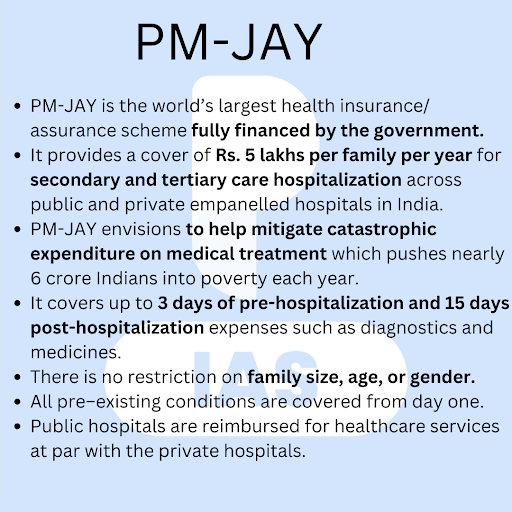
Ayushman Bharat, a flagship scheme of the Government of India, was launched as recommended by the National Health Policy 2017, to achieve the vision of Universal Health Coverage (UHC). This initiative has been designed to meet Sustainable Development Goals (SDGs) and its underlining commitment, which is to "leave no one behind."
The two components of Ayushman Bharat Are
- Health and Wellness Centres (HWCs)
- Pradhan Mantri Jan Arogya Yojana (PM-JAY)
Question: What is Ayushman Bharat Pradhan Mantri Jan Arogya Yojana?
Answer:
The Ayushman Bharat Pradhan Mantri Jan Arogya Yojana (AB-PMJAY) was launched in September 2018 as a pioneering healthcare initiative by the Government of India. Also known as the National Health Protection Scheme, its primary objective is to provide affordable healthcare access to over 500 million people across the country.
Question: What is National Health Authority (NHA)?
Answer:
National Health Authority (NHA) is the apex body responsible for implementing India’s flagship public health insurance/assurance scheme called “Ayushman Bharat Pradhan Mantri Jan Arogya Yojana” & has been entrusted with the role of designing strategy, building technological infrastructure and implementation of “Ayushman Bharat Digital Mission” to create a National Digital Health Eco-system.
MCQ
A question can be asked on the scheme, similar to the one given below
Question: With reference to ‘Pradhan Mantri Fasal Bima Yojana’, consider the following statements:
- Under this scheme, farmers will have to pay a uniform premium of two percent for any crop they cultivate in any season of the year.
- This scheme covers post-harvest losses arising out of cyclones and unseasonal rains.
Which of the statements given above is/are correct?
(a) 1 only
(b) 2 only
(c) Both 1 and 2
(d) Neither 1 nor 2
Answer: (b) See the Explanation
- Farmers are required to pay a premium of 2% for all Kharif crops and 1.5 percent for all rabi crops.
- The premium is 5% in the case of annual commercial and horticultural crops. Hence, statement 1 is incorrect.
- The schemes offer farmers with insurance coverage and financial assistance in the event that any of the registered crops fails due to natural disasters, pests, or illnesses. Hence, statement 2 is correct.
- Therefore, option (b) is the correct answer.
Download the PREPP App and attempt FREE IAS Exam Mock Tests and get complete study material!

Full Test - 04: UPSC CSE Prelims CSAT (Paper-II)
Full Test - 03: UPSC CSE Prelims CSAT (Paper-II)
UPSC CSE Prelims 2026 GS Paper 1 Question Paper (24-May-2026)
UPSC CSE Prelims 2026 CSAT Paper 2 Question Paper (24-May-2026)

17 February 2025 | The Hindu Must Read Articles | Current Affairs

16 February 2026 | The Hindu Must Read Articles | Current Affairs

13 February 2026 | The Hindu Must Read Articles | Current Affairs









Comments