Stop The Fence-Sitting In Cluster Bomb Use
Relevance: GS2 - Bilateral, regional and global groupings and agreements involving India and/or affecting India’s interests. GS3 - Defense Technology
(Source: The Hindu, 08/10/2023)
Click here for Daily Current Affairs
Why in the news?
- This article discusses the use of cluster munitions by both Russia and Ukraine during the war between the two countries.
- The Convention on Cluster Munitions which was adopted in 2008 committed to not using, producing, stockpiling, or transferring cluster munitions, but Russia and Ukraine are not signatories to the convention.
- According to the Cluster Munition Monitor, around 56,000 - 86,000 people have died in cluster munition-affected countries since the 1960s.
Table of Contents
What are cluster munitions?
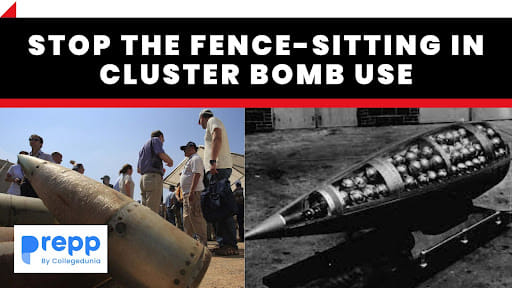
- Cluster munitions refer to a form of air-dropped or ground-launched explosives which release multiple explosive submunitions called bomblets into the air.
- Impact:
- As soon as the cluster munitions hit the ground, they explode resulting in the death and maiming of all the people in the area.
- They are generally used to kill personnel and destroy assets such as vehicles, runways, power lines, etc.
- They can also be used to disperse chemical or biological agents, land mines, or leaflets.
- Cluster bombs have been in use since World War II including by the U.S.A. in its wars against Vietnam, Afghanistan, and Iraq.
Major concerns
- These bomblets have a high dud rate (failure rate) i.e. they stay dormant for long periods without exploding.
- These bomblets can act as landmines and pose a significant threat to civilians including women and children in the region for extended periods of time.
- This can result in the contamination of the area which increases the burden on the healthcare sector and economies.
- According to Human Rights Watch, Russia has used cluster bombs against Ukraine in cities such as Kharkiv, resulting in hundreds of civilian deaths and damaging civilian objects such as homes, hospitals, and schools.
- Recently, the U.S.A. decided to send cluster munitions to Ukraine as part of a new military aid package to bolster Kyiv’s war efforts against Russia which will worsen the humanitarian situation there.
What is the Convention on Cluster Munitions?
- The Convention on Cluster Munitions was adopted and signed in 2008 by 107 member states.
- It entered into force in 2010 and became binding international law.
- Commitments:
- Article 1 of the Convention outlaws the use, production, transfer, and stockpiling of cluster munitions due to their indiscriminate and long-lasting effects on civilian populations.
- Member countries are obligated to destroy their existing stockpiles of cluster munitions.
- They are legally bound to develop a victim assistance programme to provide support and rehabilitation to the cluster bomb victims in their jurisdiction.
- It establishes a framework for cooperation with the aim of ensuring adequate assistance to survivors and communities, clearance of contaminated areas, risk reduction education, and destruction of stockpiles.
- Membership: The Convention currently has 110 State Parties and 13 Signatory States including NATO members such as France, Canada, and the U.K.
- However major nations such as the U.S.A., Russia, China, Pakistan, India, and Israel have not signed the Convention.
- Countries that ratify the convention are obliged to never use cluster munitions, and also to never develop, produce, otherwise acquire, retain, stockpile, or transfer to anyone cluster munitions.
India’s position on cluster munitions
- India views cluster bombs as legitimate weapons and produces and exports them.
- India also imports these weapons but has never used them.
- India has also acknowledged the humanitarian concerns associated with the use of cluster weapons.
Is the use of cluster weapons a violation of international law?
- Although Russia and Ukraine have argued that they are not bound by international law banning cluster bombs as they are not signatories to the Convention, this is inaccurate.
- According to international law on armed conflicts, there is a clear distinction between combatants and civilian populations and between civilian objects and military objectives.
- Discriminate use: The prohibition of indiscriminate attacks is a fundamental customary international law (CIL) that is applicable to armed conflicts.
- This means that the use of force must be discriminate i.e. it should target specific military objectives and not civilians.
- This CIL is codified in Article 51(4) of the Additional Protocol I to the 1949 Geneva Conventions to which both Russia and Ukraine are parties.
- Cluster bombs that impact civilians for an extended period constitute an indiscriminate use of force that does not differentiate between combatants and civilians, or civilian and military objectives.
- Therefore, it can be deemed illegal under CIL.
- Proportionality: According to Article 51(5) of the Additional Protocol I to the 1949 Geneva Conventions, the excessive use of force that causes incidental damage to the civilian population or civilian objects, when compared to its anticipated military benefits is prohibited.
- As cluster bombs are indiscriminate and disproportionate, causing harm to civilians, their use is illegal even if Russia and Ukraine are not signatories to the CCM.
U.S.A.
- Since the U.S.A. is not a signatory to the Convention, its supply of cluster munitions to Ukraine cannot be deemed a violation of international law.
- Moreover, U.S-made cluster weapons have a low dud rate, which means they meet the proportionality and discriminate requirements.
- However, the supply of cluster bombs is an irresponsible act as it can lead to the widespread loss of life and infrastructure in the already war-stuck region.
Conclusion
- In accordance with the goals of the Convention on Cluster Munitions, the use, possession, transfer, and supply of cluster bombs should be universally prohibited.
- All United Nations member countries including India should accede to the CCM and cooperate towards the eradication of cluster bombs.
Protocols of the Geneva Convention
|
(*Click this link to read prelims specific weekly current affairs articles)
FAQs
Question: What is NATO?
Answer:
The North Atlantic Treaty Organization (NATO) is an intergovernmental military alliance based on the North Atlantic Treaty which was signed in 1949. It constitutes a system of collective defense whereby its member states agree to mutual defense in response to an attack by a non-member external party. NATO’s headquarters are located in Brussels, Belgium,
Question: What is Human Rights Watch?
Answer:
Human Rights Watch (HRW) is an international non-governmental organization founded in 1978 as “Helsinki Watch,” initially aimed at investigating rights abuses in countries that signed the Helsinki Accords.
Currently, its ambit has expanded to about 100 countries worldwide.
It is headquartered in New York City.
MCQs
Question: Which of the following countries have not signed the Convention on Cluster Munitions (CCM)?
(a) France, Canada, and the U.K.
(b) Russia, Ukraine, and India
(c) China, Pakistan, and Israel
(d) U.S.A., India, and Russia
Answer: (d) See the Explanation
The major countries to not have signed the Convention on Cluster Munitions include the U.S.A., India, Pakistan, Ukraine, Israel and Russia.
Therefore, option (d) is the correct answer.
Question: Consider the following statements:
- India views cluster bombs as a legitimate weapon.
- Cluster bombs generally have a low dud rate.
Which of the above statements is/are correct?
(a) Only 1
(b) Only 2
(c) Both 1 and 2
(d) None of the above
Answer: (a) See the Explanation
- India sees cluster bombs as a legitimate weapon. It produces, exports and imports cluster bombs and has not signed the Convention on Cluster Munition. Hence statement 1 is correct.
- Cluster bombs are generally associated with a high dud rate, ie they do not explode and lie dormant. Hence statement 2 is incorrect.
Therefore, option (a) is the correct answer.
Download the PREPP App and attempt FREE IAS Exam Mock Tests and get complete study material!

Full Test - 04: UPSC CSE Prelims CSAT (Paper-II)
Full Test - 03: UPSC CSE Prelims CSAT (Paper-II)
UPSC CSE Prelims 2026 GS Paper 1 Question Paper (24-May-2026)
UPSC CSE Prelims 2026 CSAT Paper 2 Question Paper (24-May-2026)

17 February 2025 | The Hindu Must Read Articles | Current Affairs

16 February 2026 | The Hindu Must Read Articles | Current Affairs

13 February 2026 | The Hindu Must Read Articles | Current Affairs









Comments