To Curb Price Rise, Centre Releases More Grain Stock Under Open Market Sale
Relevance: GS 2 - Government policies and interventions for development in various sectors and issues arising out of their design and implementation; GS 3 - Public Distribution System- objectives, functioning, limitations, revamping; issues of buffer stocks and food security
(Source: The Hindu, 08/10/23)
Click here for Daily Current Affairs
Why in the news?
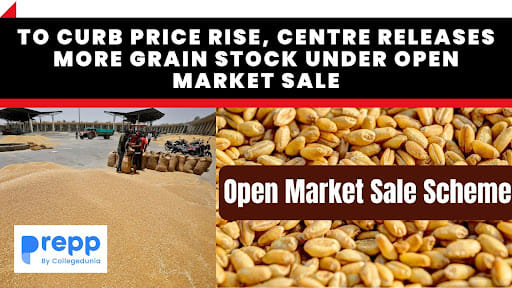
Recently, in response to escalating foodgrain costs and in order to ensure adequate domestic availability, the Centre decided to additionally sell 50 lakh metric tonnes (LMT) of wheat and 25 LMT of rice through the Open Market Sales Scheme (OMSS) from the Food Corporation of India .
Table of Contents
Reasons behind the rise in food grain prices
- Over the past year, the cost of wheat has risen by 6.77% in the retail market and 7.37% in the wholesale market, whereas, rice prices have increased by 10.63% in retail and 11.12% in wholesale markets
- Due to changing climate patterns,
- Collapse of Black Sea Grain Initiative,
- Rise in Oil Prices,
- Rise in input cost there has been increase in food grain prices.
What is an Open Market Sale Scheme?
- Open Market Sale Scheme refers to the government's/ government agencies' occasional sale of foodgrains on the open market at set prices to improve supply, notably during the lean season, and to reduce overall open market prices, particularly in deficit regions.
- FCI employs the OMSS to sell surplus central pool food grains, mainly wheat and rice, to various entities like traders, bulk consumers, and retail chains.
- E-auctions are used, allowing open market bidders to purchase specified quantities at predetermined prices set at the beginning of a cycle and adjusted regularly.
- States can also procure food grains through OMSS without participating in auctions, supplementing their supplies beyond central pool distributions for National Food Security Act (NFSA) beneficiaries.
Purpose
- OMSS activation focuses on the lean season between harvests.
- The aim is to enhance and regulate the domestic availability of wheat and rice, reducing prices in the open market.
- The major objective is to curb food grain inflation through strategic supply management.
What is the role of the Food Corporation of India(FCI) in ensuring food security?
- The Food Corporation of India (FCI) is a Public Sector Undertaking that reports to the Ministry of Consumer Affairs, Food and Public Distribution.
- Its primary responsibility is to buy, store, move/transport, distribute, and sell food grains and other foodstuffs.
- Procurement: FCI buys food grains such as rice and wheat directly from farmers at Minimum Support Prices (MSPs) declared by the government. This ensures that farmers receive a fair price for their produce and are incentivized to continue agricultural production.
- Storage: FCI operates a network of storage facilities across the country where it stores procured food grains. This prevents spoilage and wastage of agricultural produce and helps maintain a buffer stock for times of shortage.
- Distribution: FCI is involved in the distribution of food grains through the Public Distribution System (PDS) and other welfare schemes. It supplies grains to various state governments, which in turn distribute them to eligible beneficiaries at subsidized prices.
- Buffer Stock Management: FCI maintains a buffer stock of food grains to be used in case of emergencies such as droughts, floods, or poor harvests. This stock can be released to the market to stabilize food prices and ensure availability during times of scarcity.
- Price Stabilization: By regulating the supply of food grains in the market, FCI helps stabilize prices and prevents extreme fluctuations. This is important to ensure affordability for consumers and protect the interests of both farmers and consumers.
- Food Security: FCI's activities contribute to national food security by ensuring a steady supply of essential food items to the population, particularly vulnerable sections of society. It helps mitigate the impact of food shortages and price spikes.
- Support to Farmers: FCI's procurement at MSPs provides a safety net for farmers, guaranteeing them a minimum price for their crops and reducing their risk of price volatility in the open market.
What is the Public Distribution System (PDS)?
- The Public Distribution System (PDS) is an Indian food security system that evolved as a system for distributing food grains at affordable prices and managing emergency situations.
- It provides subsidized food and non-food items to India's poor.
- PDS has become an important part of the Government's policy for managing the country's food economy over the years.
- PDS is operated under the joint responsibility of the Central and the State/UT Governments.
- The Central Government, through the Food Corporation of India (FCI), has assumed the responsibility for the procurement, storage, transportation and bulk allocation of food grains to the State Governments.
- Under the PDS, presently the commodities namely wheat, rice, sugar and kerosene are being allocated to the States/UTs for distribution.
- Some States/UTs also distribute additional items of mass consumption through the PDS outlets such as pulses, edible oils, iodized salt, spices, etc
(*Click this link to read prelims specific weekly current affairs articles)
FAQs
Question: What is the Price Stabilisation Fund (PSF)?
Answer:
PSF is a fund that was established in 2014-15 to withstand excessive volatility in chosen commodity prices.S uch commodities will be purchased at the farm gate/mandi directly from farmers or farmers' organisations, and made available to consumers at a lower cost. Losses incurred by the Centre and the states, if any, must be shared in the operations. The money in the fund is typically used for activities targeted at lowering/raising high/low prices, such as the purchasing of particular items and their distribution as and when needed to keep costs
within a certain range.Question: What is Public Distribution System (PDS)?
Answer:
The Public Distribution System (PDS) is an Indian food security system that evolved as a system for distributing food
grains at affordable prices and managing emergency situations.Question: What is Pradhan Mantri Garib Kalyan Anna Yojana (PMGKAY)?
Answer:
The Centre has named its new free foodgrain scheme under the National Food Security Act, 2013, as ‘Pradhan Mantri Garib Kalyan Anna Yojana (PMGKAY)’. The integrated scheme will strengthen the provisions of the NFSA, 2013 in
terms of accessibility, affordability and availability of foodgrains for the poorUPSC Mains Practice Question:
|
MCQ
Question: The economic cost of food grains to the Food Corporation of India is Minimum Support Price and bonus (if any) paid to the farmers plus: (UPSC 2019)
(a) Transportation cost only
(b) Interest cost only
(c) Procurement incidentals and distribution costs
(d) Procurement incidentals and charges for godowns
Answer: (c) See the Explanation
- The Food Corporation of India's (FCI) economic cost of the food grains it purchases is the total of the Minimum Support Price, any bonuses given to farmers, incidentals associated with the procurement process, and distribution expenses.
- Three main elements make up the economic cost of FCI: distribution costs, procurement costs, and procurement prices.
- The first expenses paid when buying food grains are known as procurement incidentals.
- Freight, handling, storage, transit losses, and startup charges are all included in the cost of distribution.
Therefore, option (c) is the correct answer.
Download the PREPP App and attempt FREE IAS Exam Mock Tests and get complete study material!

Full Test - 04: UPSC CSE Prelims CSAT (Paper-II)
Full Test - 03: UPSC CSE Prelims CSAT (Paper-II)
UPSC CSE Prelims 2026 GS Paper 1 Question Paper (24-May-2026)
UPSC CSE Prelims 2026 CSAT Paper 2 Question Paper (24-May-2026)

17 February 2025 | The Hindu Must Read Articles | Current Affairs

16 February 2026 | The Hindu Must Read Articles | Current Affairs

13 February 2026 | The Hindu Must Read Articles | Current Affairs









Comments