China’s Deflation A Sign Of Economic Slowdown?
Relevance: GS3 - Indian Economy, Effects of liberalization on the economy
(Source: The Hindu, 08/11/2023)
Click here for Daily Current Affairs
Why in the news?
- This article discusses the deflation in China and why it is a concern for the country as the rest of the world faces the problem of inflation.
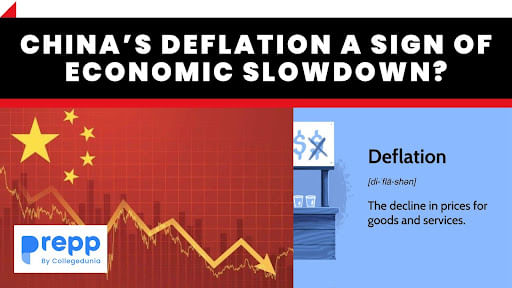
- Deflation refers to the situation where the overall price level in the economy falls for a period of time
Table of Contents
What is deflation?
- Deflation is a term in economics that refers to the general fall in prices of goods and services within an economy.
- Earlier, deflation was used to describe the fall in money supply, which would lead to lower prices.
- Similarly, inflation indicated a rise in money supply which would lead to higher prices.
- Deflation is associated with a rise in the value of money.
- It is also usually accompanied by economic slowdowns, decreased productivity, and loss of employment.
Causes of Deflation
- Competition: Increased competition can lead to a fall in prices as businesses aim to attract customers and gain market share.
- Increased savings: People save more in the hope of spending later when prices may fall. This causes prices to fall even more due to low demand.
- Technology: Technology advancements make the production process easier and simpler.
- As a result, prices fall as the production becomes cheaper.
- Less Money: Goods become cheaper and demand falls when there is less money in circulation.
Effects of Deflation
- Impaired Growth: Deflation leads to limited work and reduced production which adversely impacts the economy.
- Losses: Deflation causes businesses to drop their prices.
- As a result, the earnings from businesses drop significantly.
- The value of debt also increases in deflation.
- Employment: Businesses usually reduce jobs and remuneration during a deflation, which means people have less money in hand to spend.
- This means fewer products are sold, further affecting businesses and the cycle repeats.
Why is it a worry?
Demand, Losses, and Debt
- Demand: Deflation is considered an indicator of falling demand for goods and services.
- Demand for goods and services is the fundamental driver of economic growth.
- Therefore, a drop in prices could result in consumers postponing their purchases in the hope of getting better prices in the future, leading to a fall in demand.
- Losses: Deflation can cause losses for businesses and lower growth.
- Resource use and debt: Deflation can adversely impact borrowers as they will have to pay back lenders more in real terms.
- Deflation does not allow for the full utilization of the resources in an economy
Deflation as a Growth Indicator
- In the past, the U.S.A. and China have experienced deflation during periods of rapid economic growth.
- Japan also witnessed a rise in per capita real income levels during the era of deflation.
- In such cases, the supply of goods and services increases beyond the rate of money supply growth, leading to deflation.
- Countries that experience high price inflation have been observed to suffer from low or negative economic growth.
Deflation during economic turmoil
- Deflation can also be an indicator of economic turmoil.
- Deflation in the official price indicators can be a sign of an underlying process of resource reallocation.
- This means that consumers might temporarily change their spending patterns during economic crises.
- Spending on goods whose prices are captured by official indicators will fall while those on other goods could rise.
Consumer Behavior and Price Impact
- Some economists believe that deflation does not necessarily cause consumers to postpone purchases.
- Essentially, consumer demand is not determined by the price of goods and services rather consumer demand determines prices.
Businesses' Resilience to Deflation
Some economists claim that deflation does not necessarily cause sustained losses for businesses since they can adjust their payments for their inputs based on what their customers are willing to pay.
Case Study: Deflation in China
- In July, the consumer price index in China declined by 0.3% and producer prices dropped for the tenth consecutive month to 4.4%.
- This is the first time in over two years that consumer prices are declining in China.
Underlying Causes of Chinese Deflation
- The likely reason for the Chinese deflation could be something more fundamental than just the lack of liquidity.
- However, a proper study of the Chinese money supply and monetary transmission is necessary to identify the causes of deflation.
- The Chinese economy has been in turmoil even before the pandemic, especially in the property sector which contributes a significant share of the Chinese GDP.
People's Bank of China's Policy Response
- The People’s Bank of China has continued to keep interest rates low to boost demand.
- In contrast, other central banks have been maintaining high-interest rates to counter inflation.
- Chinese policymakers have been trying to achieve a soft landing of their economy as credit booms like the one in China can lead to a serious misallocation of resources in the economy while the subsequent bust can lead to a fall in broader prices.
What are some measures to control deflation?
- During a deflation, governments must adopt a Cheap or Dovish Monetary Policy as this will make loans cheaper.
- Benefits such as tax deductions and subsidies should be provided to encourage enhanced purchases and expenditures by individuals in the economy.
- The expenditure on public infrastructure projects such as highways, dams, etc should be increased to boost demand in the steel and cement industry.
- This will also lead to employment generation which in turn will improve their purchasing power and demand in the economy.
Conclusion
Deflation has numerous implications for growth and consumer behavior. China's experience highlights the need for a better understanding of the potential causes and outcomes and the need for a balanced approach to ensure sustainable growth.
To know more about Deflation, click the link.
(*Click this link to read prelims specific weekly current affairs articles)
FAQs
Question: What is inflation?
Answer:
Inflation refers to the general rise in the prices of goods and services within a particular economy. It is associated with a decrease in the purchasing power of the customer. It involves a fall in the value of money.
Question: What is a consumer price index?
Answer:
The Consumer Price Index or CPI is an index that is used to calculate retail inflation in the country. It is a tool to evaluate inflation and deflation. It is a numerical estimation that uses the rates of a sample of representative objects which are collected periodically.
UPSC Mains Practice Question:
|
MCQs
Question: Economic growth is usually coupled with?
(a) Deflation
(b) Inflation
(c) Stagflation
(d) Hyperinflation
Answer: (b) See the Explanation
- Increased spending leads to increased demand for foods and services in the economy.
- This leads to inflation. Therefore, economic growth is associated with inflation.
Therefore, option (b) is the correct answer.
Question: Which of the following is an effect of deflation on consumer behavior?
(a) Consumers are more likely to make immediate purchases
(b) Consumers tend to postpone purchases expecting lower prices
(c) Consumers become more cautious in their spending
(d) Consumers switch to luxury goods during deflation
Answer: (b) See the Explanation
- In a deflationary situation, consumers tend to postpone purchases with the expectation that prices will lower in the future.
- This can affect economic growth as well.
Therefore, option (b) is the correct answer.
Question: Which of the following is a potential impact of deflation on credit contracts?
(a) Borrowers are required to pay back lenders less in real terms
(b) Borrowers are required to pay back lenders more in real terms
(c) Credit contracts become more flexible
(d) Credit contracts remain unaffected by deflation
Answer: (b) See the Explanation
- Deflation leads to a rise in the value of money.
- This means borrowers have to pay back more in real terms, which can disrupt credit contracts and impact financial arrangements.
Therefore, option (b) is the correct answer.
Download the PREPP App and attempt FREE IAS Exam Mock Tests and get complete study material!

Full Test - 04: UPSC CSE Prelims CSAT (Paper-II)
Full Test - 03: UPSC CSE Prelims CSAT (Paper-II)
UPSC CSE Prelims 2026 GS Paper 1 Question Paper (24-May-2026)
UPSC CSE Prelims 2026 CSAT Paper 2 Question Paper (24-May-2026)

17 February 2025 | The Hindu Must Read Articles | Current Affairs

16 February 2026 | The Hindu Must Read Articles | Current Affairs

13 February 2026 | The Hindu Must Read Articles | Current Affairs









Comments