Bill Moved To Remove CJI From Panel To Select Election Commissioners
Relevance: GS2 - Appointment to various Constitutional posts, powers, functions and responsibilities of various Constitutional Bodies Structure, organization and functioning of the Executive and the Judiciary;
(Source: The Hindu, 08/11/2023)
Click here for Daily Current Affairs
Why in the news?
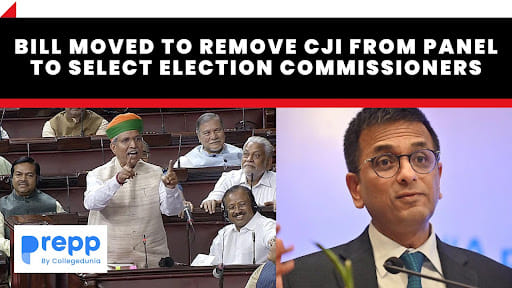
Recently, the Union Government moved a bill in the Rajya Sabha to remove the Chief Justice of India from the panel that selects the Chief Election Commissioner and Election Commissioners.
Table of Contents
What does the Bill propose?
- The Chief Election Commissioner and other Election Commissioners (Appointment, Conditions of Service and Term of Office) Bill, 2023 aims to create a structured legislative process for the appointment of members to the Election Commission of India (ECI).
- Search Committee: A committee headed by the Cabinet Secretary and comprising two other governmental officials who are experienced in election affairs.
- The committee must create a list of five potential candidates for consideration by the Selection panel.
- Selection Panel: The panel will consist of the Prime Minister of India as chairperson, a Cabinet Minister, and the Leader of the Opposition in the Lok Sabha as members.
- The government replaced the Chief Justice of India in the panel.
- In case, there is no Leader of the Opposition in the Lower House, the Statement and Objectives of the Bill states that the leader of the single largest opposition party will be considered the LoP.
How were the members of the Election Commission selected earlier?
- The Constitution does not set out any specific legislative process for the appointment of the CEC and ECs.
- The President used to appoint the members of the Election Commission on the advice of the Union Council of Ministers headed by the Prime Minister.
- In March 2023, a Constitutional bench of the Supreme Court ruled that the members of the Election Commission were to be chosen by a three-member high power committee consisting of the Prime Minister as Chairperson, and the Leader of the Opposition in the Lok Sabha and the Chief Justice of India as members.
- The Court had stated that its order would stay valid until a law concerning the matter was enacted by Parliament.
What are the concerns raised about the bill?
- There are concerns that the inclusion of two members of the ruling party in the selection panel could compromise the neutrality and independence of the Election Commission.
- An independent and neutral appointment process for the members of the Election Commission is necessary to ensure the conduct of free and fair elections.
- This will also neutralize the opinion of the LoP as the majority of the panel are from the ruling party.
- The Bill goes against the spirit of the directions Supreme Court by replacing the Chief Justice of India on the selection panel
- The SC had stated that the Executive should not have a central role in the appointment of Election commissioners.
- The Constitution mandates that the Judiciary, EC, and investigative agencies be independent from the Executive.
Conclusion
- The government has proposed the legislation with the aim of streamlining the appointment of Election Commissioners which is part of the powers of Parliament.
- The Election Commission is one of the most important pillars of democracy in the country. Therefore, it is necessary to maintain the independence and integrity of the selection process so as to ensure free and fair elections in the country.
Election Commission of India
|
(*Click this link to read prelims specific weekly current affairs articles)
FAQs
Question: What is a constitutional bench?
Answer:
A constitutional bench is a bench of the Supreme Court having five or more judges on it which is set up to hear matters relating to the interpretation of the Constitution or substantial questions of law, as mentioned in Article 145(3). They are set up on an ad hoc basis depending on the requirements.
Question: Who are election commissioners?
Answer:
Election Commissioners are the members of the Election Commission. The EC consists of three members, of which the Chief Election Commissioner is the first among equals. They are responsible for the superintendence, direction and control of elections to both House of Parliament and the Legislatures of the states.
UPSC Mains Practice Question:
|
MCQs
Question: Consider the following statements.
- The Election Commission of India is a five-member body.
- Union Ministry of Home Affairs decides the election schedule for the conduct of both general elections and bye-elections.
- Election Commission resolves the disputes relating to splits/mergers of recognized political parties.
Which of the above statements is/are correct? (UPSC CSE 2017)
(a) 1 and 2 only
(b) 2 only
(c) 2 and 3 only
(d) 3 only
Answer: (d) See the Explanation
- The Election Commission is a three-member body consisting of the Chief Election Commissioner and two Election Commissioners. Hence, statement 1 is incorrect.
- The EC determines the schedules for the conduct of elections including general elections and bye-elections. Hence, statement 2 is incorrect.
- The EC is empowered with quasi-judicial powers to settle disputes relating to splits and mergers of recognized political parties. Hence, statement 3 is correct.
Therefore, option (d) is the correct answer.
Question: Consider the following statements.
- Union Territories are not represented in the Rajya Sabha.
- It is within the purview of the Chief Election Commissioner to adjudicate election disputes.
- According to the Constitution of India, the Parliament consists of the Lok Sabha and the Rajya Sabha only.
Which of the above statements is/are correct? (UPSC CSE 2012)
(a) 1 only
(b) 2 and 3 only
(c) 1 and 3 only
(d) None
Answer: (d) See the Explanation
- The Union Territories of Delhi and Puducherry are represented in the Rajya Sabha while the other UTs are not. Hence statement 1 is incorrect.
- The Chief Election Commissioner is not empowered to adjudicate election disputes in India. Election disputes are adjudicated by the respective High Courts and Supreme Court. Hence statement 2 is incorrect.
- According to the Constitution of India, the Parliament consists of the President, the Lok Sabha, and the Rajya Sabha. Hence statement 3 is incorrect.
Therefore, option (d) is the correct answer.
Download the PREPP App and attempt FREE IAS Exam Mock Tests and get complete study material!

Full Test - 04: UPSC CSE Prelims CSAT (Paper-II)
Full Test - 03: UPSC CSE Prelims CSAT (Paper-II)
UPSC CSE Prelims 2026 GS Paper 1 Question Paper (24-May-2026)
UPSC CSE Prelims 2026 CSAT Paper 2 Question Paper (24-May-2026)

17 February 2025 | The Hindu Must Read Articles | Current Affairs

16 February 2026 | The Hindu Must Read Articles | Current Affairs

13 February 2026 | The Hindu Must Read Articles | Current Affairs









Comments