Will The Federal Fund Hike Impact Developing Country Debt?
Relevance: GS 2- Effect of policies and politics of developed and developing countries on India’s interests, Indian diaspora. GS3 - Effects of liberalization on the economy
(Source: The Hindu, 08/11/23)
Click here for Daily Current Affairs
Why in the news?
- Recently, the Federal Open Market Committee meeting resulted in a 25 basis points increase in the targeted federal funds rate to 5.25-5.5%, reaching a 21-year high.
- The Fed Reserve President Jerome Powell explained that the decision was aimed at reducing inflation to 2%. Since March 2022, rates have risen consistently, culminating in the recent increase to 5.25-5.5% in July.
- This rapid hike of over 450 basis points within a year raises questions about the global economy's capacity to absorb such a sharp rise.
Table of Contents
What is the federal funds rate?
- The federal funds rate is the interest rate at which banks lend and borrow excess reserves overnight.
- This rate determines lending rates among banks and plays a significant role in stabilizing the financial system.
- The Federal Reserve intervenes in this market by buying or selling bonds to maintain the targeted rate range, which is now set between 5.25% and 5.5%.
- Federal Funds Rate since the financial crisis of 2008: After the global financial crisis in 2008, central banks expanded balance sheets, keeping federal funds rates near zero from 2008 to 2015.
- With the reversal of monetary policies by advanced countries, rates climbed to 2.41% by March 2019. The pandemic led to a drastic cut to 0.05% in March 2020.
What consequences would this have on the rest of the world?
- Emerging markets: Post the global crisis, advanced countries' central bank balance sheets grew, leading to historic low-interest rates. This contributed to double external debt in low/middle-income nations by 2016, exceeding 200% of GDP by 2020. This setup allowed a "carry trade," using dollar loans for investment in emerging markets due to higher rates.
- Corporates: Corporations in developing economies have accumulated around $5.14 trillion of the outstanding $13 trillion dollar debt held by non-financial corporations outside the U.S., leveraging low global rates.
- However, the shifting tide of capital flows driven by rising interest rates and currency devaluation poses a threat to these corporations with unhedged dollar debts.
- In the international economy, there has been a substantial increase in private non-guaranteed (PNG) debt taken by corporations, while governments continue to be important borrowers.
Will the rate hike mainly impact corporations, while governments remain unaffected?
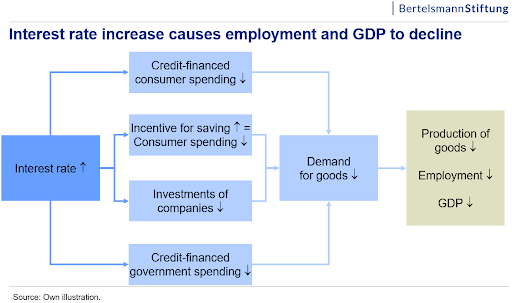
- Increased spending on Debt servicing: When these investors offload domestic securities, prices drop, interest rates rise, and currencies weaken vis-a-vis the dollar.
- World Bank's recent International Debt Report highlights poorest countries using at least 10% of export earnings for debt servicing.
- Risk of defaults:Governments facing challenges like climate shocks, commodity price declines, and low growth risk default. Vulture funds exploit defaults by buying bonds cheaply and suing for higher repayments, as seen in Zambia's case.
- Reduction in social expenditure: High debt service obligations force developing countries to reduce investments in health, education, and sustainable development, reversing social progress. UNCTAD reports 3.3 billion people live where interest payments surpass health and education spending.
- Recession: Rate hikes and a prolonged phase of elevated interest rates can hit the US economy significantly and may push it into a recession. An economic slowdown in the US will negatively impact Indian IT firms.
- Impact climate goals: Climate goals and emissions reduction efforts are compromised due to financial constraints.
What could be done?
- Collective efforts are vital to reform the international financial system, addressing disparities.
- Massive scaling up of contingency financing for needy countries
- Expansion of affordable long term financing for development is required to address the growing concerns of developing country debt.
(*Click this link to read prelims specific weekly current affairs articles)
FAQs
Question: What is the Federal Funds rate?
Answer:
The federal funds rate is the interest rate at which banks lend and borrow excess reserves overnight.
- This rate determines lending rates among banks and plays a significant role in stabilizing the financial system.
Question: What is Monetary Policy?
Answer:
Monetary policy means the set of measures taken to control a nation’s entire money supply. Monetary policy seeks to promote economic growth, limit inflation, create job opportunities, and maintain an appropriate exchange rate. Interest rate changes and adjustments to bank reserve requirements are examples of monetary policy strategies. “
Question: What is Private nonguaranteed debt?
Answer: Private nonguaranteed external debt comprises long-term external obligations of private debtors that are not guaranteed for repayment by a public entity.
MCQ
Question: Consider the following statements: (UPSC-2022)
- Tight monetary policy of the US Federal Reserve could lead to capital flight.
- Capital flight may increase the interest cost of firms with existing External Commercial Borrowings (ECBs).
- Devaluation of domestic currency decreases the currency risk associated with ECBS.
Which of the statements given above are correct?
(a) 1 and 2 only
(b) 2 and 3 only
(c) 1 and 3 only
(d) 1, 2 and 3
Answer: (b) See the Explanation
- Higher US federal funds rates due to tight monetary policy affect global borrowing rates, financial markets, and emerging economies like India. It triggers capital flight, distress sales, and raises debt servicing costs, impacting firms and economies reliant on foreign investments and loans. Hence statement 1 is correct.
- Reversing capital flows in emerging markets like India can lead to currency depreciation, impacting investments denominated in foreign currencies. A weaker local currency decreases investment value in dollar terms, prompting distress sales by foreign investors. This capital flight may raise interest costs for firms with foreign currency debt due to increased debt-servicing expenses in local currency terms. Hence statement 2 is correct.
- Devaluing the domestic currency amplifies currency risk linked to External Commercial Borrowings (ECBs), often in foreign denominations. For instance, if 1 dollar was Rs 75 during ECB raising and later depreciates to Rs 80, repayment converts to more rupees, raising payment burden for firms. This escalation increases their exposure to currency risk.Hence statement 3 is not correct.
- Therefore, option (b) is the correct answer.
Download the PREPP App and attempt FREE IAS Exam Mock Tests and get complete study material!

Full Test - 04: UPSC CSE Prelims CSAT (Paper-II)
Full Test - 03: UPSC CSE Prelims CSAT (Paper-II)
UPSC CSE Prelims 2026 GS Paper 1 Question Paper (24-May-2026)
UPSC CSE Prelims 2026 CSAT Paper 2 Question Paper (24-May-2026)

17 February 2025 | The Hindu Must Read Articles | Current Affairs

16 February 2026 | The Hindu Must Read Articles | Current Affairs

13 February 2026 | The Hindu Must Read Articles | Current Affairs









Comments