MPC Holds Rates, Raises FY24 Inflation Forecast To 5.4%; Retains GDP Growth Projection At 6.5%
Relevance: GS3 - Indian Economy and issues relating to planning, mobilization, of resources, growth, development and employment, Government Budgeting
(Source: The Hindu, 08/11/2023)
Click here for Daily Current Affairs
Why in the news?
- Recently, the Monetary Policy Committee (MPC) of the Reserve Bank of India (RBI) decided to keep the repo rate unchanged at 6.5% in its second bi-monthly monetary policy meeting of the fiscal year FY23–24.
Table of Contents
Highlights of the Recent Monetary Policy of RBI
- Interest Rates:
- Repo rate unchanged at 6.5%
- Standing deposit facility (SDF) rate remains at 6.25%
- Marginal standing facility (MSF) rate and Bank Rate maintained at 6.75%
- Cash Reserve Ratio (CRR) remains unchanged at 4.5%.
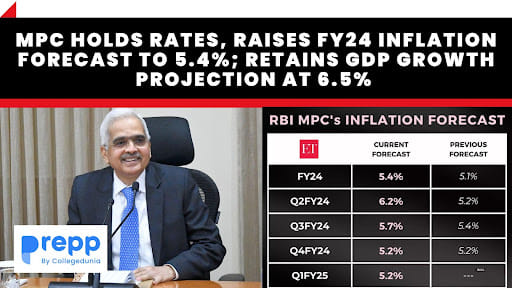
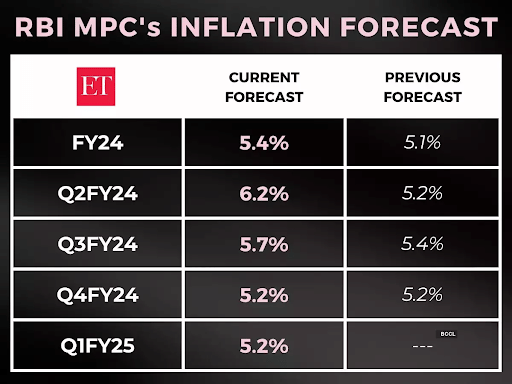
- Inflation Forecast: RBI changed the inflation forecast to 5.4% which was revised from the 5.1% forecast in June. It was stated that a rise in vegetable prices, especially tomatoes, could significantly push up inflation in the near future.
- The headline inflation after reaching a low of 4.3% in May 2023, rose in June and is expected to surge during July and August, led by vegetable prices.
- Liquidity Management: To address excess liquidity with banks due to various factors, the RBI introduced an incremental cash reserve ratio (I-CRR) of 10% on the increase in net demand and time liabilities (NDTL) from May 19, 2023, to July 28, 2023. This measure was temporary and intended to manage liquidity overhang.
- UPI:
- To launch Conversational Payments on UPI
- Transaction limit of UPI Lite raised to ₹500 from ₹200
- To introduce offline payments using Near Field Communication (NFC) technology
What is Monetary Policy?
- Monetary policy means the set of measures taken to control a nation’s entire money supply.
- It seeks to promote economic growth, limit inflation, create job opportunities, and maintain an appropriate exchange rate.
- Interest rate changes and adjustments to bank reserve requirements are examples of monetary policy strategies.
- There are two primary categories of monetary policy:
- Expansionary policy: This approach is employed to stimulate economic activity during periods of slowdown or recession. It involves increasing the overall money supply within the economy. Accomplished by reducing general interest rates on loans and debt instruments, lower interest rates encourage higher consumer spending and borrowing. This, in turn, promotes economic growth and recovery.
- Contractionary policy: Implemented through an increase in interest rates, the contractionary policy aims to decrease the total money supply in the economy. By raising interest rates, this policy seeks to counteract inflationary pressures caused by an excessive money supply, thereby stabilizing prices.
About Monetary Policy Committee (MPC)
- The Monetary Policy Committee (MPC) is the committee set up by the Union government to set the policy interest rates as a part of its monetary policy.
- Chairman: It is headed by the Governor of the Reserve Bank of India (RBI).
- The Monetary Policy Committee decisions will impact the money supply and liquidity in the economy.
- The MPC is a six-person committee appointed by the Central Government (Section 45ZB of the amended RBI Act, 1934).
- The MPC must meet at least four times per year. The MPC meeting requires a quorum of four members.
- Each MPC member has one vote, and in the event of a tie, the Governor has a second or casting vote.
Important Keyword for Prelims
|
(*Click this link to read prelims specific weekly current affairs articles)
FAQs
Question: What is Monetary Policy?
Answer:
Monetary policy means the set of measures taken to control a nation’s entire money supply. It seeks to promote economic growth, limit inflation, create job opportunities, and maintain an appropriate exchange rate.
Question: What is the Monetary Policy Committee (MPC)?
Answer: The Monetary Policy Committee (MPC) is the committee set up by the Union government to set the policy interest rates as a part of its monetary policy. It is headed by the Governor of the Reserve Bank of India (RBI).
Question: What is Inflation?
Answer: It is the general rise in the price level of goods and services over a period of time within a particular economy where the purchasing power of the customer decreases.
MCQs
Question: If the RBI decides to adopt an expansionist monetary policy, which of the following would it not do? (UPSC 2020)
- Cut and optimize the Statutory Liquidity Ratio
- Increase the Marginal Standing Facility Rate
- Cut the Bank Rate and Repo Rate
Select the correct answer using the code given below:
(a) 1 and 2 only
(b) 2 only
(c) 1 and 3 only
(d) 1, 2 and 3
Answer: (b) See the Explanation
- Expansionary monetary policy involves a central bank using tools to boost the economy by increasing the money supply, lowering interest rates, and raising demand, promoting economic growth.
- Increasing the SLR prompts banks to invest more in government securities, reducing available cash in the economy. The opposite maintains cash flow. Hence, statement 1 is incorrect.
- Raising the MSF Rate raises borrowing costs for banks, limiting available lending resources. So, statement 2 is correct.
- In expansionary policy, the RBI cuts repo and bank rates to enhance banking sector liquidity. Hence, statement 3 is incorrect.
Therefore, option (b) is the correct answer.
Question: Which of the following statements is/are correct regarding the Monetary Policy Committee (MPC)? (UPSC 2017)
- It decides the RBI’s benchmark interest rates.
- It is a 12-member body including the Governor of RBI and is reconstituted every year.
- It functions under the chairmanship of the Union Finance Minister.
Select the correct answer using the code given below:
(a) 1 only
(b) 1 and 2 only
(c) 3 only
(d) 2 and 3 only
Answer: (a) See the Explanation
MPC has 6 members, not 12; and it's headed by the RBI governor and not the Finance Minister.
Therefore, option (a) is the correct answer.
Download the PREPP App and attempt FREE IAS Exam Mock Tests and get complete study material!

Full Test - 04: UPSC CSE Prelims CSAT (Paper-II)
Full Test - 03: UPSC CSE Prelims CSAT (Paper-II)
UPSC CSE Prelims 2026 GS Paper 1 Question Paper (24-May-2026)
UPSC CSE Prelims 2026 CSAT Paper 2 Question Paper (24-May-2026)

17 February 2025 | The Hindu Must Read Articles | Current Affairs

16 February 2026 | The Hindu Must Read Articles | Current Affairs

13 February 2026 | The Hindu Must Read Articles | Current Affairs









Comments