Types of Earthquakes - Geography Notes
Earthquakes can be categorized based on their origin and the geological activity that causes them. Mainly there are four types of earthquakes Tectonic Earthquakes, Volcanic Earthquakes, Collapse Earthquakes, Explosion Earthquakes, etc. The topic “Types of Earthquakes” is an important part of the UPSC/IAS Exam Geography syllabus which is discussed in this article in detail.
|
Table of Contents |
What is an Earthquake?
- An earthquake is the shaking of the surface of the Earth resulting from a sudden release of energy in the Earth's lithosphere that creates seismic waves.
- Earthquakes can range in size from those that are so weak that they cannot be felt to those violent enough to toss people around and destroy whole cities.
- Seismicity, or seismic activity, of an area, refers to the frequency, type, and size of earthquakes experienced over a period of time. The word tremor is also used for non-earthquake seismic rumbling.
- Cause of earthquakes is often due to the movement of tectonic plates beneath the Earth's surface.
- When these plates move past each other, they sometimes get stuck at their edges due to friction.
- When the stress on the edge overcomes the friction, there is an earthquake that releases energy in the form of seismic waves, which causes the ground to shake.
- The location below the Earth's surface where the earthquake starts, is called the hypocenter, and the location directly above it on the surface is called the epicenter.
- Earthquakes can occur anywhere, but their most common sites are along tectonic plate boundaries.
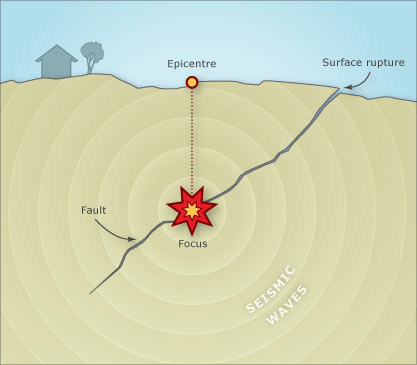
Types of Earthquakes
On the Basis of Causative Factors
Natural earthquakes are those which are caused by natural processes i.e., due to endogenic processes. These are further subdivided into the following sub-categories:
1) Tectonic Earthquakes
- They are caused by to dislocation of rock blocks during faulting activities.
- A tectonic earthquake occurs when two tectonic plates collide at a point called the boundary.
- A convergent plate boundary is formed when two plates push into each other.
- The oceanic Nazca Plate, for example, pushes into and is subducted into the South American Plate off the coast of South America along the Peru-Chile trench.
- The Andes mountains are formed as a result of this action, which rises the South American Plate.
- The Nazca Plate is broken into smaller pieces that are stuck in place for lengthy periods of time before shifting suddenly and causing earthquakes.
- The Mid-Atlantic Ridge, which stretches from the Arctic Ocean to beyond the southern tip of Africa, is an example of a divergent boundary, which happens when two plates shift away from each other, forming a new crust.
- It has produced thousands of kilometers of plate movement over millions of years.
- When plates slide horizontally past one another, they generate a transform boundary that neither destroys nor produces crust.
- Plate movement results in zigzagging plate edges and shallow earthquakes.
- These are also generated due to the sliding of rocks along a fault plane. Example: 2001 earthquake of Gujarat.
Types of Plate Boundaries
|
2) Volcanic Earthquakes
- Volcano earthquakes are caused by stress changes in the solid rock caused by the injection or withdrawal of magma (molten rock).
- They are caused due to volcanic eruptions of explosive and fissure types.
- The intensity and magnitude of the earthquake depend on the intensity and magnitude of volcanic eruptions.
- We can't predict when the volcano will erupt, but it might happen at any time. Example: severe earthquakes caused by Karakatao volcano 1883.
3) Isostatic Earthquakes
- Isostatic or isostasy-related earthquakes are those associated with the buoyant behavior of the Earth's crust as it undergoes vertical movements due to changes in surface loads.
- Isostasy refers to the equilibrium that exists between the Earth's lithosphere (the crust and uppermost mantle) and the more fluid asthenosphere beneath it.
- The lithosphere essentially "floats" on the asthenosphere in a manner similar to how an iceberg floats on water.
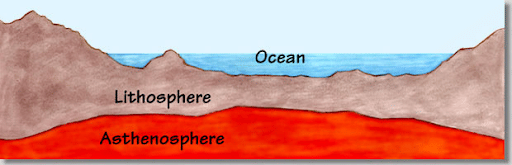
Floating Lithosphere
- They are triggered due to sudden disturbances in isostatic balance at a regional scale.
- If a significant weight, such as a massive ice sheet, is added to or removed from the crust, the crust will respond by sinking or rebounding, respectively.
- A classic example of isostatic adjustment is seen in areas that were once covered by large ice sheets during the last Ice Age.
- As these ice sheets melted, the previously compressed crust began to rise or "rebound" back to its original position.
- This process, which can take thousands of years, can cause earthquakes, although they are typically of lower magnitude.
- This rebound is often referred to as post-glacial or glacio-isostatic rebound.
- Mountains, after being built up due to tectonic forces, can undergo erosion over millions of years. As they erode, the crust can adjust isostatically, leading to earthquakes.
4) Plutonic Earthquakes
- They are deep-focus earthquakes whose centers lie at depths from 240 km to 600 km.
- They occur almost exclusively at convergent boundaries in association with subducted oceanic lithosphere.
- Herbert Hall Turner initially brought preliminary evidence for the presence of deep-focus earthquakes to the attention of the scientific community in 1922.
- Kiyoo Wadati demonstrated the existence of earthquakes deep into the lithosphere in 1928, debunking the myth that earthquakes only occur at shallow focal depths.
- Deep-focus earthquakes produce very few surface waves. Because of their focal depth, earthquakes are less likely to create a seismic wave motion with concentrated energy at the surface.
- Deep-focus earthquake seismic waves only pass through the heterogeneous upper mantle and highly changeable crust once on their way from the focus to the recording station.
- As a result, compared to seismic waves from shallow earthquakes, body waves experience less attenuation and reverberation, resulting in strong body wave peaks.
5) Artificial or Man Induced Earthquakes
- They are caused by anthropogenic activities such as underground explosions, mining, large reservoir-induced pressure, etc.
- Example: The enormous load exerted by dam reservoirs resulted in the strongest ever induced earthquake.
- The most notable fluid-induced earthquake in India happened in 1967 near Koyna, Maharashtra, and was ascribed to seismic activity caused by the Koyna dam's impoundment.
- Earthquakes in Oklahoma's tectonically quiet region have also been connected to oil and gas drilling activity.
- Such areas of man-made earthquake activity are thought to exceed the degree of seismic activity in hotspots like southern California.
On the Basis of the Focus of an Earthquake
1) Shallow Focus Earthquake
- It has its seismic foci located at depths from the ground surface to 70 km.
- The majority of earthquakes have a shallow focal point. As a result, they're also known as 'crustal earthquakes.'
- Smaller earthquakes make up the majority of shallow-focus earthquakes (usual range of 1 to 5). However, a few are of greater magnitude and can create widespread devastation.
- They happen frequently and seemingly at random. However, because the majority of them are of minor magnitude or occur along submarine ridges, they are rarely felt.
- Shallow focus earthquakes are particularly common at divergent boundaries, such as mid-ocean ridges, and transform boundaries, like the San Andreas Fault in California.
2) Intermediate Focus Earthquake
- Intermediate focus earthquakes are seismic events that originate at depths ranging from 70 km to 300 km below the Earth's surface.
- These earthquakes predominantly occur in subduction zones where one tectonic plate is being forced under another. As the subducting plate descends into the mantle, it can cause earthquakes at varying depths, including the intermediate range.
- While shallow focus earthquakes are the most common, intermediate focus events also occur frequently, especially in regions with active subduction zones.
- Examples include the Pacific "Ring of Fire", which encircles the Pacific Ocean and features many subduction zones.
- The intensity of shaking at the Earth's surface from an intermediate focus earthquake can be less than that of a similarly sized shallow focus earthquake.
- This is because the seismic waves have a longer distance to travel before reaching the surface, which can cause them to dissipate some of their energy.
- Examples: The 2011 earthquake off the Pacific coast of Tōhoku, Japan, which led to the devastating tsunami and Fukushima Daiichi nuclear disaster, was an intermediate focus earthquake. Another example is the 1976 Tangshan earthquake in China.
3) Deep Focus Earthquakes
- Deep focus earthquakes are seismic events that originate at depths ranging from 300 km to about 700 km beneath the Earth's surface. It is also known as Wadati–Benioff Zone.
- They stand out because, at such profound depths, the Earth's materials are expected to deform ductilely rather than fracture and slip, which is how earthquakes typically occur.
- Like intermediate focus earthquakes, deep focus earthquakes predominantly occur in subduction zones, where one tectonic plate is diving beneath another into the mantle.
- The occurrence of earthquakes at these depths is somewhat enigmatic because temperatures and pressures are so high that rocks are expected to deform plastically rather than breaking in a brittle fashion.
- Several mechanisms, such as phase transitions (changes in the crystal structure of minerals), have been proposed to explain these events.
- Deep focus earthquakes are particularly common in a few subduction zones around the Pacific "Ring of Fire."
- Regions such as beneath the Fiji-Tonga area in the South Pacific and beneath the Sea of Okhotsk off the Russian Far East are known for these types of earthquakes.
- Like intermediate focus earthquakes, the intensity of shaking from a deep focus earthquake at the Earth's surface can be less than that of a similarly sized shallow focus earthquake. They can, however, still be of high magnitude and potentially damaging.
- Examples: One of the most significant deep focus earthquakes in recorded history was the 2013 Sea of Okhotsk earthquake, with a depth of approximately 609 km and a magnitude of 8.3.
- Because deep focus earthquakes occur at depths inaccessible for direct study, their investigation offers valuable insights into the Earth's deep interior, the properties of materials under extreme conditions, and the complex interactions in subduction zones.
| Other Relevant Links | |
|---|---|
| P Waves | S Waves |
| surface waves | Emergence of Shadow Zone |
| Effects of Earthquake | Seismic Activity |
| Gravitational Force | Magnetic Field |
Measurement of Earthquakes
- The magnitude and severity of the shock are used to scale earthquake events.
- The Richter scale is the magnitude scale.
- The magnitude is related to the amount of energy released during the earthquake.
- The magnitude is given in absolute values ranging from 0 to 10.
- Mercalli, an Italian seismologist, inspired the intensity scale.
- The intensity scale considers the visible damage caused by the incident.
- The intensity scale ranges from 1 to 12.
|
Measurement
Richter Scale
Mercalli Scale
|
Causes of Earthquakes
Tectonic Movements
- Convergent Boundaries: At these boundaries, two tectonic plates move towards each other. If oceanic crust is involved, it can be forced (or subducted) under another plate, forming a subduction zone. The intense pressure and friction at these boundaries can lead to powerful earthquakes.
- Divergent Boundaries: Here, two tectonic plates move away from each other. As magma rises to fill the gap, it can cause the lithosphere to rupture, leading to earthquakes. An example is the Mid-Atlantic Ridge.
- Transform Boundaries: At these boundaries, two plates slide horizontally past each other. This is seen at the San Andreas Fault in California, where the Pacific Plate is moving northward relative to the North American Plate.
Volcanic Activity
- Earthquakes can result from the movement of magma within a volcano.
- As magma rises and moves, it can cause the surrounding rocks to crack, producing volcanic or volcanic-tectonic earthquakes.
Human Activities
- Reservoir-Induced Seismicity: Large reservoirs behind dams can induce seismic activity by increasing the pressure in the Earth's crust below the reservoir. This phenomenon is called reservoir-induced seismicity.
- Mining: Large-scale mining operations, where vast amounts of rock are removed, can induce earthquakes.
- Geothermal Energy Production: Extracting geothermal fluids can change the pressure within the Earth, potentially inducing earthquakes.
- Hydraulic Fracturing: Popularly known as "fracking," this involves injecting liquid at high pressures to fracture rocks and extract natural gas or oil. This can induce small-scale seismic activity.
Collapse Earthquakes
- These are small earthquakes in underground caverns and mines that are caused by seismic waves generated by the collapse of these structures.
Isostatic Rebound
- After being compressed by heavy ice sheets during an ice age, the Earth's crust can "rebound" or rise back to its original position. This can cause earthquakes, though they're typically of lower magnitude.
Stress Accumulation and Release
- Over long periods, stress can accumulate in the Earth's crust due to tectonic forces. When the stress exceeds the friction holding the rocks together, it is released in the form of an earthquake.
- This is often referred to as the elastic-rebound theory.
Effects of Earthquakes
- Ground Shaking: This can lead to the collapse of buildings, bridges, roads, and other infrastructure. The intensity of shaking generally decreases with distance from the earthquake's epicenter.
- Surface Rupture: Occurs when the earthquake movement along a fault actually breaks the Earth's surface. Results in visible displacements and deformations of the land.
- Tsunamis: Generated by undersea earthquakes, especially in subduction zones. Huge waves can inundate coastal areas, causing loss of life and massive property damage.
- Landslides: Earthquakes can trigger landslides in hilly or mountainous areas, leading to further destruction and casualties.
- Liquefaction: Occurs when saturated loose soil or sand is shaken and loses its strength, behaving like a liquid.
- Fires: Result from broken gas lines and electrical shorts. Can cause additional destruction following the initial earthquake.
- Infrastructure Damage: Roads, bridges, airports, harbors, rail lines, utilities, and other critical infrastructure can be damaged or destroyed.
- Aftershocks: Smaller tremors that follow the main earthquake event. Can further damage already weakened structures.
- Economic Impact: Business operations can be disrupted, leading to economic losses. Costs of repair and reconstruction can strain local and national budgets.
- Social and Psychological Effects: Loss of life and injuries can have long-term effects on families and communities. Displacement of populations if homes are destroyed.
- Environmental Impact: Displacement of land can affect rivers and local ecosystems. Landslides can change landscape and alter drainage patterns.
- Cultural Impact: Historical buildings, monuments, and cultural heritage sites can be damaged or destroyed.
- Disease and Epidemics: Displacement of people can lead to overcrowded conditions with inadequate sanitation, potentially leading to the spread of diseases.
*For detailed notes on this topic, check this link Effects of Earthquakes
Conclusion
Different types of earthquakes dictate different levels of danger, preparedness measures, and mitigation strategies. Yet, understanding these events and proactive initiatives have gone a long way in safeguarding its citizens. Furthermore, because of increased population and construction, an earthquake with a force comparable to historical earthquakes would pose a considerably larger risk to human life and property today.
FAQs
Question: What are the main types of earthquakes?
Answer: The main types of earthquakes are tectonic, volcanic, collapse, and explosion earthquakes. Tectonic earthquakes occur due to the movement of tectonic plates, volcanic earthquakes are associated with volcanic activity, collapse earthquakes result from the collapse of underground caves, and explosion earthquakes are caused by nuclear or chemical explosions.
Question: What causes tectonic earthquakes?
Answer: Tectonic earthquakes are caused by the sudden release of energy due to the movement of Earth's tectonic plates along faults. This movement generates seismic waves that cause the ground to shake. They are the most common and powerful type of earthquake.
Question: How are volcanic earthquakes different from tectonic earthquakes?
Answer: Volcanic earthquakes are triggered by volcanic activity, such as the movement of magma beneath the Earth's surface. In contrast, tectonic earthquakes result from the movement of tectonic plates. Volcanic earthquakes are usually localized around volcanoes and can precede eruptions.
Question: What is an induced earthquake?
Answer: Induced earthquakes, also known as human-induced or anthropogenic earthquakes, are caused by human activities such as mining, reservoir-induced seismicity from large dams, and hydraulic fracturing (fracking). These activities can alter stress levels in the Earth's crust, leading to seismic events.
Question: What are aftershocks?
Answer: Aftershocks are smaller earthquakes that occur after the main shock of a larger earthquake. They result from the Earth's crust adjusting to the new position of the fault. Aftershocks can continue for days, weeks, or even months, depending on the magnitude of the main earthquake.
MCQs
1. Which type of earthquake is caused by the movement of tectonic plates?
A) Volcanic earthquake
B) Collapse earthquake
C) Tectonic earthquake
D) Explosion earthquake
Answer: (C) See the Explanation
Explanation: Tectonic earthquakes are caused by the movement of the Earth's tectonic plates along faults. This type of earthquake is the most common and can release significant energy.
2. What type of earthquake is associated with volcanic activity?
A) Tectonic earthquake
B) Volcanic earthquake
C) Collapse earthquake
D) Induced earthquake
Answer: (B) See the Explanation
Explanation: Volcanic earthquakes are associated with volcanic activity, often caused by the movement of magma beneath the Earth's surface, and are typically localized around volcanic regions.
3. What are induced earthquakes typically caused by?
A) Natural tectonic movement
B) Volcanic eruptions
C) Human activities like mining and dam construction
D) Seafloor spreading
Answer: (C) See the Explanation
Explanation: Induced earthquakes are typically caused by human activities such as mining, hydraulic fracturing, and the construction of large reservoirs, which alter the stress levels in the Earth's crust.
4. What term is used to describe smaller earthquakes following a major seismic event?
A) Mainshocks
B) Foreshocks
C) Aftershocks
D) Tremors
Answer: (C) See the Explanation
Explanation: Aftershocks are smaller earthquakes that occur after the main event as the Earth's crust adjusts to changes in stress distribution.
5. What is the primary cause of a collapse earthquake?
A) Volcanic eruptions
B) Tectonic plate movement
C) The collapse of underground caves
D) Oceanic activity
Answer: (C) See the Explanation
Explanation: Collapse earthquakes are caused by the collapse of underground caves or mines, leading to localized seismic activity.
GS Mains Questions and Model Answers
Q1: Explain the different types of earthquakes and their causes. Highlight the significance of understanding these types for disaster management.
Answer: Earthquakes are classified into several types based on their causes: tectonic, volcanic, collapse, explosion, and induced earthquakes. Tectonic earthquakes result from the movement of tectonic plates along faults and are the most common and powerful type. Volcanic earthquakes occur due to volcanic activity and are typically found near active volcanoes. Collapse earthquakes are caused by the sudden collapse of underground structures like caves or mines. Explosion earthquakes are rare and result from nuclear or chemical explosions. Induced earthquakes are caused by human activities such as mining and reservoir construction. Understanding these types is crucial for disaster management as it helps in assessing risks, planning infrastructure, and preparing emergency response strategies for regions prone to different kinds of seismic activity.
Q2: Discuss the impact of induced earthquakes on human settlements. What measures can be taken to mitigate their effects?
Answer: Induced earthquakes, caused by human activities such as mining, dam construction, and hydraulic fracturing, can significantly impact human settlements. These earthquakes may lead to structural damage, loss of property, and potential casualties, especially in regions not typically prone to natural seismic activity. To mitigate their effects, strict regulations and risk assessments should be implemented before large-scale industrial activities. Monitoring systems and seismic hazard mapping can help identify potential risks. Additionally, adopting construction practices that adhere to seismic safety standards and educating local populations about emergency response can reduce the impact of induced earthquakes on communities.
Q3: Analyze the role of seismic studies in predicting earthquakes and enhancing disaster preparedness. What limitations do these studies face?
Answer: Seismic studies play a crucial role in understanding the behavior of earthquakes and enhancing disaster preparedness. By analyzing seismic wave data, scientists can identify active fault lines and assess the probability of future earthquakes. Seismic monitoring networks and early warning systems can provide alerts to reduce casualties and damage. However, the limitations of seismic studies include the unpredictability of the exact time and magnitude of earthquakes. Additionally, regions with limited seismic data face challenges in accurate risk assessment. Overcoming these limitations requires investment in advanced technology, global data-sharing initiatives, and public awareness programs to build resilient communities.
Previous Year Questions on Types of Earthquakes
1. UPSC CSE Prelims 2021:
Question: Which type of earthquake is caused by the sudden collapse of an underground cave?
A) Tectonic earthquake
B) Volcanic earthquake
C) Collapse earthquake
D) Explosion earthquake
Answer: (C)
Explanation: Collapse earthquakes occur when underground caves or mines suddenly collapse, causing localized seismic activity.
2. UPSC CSE Mains 2020 (GS Paper 1):
Question: "Explain the various types of earthquakes and their implications for disaster management in earthquake-prone areas."
Answer: The main types of earthquakes include tectonic, volcanic, collapse, explosion, and induced earthquakes. Tectonic earthquakes, resulting from the movement of tectonic plates, are the most common and have significant implications for disaster management due to their potential for widespread damage. Volcanic earthquakes occur near volcanic regions and can signal impending eruptions. Collapse earthquakes are localized and result from the sudden collapse of underground structures. Explosion earthquakes are rare and caused by human-induced blasts, such as nuclear tests. Induced earthquakes, triggered by activities like mining and reservoir construction, pose risks to regions not typically associated with natural seismic activity. Effective disaster management requires understanding these types to develop appropriate risk assessment and mitigation strategies, including infrastructure resilience and public preparedness plans.
Download the PREPP App and attempt FREE IAS Exam Mock Tests and get complete study material!

Full Test - 04: UPSC CSE Prelims CSAT (Paper-II)
Full Test - 03: UPSC CSE Prelims CSAT (Paper-II)
UPSC CSE Prelims 2026 GS Paper 1 Question Paper (24-May-2026)
UPSC CSE Prelims 2026 CSAT Paper 2 Question Paper (24-May-2026)

17 February 2025 | The Hindu Must Read Articles | Current Affairs

16 February 2026 | The Hindu Must Read Articles | Current Affairs

13 February 2026 | The Hindu Must Read Articles | Current Affairs









Comments