Different Layers of the Earth (Structure of the Earth) - Geography Notes
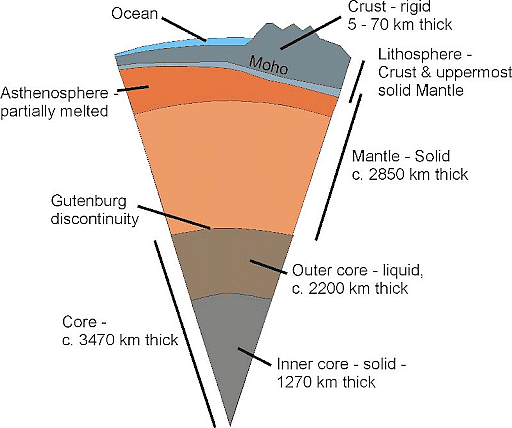
Earth is made up of three layers: the crust, mantle, and core (inner and outer). The crust is a silicate solid, the mantle is a viscous molten rock, the outer core is a viscous liquid, and the inner core is a dense solid. Each layer of the earth has its own physical and chemical properties. This article will explain the concepts of all the different layers of the Earth which is an integral part of the geography syllabus of the UPSC/IAS Exam.
|
Table of Contents |

Different Layers of the Earth
Different Layers of the Earth
- The Earth's strata are mechanically classified as the lithosphere, asthenosphere, mesospheric mantle (a portion of the Earth's mantle beneath the lithosphere and asthenosphere), outer core, and inner core being particularly noteworthy due to their distinct physical and chemical features.
- The crust, upper mantle, lower mantle, outer core, and inner core are the chemical divisions of Earth.
| Other Relevant Links | |
|---|---|
| Sources of the Information about the Interior of Earth | Gravitational Force |
| Direct Sources | Indirect Sources |
| Magnetic Field | Seismic Activity |
Crust of the Earth
- The crust is the earth's outermost layer, accounting for 0.5-1.0 percent of its volume and less than 1% of its mass.
- Density rises with depth, with an average density of roughly 2.7 g/cm3 (the earth's average density is 5.51 g/cm3).
- The thickness of the crust varies from 5 to 30 kilometers in the oceanic crust and 50 to 70 kilometers in the continental crust.
- In the locations of major mountain systems, the continental crust can be up to 70 kilometers thick. In the Himalayan region, it can be up to 70-100 kilometers thick.
- The temperature of the crust increases with depth, reaching levels of around 200°C to 400°C near the mantle-crust boundary.
- In the higher region of the crust, the temperature rises by up to 30°C for every kilometer.
- The crust's outer layer is made up of sedimentary material, and beneath it are acidic crystalline, igneous, and metamorphic rocks.
- Basaltic and ultrabasic rocks make up the crust's lowest layer.
Most Abundant Elements of the Earth’s Crust
| Element | Approximate % by weight | |
|---|---|---|
| 1 | Oxygen (O) | 46.6 |
| 2 | Silicon (Si) | 27.7 |
| 3 | Aluminum (Al) | 8.1 |
| 4 | Iron (Fe) | 5.0 |
| 5 | Calcium (Ca) | 3.6 |
| 6 | Sodium (Na) | 2.8 |
| 7 | Potassium (K) | 2.6 |
| 8 | Magnesium (Mg) | 1.5 |
The Mohorovic Discontinuity
|
Lithosphere
- The lithosphere is the earth's rigid outer layer, with a thickness ranging from 10 to 200 kilometers.
- It consists of the crust as well as the upper part of the mantle.
- The lithosphere is divided into tectonic plates (lithospheric plates), which move and create large-scale changes in the earth's geological structure (folding, faulting).
- The primordial heat left over from the planet's birth, as well as the radioactive decay of uranium, thorium, and potassium in Earth's crust and mantle, are the sources of heat that drive plate tectonics.
Asthenosphere

- It lies below the lithosphere extending up to 80-200 km.
- The rigid lithosphere can easily move over it because the asthenosphere is soft and plastic.
- It is viscous, brittle, and ductile, and its density is higher than the crust.
- During volcanic eruptions, it is the primary source of magma that rises to the surface.
- The lithospheric shell is divided into large pieces called lithospheric plates. These plates can separate from one another at one location, while elsewhere they may collide in crushing impacts that raise great ridges.
The Mantle
- It equates to roughly 83 percent of the earth's volume and 67 percent of its mass.
- It reaches a depth of 2,900 kilometers from Moho's discontinuity.
- The upper mantle's density ranges from 2.9 to 3.3 g/cm3.
- The asthenosphere reaches beyond the lower mantle. It is completely solid.
- In the lower mantle, density ranges from 3.3 g/cm3 to 5.7 g/cm3.
- In comparison to the crust, the mantle is made up of silicate rocks that are high in iron and magnesium.
- The mantle is made up of 45 percent oxygen, 21 percent silicon, and 23 percent magnesium as basic elements (OSM).
- Temperatures in the mantle range from around 200°C at the upper crustal border to almost 4,000°C at the core-mantle boundary.
- A convective material circulation occurs in the mantle as a result of the temperature differential (although solid, the high temperatures within the mantle cause the silicate material to be sufficiently ductile).
- The motions of tectonic plates represent the mantle's convection at the surface.
- Seismicity in the mantle should be inhibited by high-pressure circumstances. However, earthquakes have been detected in subduction zones as far as 670 kilometers below the surface (420 mi).
The Earth’s Core

- The core is made up of very heavy material mostly composed of nickel and iron.
- It is sometimes referred to as the NIFE layer.
- The core-mantle boundary is located at a depth of 2900 km.
- At this boundary, called the Gutenberg discontinuity, there is a sudden change from 5.5 gm/cm3 of the mantle to 10 gm/cm3.
- The core is divided into two parts: the outer core and the inner core.
The Outer Core
- The outer core, which surrounds the inner core, is located between 2900 and 5100 kilometers beneath the surface of the planet.
- Iron with nickel and trace amounts of lighter metals make up the outer core.
- The outer core is liquid because it is not under enough pressure to solidify, despite having a comparable composition to the inner core.
- According to dynamo theory, Earth's magnetic field is created by convection in the outer core mixed with the Coriolis effect.
The Inner Core
- The inner core stretches from the earth's center to 5100 kilometers below the surface.
- This layer is solid because it can transmit shear waves (transverse seismic waves).
- The rotation of the Earth's inner core is slightly quicker than the rotation of the surface.
- A persistent magnetic field cannot be maintained in the solid inner core because it is too hot.
- The core (inner core and outer core) makes up only around 16% of the earth's volume but accounts for 33% of its mass.
Seismic Discontinuities
- Seismic discontinuities refer to boundaries or zones within the Earth's interior where there is a sudden change in seismic wave velocities.
- These abrupt changes in wave speed are typically due to variations in rock composition, temperature, and/or phase transitions.
- The identification and study of these discontinuities provide critical insights into the Earth's internal structure, composition, and materials present at various depths.
Two major discontinuities named after their discoverer are as follows:
- Mohorovicic Discontinuity: Located between the Earth's crust and mantle.
- Named after Andrija Mohorovičić, the seismologist who identified it.
- Represents a transition from the relatively low-velocity rocks of the crust to the denser and higher-velocity rocks of the mantle.
- It typically lies at a depth of about 5-10 km beneath oceanic basins and 20-70 km beneath continents.
- Gutenberg Discontinuity: Boundary between the Earth's mantle and the outer core.
- Seismic P-waves (primary or compressional waves) experience a marked drop in velocity at this discontinuity.
- Seismic S-waves (secondary or shear waves) do not travel through the outer core, so they disappear at this discontinuity.
Conclusion
The intricate layers of the Earth, from the thin crust beneath our feet to the blazing core at its center, present a fascinating testament to our planet's dynamic and complex history. As we delve deeper into each layer, we uncover more about Earth's formation, evolution, and the powerful processes that drive phenomena like earthquakes and volcanic eruptions.
FAQs
Q1: What are the three main layers of the Earth?
Answer: The Earth is divided into three main layers: the crust, the mantle, and the core. The crust is the outermost layer, followed by the mantle, and the core, which is further divided into the outer and inner core.
Q2: What is the Earth's crust made of?
Answer: The Earth's crust is primarily made up of solid rocks and minerals. It consists of two types: the continental crust, which is thicker and made of granitic rocks, and the oceanic crust, which is thinner and composed mainly of basalt.
Q3: What is the mantle, and how is it different from the crust?
Answer: The mantle is the layer beneath the crust, extending up to about 2,900 kilometers in depth. It is made of semi-solid rock that flows slowly. Unlike the crust, the mantle is much thicker and denser due to its composition of silicate minerals rich in magnesium and iron.
Q4: What are the characteristics of the Earth's core?
Answer: The Earth's core is divided into the outer core, which is liquid, and the inner core, which is solid. The core is primarily composed of iron and nickel and is responsible for generating the Earth's magnetic field.
Q5: How do scientists study the Earth's interior?
Answer: Scientists study the Earth's interior using indirect methods, such as seismic waves generated by earthquakes. The way these waves travel through the Earth provides information about the different layers and their properties.
MCQs
- Which of the following layers of the Earth is the thinnest?
a) Crust
b) Mantle
c) Outer core
d) Inner core
Answer: (A) See the Explanation
- What is the primary composition of the Earth's outer core?
a) Silica and alumina
b) Nickel and iron
c) Magnesium and iron
d) Carbon and hydrogen
Answer: (B) See the Explanation
- Which layer of the Earth is responsible for tectonic plate movements?
a) Crust
b) Mantle
c) Outer core
d) Inner core
Answer: (B) See the Explanation
- The boundary between the Earth's crust and mantle is known as?
a) Lithosphere
b) Asthenosphere
c) Mohorovičić discontinuity (Moho)
d) Gutenberg discontinuity
Answer: (C) See the Explanation
- Which of the following is the hottest layer of the Earth?
a) Crust
b) Mantle
c) Outer core
d) Inner core
Answer: (D) See the Explanation
GS Mains Questions and Model Answers
Q1: Describe the structure of the Earth, highlighting the key characteristics of each layer.
Answer: The Earth is composed of three main layers: the crust, the mantle, and the core.
- Crust: The outermost layer, the crust, is solid and thin, ranging from 5 to 70 kilometers in thickness. It is divided into two types: continental crust (thicker and composed of granite) and oceanic crust (thinner and composed of basalt). The crust forms the Earth's surface, including land and ocean floors.
- Mantle: Beneath the crust is the mantle, which extends to about 2,900 kilometers in depth. The mantle is composed of silicate minerals rich in magnesium and iron and is semi-solid, allowing it to flow slowly. The upper mantle, including the asthenosphere, is involved in tectonic plate movement.
- Core: The core is divided into the outer and inner core. The outer core is liquid, composed mainly of iron and nickel, and generates the Earth's magnetic field. The inner core is solid, also made of iron and nickel, and is extremely hot, with temperatures exceeding 5,500°C.
Each layer plays a crucial role in the Earth's geophysical processes, including tectonics, volcanism, and the generation of the magnetic field.
Q2: Explain the significance of the mantle in Earth's tectonic activity.
Answer: The mantle, especially the upper part known as the asthenosphere, plays a critical role in tectonic activity. The mantle is composed of semi-solid rock that moves slowly due to convection currents caused by heat from the core. These currents drive the movement of tectonic plates, which float on the more fluid asthenosphere. This movement leads to various geological phenomena such as earthquakes, volcanic activity, and the creation of mountain ranges. The mantle’s ability to flow and transfer heat is essential for the dynamics of the Earth’s lithosphere, including the recycling of crustal material through subduction and seafloor spreading. The mantle’s convective currents are, therefore, fundamental to the Earth's tectonic processes.
Q3: Discuss the methods used by scientists to study the internal structure of the Earth.
Answer: Scientists use several indirect methods to study the internal structure of the Earth, as direct observation is not possible due to extreme temperatures and pressures. The most important method is the study of seismic waves generated by earthquakes. These waves travel through the Earth and change speed or direction when they encounter different materials, providing insights into the composition and state of the Earth's layers. There are two main types of seismic waves:
- P-waves (primary waves): These can travel through both solids and liquids and are the fastest seismic waves.
- S-waves (secondary waves): These can only travel through solids, not liquids, which helps scientists understand the state of the Earth's core (liquid outer core, solid inner core).
Other methods include the study of volcanic materials brought to the surface, laboratory simulations of high-pressure conditions, and the Earth's magnetic field, which provides clues about the behavior of the core.
Previous Year Questions on Different Layers of the Earth
1. UPSC CSE 2017
Question: Discuss the significance of the Mohorovičić discontinuity (Moho) in understanding Earth's structure.
Answer: The Mohorovičić discontinuity, commonly known as the Moho, is the boundary that separates the Earth’s crust from the mantle. Discovered by Croatian seismologist Andrija Mohorovičić in 1909, the Moho is significant because it marks a change in the composition and physical properties between the crust and mantle. Seismic waves, particularly P-waves and S-waves, travel at different speeds when they pass through this boundary, which has allowed scientists to determine its depth and characteristics. The Moho is located at an average depth of about 35 kilometers beneath continents and around 5-10 kilometers under oceans. Understanding the Moho helps geologists differentiate between the relatively lighter rocks of the crust and the denser materials of the mantle. It also provides critical insights into tectonic processes, such as plate movements and the formation of earthquakes, as these processes often involve interactions between the crust and mantle.
2. UPSC CSE 2019
Question: Explain the role of seismic waves in the study of Earth's internal structure.
Answer: Seismic waves, generated by earthquakes, are crucial tools for studying the internal structure of the Earth. These waves travel through the Earth’s layers and change speed or direction when they encounter different materials, providing key information about the composition and physical state of these layers. There are two main types of seismic waves:
- P-waves (primary waves): These are the fastest seismic waves and can travel through both solids and liquids. They slow down when they pass through the outer core, which indicates the presence of liquid material.
- S-waves (secondary waves): These waves can only travel through solids and are blocked by the liquid outer core, providing evidence that the outer core is liquid.
By studying the travel time, speed, and paths of these waves, scientists can infer the thickness, composition, and state of the Earth’s layers, including the crust, mantle, and core. Seismic wave data has been instrumental in identifying the presence of discontinuities like the Mohorovičić discontinuity (Moho) and the Gutenberg discontinuity between the mantle and core.
Download the PREPP App and attempt FREE IAS Exam Mock Tests and get complete study material!

Full Test - 04: UPSC CSE Prelims CSAT (Paper-II)
Full Test - 03: UPSC CSE Prelims CSAT (Paper-II)
UPSC CSE Prelims 2026 GS Paper 1 Question Paper (24-May-2026)
UPSC CSE Prelims 2026 CSAT Paper 2 Question Paper (24-May-2026)

17 February 2025 | The Hindu Must Read Articles | Current Affairs

16 February 2026 | The Hindu Must Read Articles | Current Affairs

13 February 2026 | The Hindu Must Read Articles | Current Affairs









Comments