Magnetic Field As An Indirect Source of Earth's Interior - Geography Notes
Magnetic Field is one of the indirect sources of the earth's interior. Earth’s magnetic field is referred to as Geomagnetism. Magnetic surveys provide information about the distribution of magnetic material in the crustal portion. This article will explain the concepts of the magnetic field which is an integral part of the geography syllabus. Magnetic Field gives proof of Earth’s interior structure and thus qualifies as an important topic for the UPSC exam.
|
Table of Contents |

Magnetic Field Lines
What is a Magnetic Field?
- The magnetic field that extends from Earth's interior out into space, where it interacts with the solar wind, a stream of charged particles emerging from the Sun, is known as the Earth’s Magnetic Field or geomagnetic field.
- Although a magnetic field can stretch indefinitely, it decreases as it gets further away from its source.
- According to a paleomagnetic study of Australian red dacite and pillow basalt, the magnetic field of Earth is believed to be at least 3.5 billion years old.
| Other Relevant Links | |
|---|---|
| Sources on the Information about the Interior of Earth | Direct Sources |
| Gravitational Force | Indirect Sources |
Magnetic Field as an Indirect Source of Earth’s Interior
- The magnetic field of the earth is created by the flow of electric current generated by rotating metallic fluids of iron and nickel in the earth's outer core. This is known as the Dynamo effect.
- Due to the rotation of the earth around its axis, various gases are ionized in the ionosphere, and charged ions create a strong magnetic field.
- Magnetic anomalies aid in deciphering subsurface structures, from tectonic plate boundaries to underground mineral deposits.
- They also shed light on the historical geomagnetic reversals and movements within the Earth’s mantle and core, such as magnetic reversals in paleostructures.
Main Features of Earth’s Magnetic Field
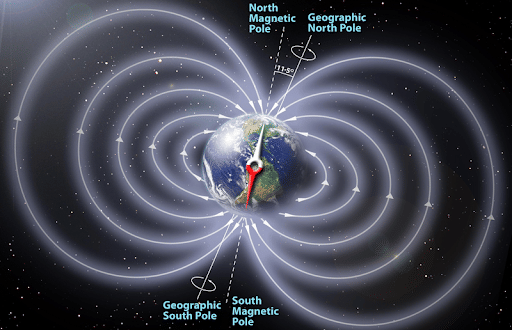
- The strength of the earth's magnetic field varies across the earth; both poles have a stronger magnetic field than the equator. At the center of the earth is a supposed huge magnetic dipole.
- The magnetic pole's axis is not the same as the earth's rotational axis or the geographical axis.
- A magnetic dipole's axis is slanted 11.3 degrees away from the rotation axis, or approximately 78 degrees away from the orbital plane.
- Magnetic poles that are close to geographical north poles are known as north magnetic poles.
- South magnetic poles are those that are close to the earth's geographic south poles.
- At the north magnetic poles, a magnetic field line enters the earth and emerges at the south magnetic poles.
- The earth has a reverse dipole, which means the north magnetic poles act like the south magnetic poles of a bar placed inside the earth.
Importance of Earth’s Magnetic Field
- The Earth's magnetic field, which deflects most of the charged particles, protects it from the solar wind, which is a stream of intensely charged particles emerging from the Sun.
- The Van Allen radiation belt traps some of the charged particles from the solar wind.
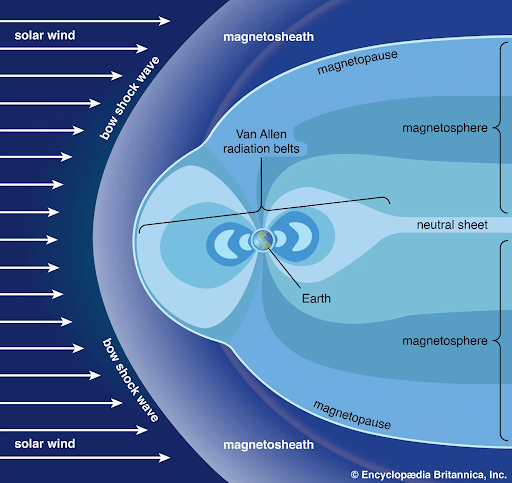
- A lesser number of particles from the solar wind make it to the Earth's upper atmosphere and ionosphere in the auroral zones, as if on an electromagnetic energy transmission line.
- The solar wind is only seen on Earth when it is powerful enough to cause auroras and geomagnetic storms.
- Bright auroras heat the ionosphere, causing its plasma to expand into the magnetosphere, expanding the plasma geosphere's size and allowing atmospheric materials to escape into the solar wind.
- When the pressure of plasmas contained within the magnetosphere is high enough, it inflates and distorts the geomagnetic field, causing geomagnetic storms.
Conclusion
Earth's magnetic field, often visualized as a bar magnet tilted at an angle to the Earth's rotational axis, plays a pivotal role in guiding compasses globally. Changes and anomalies in the magnetic field can be correlated with various aspects of Earth's interior, such as composition, movement, and temperature.
FAQs
Question: What is the magnetic field?
Answer: A magnetic field is a region around a magnetic material or a moving electric charge within which the force of magnetism acts. It is a vector field that exerts a force on particles with magnetic moments, such as electrons, or on other magnets. The Earth itself has a magnetic field, which is crucial for navigation and for protecting the planet from harmful solar and cosmic radiation.
Question: What causes the Earth's magnetic field?
Answer: The Earth's magnetic field is primarily caused by the motion of molten iron and other metals in the Earth's outer core, a process known as the geodynamo. As these metals move, they generate electric currents, which in turn create magnetic fields. These magnetic fields combine to produce the Earth's overall magnetic field, which is similar to that of a giant bar magnet with poles near the planet’s geographic poles.
Question: What are the main components of the Earth's magnetic field?
Answer: The Earth’s magnetic field has two primary components: the main field and the anomalous field. The main field is generated by the geodynamo and is the dominant source of the Earth's magnetic field. The anomalous field is caused by irregularities in the Earth's crust, such as magnetic minerals. The magnetic field is also divided into the magnetic poles (north and south), where the magnetic field lines converge, and the magnetic equator, where the magnetic field is horizontal.
Question: How does the magnetic field affect life on Earth?
Answer: The magnetic field plays a critical role in protecting life on Earth. It acts as a shield, deflecting harmful solar wind and cosmic radiation that could otherwise strip away the planet's atmosphere and make the surface inhospitable. The magnetic field also aids in navigation, as compasses align with the Earth's magnetic field, allowing people to determine directions. Additionally, many species, including migratory birds and sea turtles, rely on the Earth's magnetic field for navigation during their long journeys.
Question: How is the magnetic field measured?
Answer: The Earth's magnetic field is measured using instruments called magnetometers, which detect the strength and direction of the magnetic field. These instruments can be placed on the ground, in the air, or in space. Magnetometers measure the magnetic field in terms of magnetic flux density (measured in teslas or gauss), and the data collected helps scientists monitor changes in the Earth's magnetic field and study phenomena like geomagnetic storms.
MCQs
- The Earth's magnetic field is caused by:
a) Solar wind
b) The Earth's rotation
c) The motion of molten iron in the outer core
d) Earth's gravitational field
Answer: (c) See the Explanation
The Earth's magnetic field is generated by the motion of molten iron and other metals in the Earth's outer core through the geodynamo process.
- What is the term used to describe the region where the Earth's magnetic field is the strongest?
a) Magnetic equator
b) Magnetic poles
c) Magnetic meridian
d) Magnetic zone
Answer: (b) See the Explanation
The magnetic poles are where the Earth's magnetic field is the strongest, and the magnetic field lines converge.
- Which of the following instruments is used to measure the Earth's magnetic field?
a) Thermometer
b) Barometer
c) Magnetometer
d) Seismograph
Answer: (c) See the Explanation
A magnetometer is used to measure the Earth's magnetic field by detecting the strength and direction of magnetic fields.
- The Earth's magnetic field protects life on Earth by:
a) Providing a shield against harmful radiation
b) Helping plants grow
c) Controlling weather patterns
d) Regulating volcanic activity
Answer: (a) See the Explanation
The Earth’s magnetic field acts as a protective shield, deflecting harmful solar wind and cosmic radiation that could otherwise harm life on Earth.
- The magnetic field of the Earth is similar to that of:
a) A light bulb
b) A bar magnet
c) A telescope
d) A battery
Answer: (b) See the Explanation
The Earth's magnetic field resembles that of a bar magnet, with distinct magnetic poles and field lines that extend between them.
GS Mains Questions and Model Answers
Q1: Explain the origin and significance of the Earth’s magnetic field.
Answer: The Earth’s magnetic field originates from the geodynamo process occurring in the outer core, which is composed of molten iron and other metals. As the molten metals move due to convection currents and the Earth’s rotation, electric currents are generated, which in turn create magnetic fields. These magnetic fields combine to produce the Earth’s overall magnetic field. The significance of the Earth's magnetic field is multifaceted. It plays a crucial role in protecting the planet from the harmful effects of solar wind and cosmic radiation, which would otherwise strip away the atmosphere and make life on Earth impossible. The magnetic field also aids in navigation, allowing compass-based direction finding, and has been essential for human exploration and travel. Additionally, it is used in various scientific studies, including space weather forecasting and understanding Earth’s geology. The magnetic field also affects the movement of charged particles in the Earth's atmosphere, contributing to phenomena like the aurora borealis.
Q2: Discuss the impact of geomagnetic storms on Earth and how the Earth’s magnetic field protects us.
Answer: Geomagnetic storms are disturbances in the Earth's magnetic field caused by solar wind and solar flare activity. These storms can have a variety of impacts on Earth, including disruptions to satellite communications, GPS systems, power grids, and other technologies that rely on electromagnetic signals. They can also cause auroras at higher latitudes, as charged particles from the sun interact with the Earth's magnetic field. However, the Earth’s magnetic field acts as a protective shield against these harmful effects. It deflects the solar wind and its charged particles, preventing them from directly reaching the surface of the Earth. The magnetic field redirects these particles toward the polar regions, where they interact with the atmosphere to create auroras but do not cause widespread damage to life or infrastructure. Without this protective shield, Earth’s atmosphere could be stripped away by continuous solar winds, making it inhospitable for life. Thus, the magnetic field plays a critical role in maintaining the habitability of the planet.
Q3: How does the Earth’s magnetic field influence navigation and modern technology?
Answer: The Earth’s magnetic field has long been used in navigation, particularly through the use of compasses. A compass needle aligns itself with the Earth's magnetic field, pointing toward the magnetic poles, thus providing a reliable method of determining direction. This simple yet essential tool has been used by sailors, explorers, and travelers for centuries. In addition to traditional navigation, the Earth’s magnetic field also influences modern technologies. Many technologies, such as GPS systems, satellite communications, and electrical grids, can be affected by changes in the magnetic field, particularly during geomagnetic storms. These storms can induce electrical currents in power lines, potentially causing disruptions. However, the magnetic field also protects satellites and astronauts from harmful radiation in space. Furthermore, the magnetic field is used in a variety of scientific instruments for measuring changes in Earth’s geology, understanding tectonic movements, and monitoring the planet’s climate and weather systems. Thus, the Earth’s magnetic field remains essential not only for traditional navigation but also for a wide range of technological and scientific applications.
Previous Year Questions on Magnetic Field
1. UPSC CSE 2020
Question: "Discuss the role of the Earth’s magnetic field in protecting life on Earth."
Answer: The Earth’s magnetic field plays a crucial role in protecting life by shielding the planet from harmful solar winds and cosmic radiation. These high-energy particles can strip away the Earth’s atmosphere, leading to the loss of essential gases like oxygen and nitrogen that support life. The magnetic field deflects these particles toward the poles, where they interact with the atmosphere to produce auroras, but without harming life on the surface. Additionally, the magnetic field helps maintain the stability of the Earth's atmosphere and plays a significant role in the Earth’s long-term habitability. The protection provided by the magnetic field is essential for sustaining life on Earth, as it prevents the adverse effects of space weather from impacting the atmosphere and the biosphere.
2. UPSC CSE 2019
Question: "Explain how the Earth’s magnetic field is generated and its significance for human activities."
Answer: The Earth’s magnetic field is generated by the movement of molten iron and other metals in the Earth's outer core, a process known as the geodynamo. As the molten metals move, they generate electric currents, which in turn create magnetic fields. These magnetic fields combine to produce the overall magnetic field of the Earth, which extends from the Earth’s surface into space. The significance of the Earth’s magnetic field is immense for human activities. It aids in navigation, as compasses align with the Earth's magnetic field to help travelers find direction. The magnetic field also protects the planet from harmful solar radiation, preventing the atmosphere from being stripped away and allowing life to thrive. In modern times, the magnetic field's stability is essential for the functioning of technologies such as satellite communication, GPS systems, and electrical grids. Furthermore, it has applications in scientific research, helping scientists study geological formations, climate patterns, and space weather. The magnetic field, therefore, plays an indispensable role in both everyday life and scientific exploration.
Download the PREPP App and attempt FREE IAS Exam Mock Tests and get complete study material!

Full Test - 04: UPSC CSE Prelims CSAT (Paper-II)
Full Test - 03: UPSC CSE Prelims CSAT (Paper-II)
UPSC CSE Prelims 2026 GS Paper 1 Question Paper (24-May-2026)
UPSC CSE Prelims 2026 CSAT Paper 2 Question Paper (24-May-2026)

17 February 2025 | The Hindu Must Read Articles | Current Affairs

16 February 2026 | The Hindu Must Read Articles | Current Affairs

13 February 2026 | The Hindu Must Read Articles | Current Affairs









Comments