Gravitational Force As An Indirect Source of Earth's Interior - Geography Notes
Gravitational force is the force of attraction exerted by the earth on a body. The downward movement of water in a river is a simple example of gravitational force. Gravitational force is one of the indirect sources of the earth's interior. Gravitational Force is by far the least powerful known natural force. This article will explain the concept of gravitational force which is an integral part of the earth’s structure. Gravitational force gives proof of Earth's interior structure and thus is an important topic for the UPSC/ IAS exam.
|
Table of Contents |
What is Gravitational Force?
- The universal law of gravitation states that every object in the universe attracts every other object with a force called the gravitational force.
- In other words, gravitational force is an attracting force that pulls all mass-containing physical objects toward it.
- But in most cases, the gravitational force is too weak to be observed due to the very large distance of separation.
- The gravitational force of attraction was first discovered by Sir Isaac Newton and named Newton’s law of gravitation in the year 1680.
Newton’s Law of Gravitation
- Every object in the universe attracts every other object with a force that is proportional to the product of their masses and inversely proportional to the square of the distance between them. The force is along the line joining the centers of two objects.
Force (F) = G (M1M2) / d2
- F = Gravitational force between the two objects in Newton (N)
- G = Gravitational constant
- M₁ = Mass of object 1 in Kg
- M₂ = Mass of object 2 in Kg
- D² = Distance between the two objects in Km
| Other Relevant Links | |
|---|---|
| Sources on the Information about the Interior of Earth | Direct Sources |
| Indirect Sources | Magnetic Field |
Gravitational Force - Examples
- The force that exists between the Sun and the Earth.
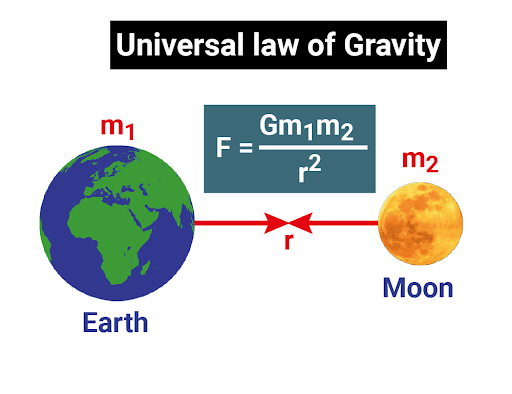
- The force behind the moon's revolution around the Earth.
- Oceanic tides are brought about by the force of the moon.
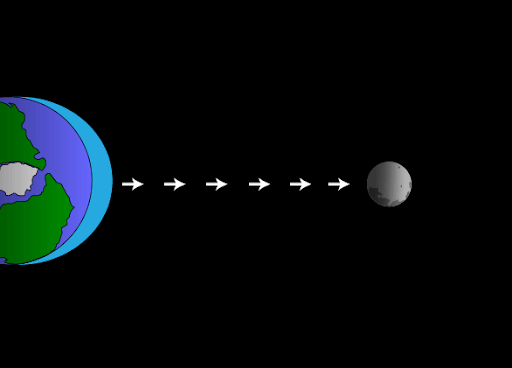
- The force holding all the gases inside the sun in place.
- The force that acts on humans and makes them walk on the ground and not float in the air.

Gravitational Force as an Indirect Source of Earth’s Interior
- At different latitudes on the Earth, the gravitational force is variable.
- Near the poles, the gravitational force is higher, whereas, near the equator, it is lower.
- This is because the distance between the equator and the poles is higher at the equator than at the poles.
- Gravity values vary depending on the mass of the material. This number is influenced by the uneven distribution of material mass within the planet.
- Many other factors influence gravity readings at different locations. These results are not in line with what was expected. Gravity anomaly refers to such a disparity.
- Gravity anomalies provide information on the mass distribution of the material in the earth's crust.
Conclusion
The gravitational pull, a fundamental aspect of our universe, plays a crucial role in geophysical explorations. By mapping gravitational anomalies, we unlock layers of information about the Earth's interior, from crustal thickness variations to deep-rooted structures.
FAQs
Question: What is gravitational force?
Answer: Gravitational force is the force of attraction that pulls objects towards the center of a massive body, like Earth. It is one of the fundamental forces of nature and is responsible for phenomena like objects falling to the ground, the formation of planetary orbits, and the tides. According to Newton's Law of Universal Gravitation, the force of gravity between two objects is proportional to the product of their masses and inversely proportional to the square of the distance between them.
Question: How does gravitational force affect the Earth’s movement?
Answer: Gravitational force plays a key role in the Earth’s movement, particularly in its orbit around the Sun. The gravitational pull from the Sun causes the Earth to stay in orbit and move along an elliptical path. Similarly, the gravitational pull from the Moon causes tides in Earth's oceans. Additionally, gravitational forces influence the Earth's rotation and the distribution of mass on its surface, impacting phenomena like plate tectonics and the Earth's shape.
Question: How is the strength of gravitational force calculated?
Answer: The strength of gravitational force between two objects can be calculated using Newton's Law of Universal Gravitation:
\[ F = \frac{G \cdot (m_1 \cdot m_2)}{r^2} \]
where:
- F is the gravitational force
- G is the gravitational constant (\(6.674 \times 10^{-11} \, \text{N m}^2 \, \text{kg}^{-2}\))
- \(m_1\) and \(m_2\) are the masses of the two objects
- r is the distance between the centers of the two objects
Question: What are some common examples of gravitational force in daily life?
Answer: Gravitational force is responsible for many everyday phenomena, such as:
- Objects falling to the ground when dropped
- The weight of an object on Earth, which is a result of Earth's gravitational pull
- The motion of the Moon around Earth, causing tidal effects in the oceans
- The force that keeps satellites in orbit around the Earth
Question: What is the difference between weight and mass in relation to gravitational force?
Answer: Mass is a measure of the amount of matter in an object and is constant regardless of its location. Weight, on the other hand, is the force exerted on an object due to gravity. Weight depends on the gravitational pull of the body on which the object is located. Mathematically, weight is calculated as:
\[ W = m \cdot g \]
where:
- W is weight
- m is mass
- g is the acceleration due to gravity (approximately \(9.8 \, \text{m/s}^2\) on Earth)
MCQs
1. Which law explains the relationship between mass and gravitational force?
A) Newton’s Third Law
B) Newton’s Law of Universal Gravitation
C) Kepler’s Laws
D) Law of Conservation of Momentum
Answer: (B) See the Explanation
Explanation: Newton's Law of Universal Gravitation explains the relationship between the masses of two objects and the force of attraction between them. This law is fundamental to understanding gravitational force.
2. What is the value of the gravitational constant (G) in Newton’s Law of Universal Gravitation?
A) \( 6.674 \times 10^{-11} \, \text{N m}^2 \, \text{kg}^{-2} \)
B) \( 9.8 \, \text{m/s}^2 \)
C) \( 9.81 \, \text{m/s}^2 \)
D) \( 10 \, \text{m/s}^2 \)
Answer: (A) See the Explanation
Explanation: The gravitational constant, G, has a value of \( 6.674 \times 10^{-11} \, \text{N m}^2 \, \text{kg}^{-2} \), which is a constant that appears in Newton’s Law of Universal Gravitation to calculate the gravitational force between two objects.
3. What is the effect of increasing the distance between two objects on the gravitational force?
A) The force increases
B) The force decreases
C) The force remains the same
D) The force becomes zero
Answer: (B) See the Explanation
Explanation: According to Newton’s Law of Universal Gravitation, the gravitational force decreases as the square of the distance between two objects increases. Thus, increasing the distance between two objects reduces the gravitational force between them.
4. What is the effect of the Earth’s gravity on a satellite in orbit?
A) The satellite is pulled toward the Earth
B) The satellite is pulled away from the Earth
C) The satellite remains unaffected
D) The satellite moves at a constant speed
Answer: (A) See the Explanation
Explanation: A satellite in orbit experiences gravitational force from the Earth, which pulls it towards the planet. This force is balanced by the satellite's centrifugal force due to its motion, allowing it to stay in orbit.
5. What happens to the weight of an object if the acceleration due to gravity decreases?
A) The weight increases
B) The weight decreases
C) The weight remains the same
D) The weight becomes zero
Answer: (B) See the Explanation
Explanation: The weight of an object is directly proportional to the acceleration due to gravity. Therefore, if gravity decreases, the weight of the object also decreases.
GS Mains Questions and Model Answers
Q1: Explain the role of gravitational force in shaping planetary orbits. How does it influence the motion of celestial bodies?
Answer: Gravitational force is the fundamental force responsible for the orbital motion of planets and other celestial bodies. It acts as the centripetal force that keeps planets in orbit around stars, such as the Sun. This force is attractive and is proportional to the masses of the objects involved, with stronger masses exerting a stronger pull. The gravitational force also influences the trajectories of comets, asteroids, and moons, ensuring that they follow predictable paths. Newton’s Law of Universal Gravitation and Kepler’s laws describe this relationship, where the closer an object is to the central body, the stronger the gravitational pull it experiences, which results in a faster orbit.
Q2: How does gravitational force affect daily life on Earth? Discuss its practical implications.
Answer: Gravitational force is fundamental to daily life on Earth as it is responsible for keeping everything grounded. It determines the weight of objects, which impacts everything from how we carry loads to the functioning of machinery. Gravitational force also causes tides in the oceans, driven by the Moon’s gravitational pull. In transportation, gravitational considerations are essential for building structures like bridges, tunnels, and dams, which must account for the Earth’s gravitational pull. Additionally, gravitational force impacts sports, especially those involving jumping or throwing, where the force of gravity determines the height or distance achieved.
Q3: Evaluate the significance of understanding gravitational force for space exploration. How does this knowledge aid in the launch and trajectory planning of spacecraft?
Answer: Understanding gravitational force is crucial for space exploration, as it influences the launch, trajectory, and orbital mechanics of spacecraft. Gravitational calculations help scientists determine the amount of thrust needed to launch a spacecraft and to break free from Earth's gravity. The force also dictates the path of spacecraft once they are in orbit, which is essential for interplanetary travel. Gravitational assist maneuvers, used to increase the speed of spacecraft by utilizing the gravitational field of planets, rely on a deep understanding of gravitational forces. Accurate gravitational modeling ensures that missions are efficient and precise, preventing costly errors.
Previous Year Questions on Gravitational Force
1. UPSC CSE Prelims 2020:
Question: Which of the following statements regarding gravitational force is correct?
A) Gravitational force is a vector quantity
B) Gravitational force is independent of the masses of the two objects
C) Gravitational force is always attractive
D) Gravitational force only acts between objects on Earth
Answer: (C)
Explanation: Gravitational force is always attractive, acting between masses and pulling them toward each other. This is a fundamental property of gravity, as described by Newton’s law of gravitation.
2. UPSC CSE Mains 2019 (GS Paper 1):
Question: “Discuss how Newton’s Law of Universal Gravitation helped in understanding the motion of planets. How does it apply to the motion of celestial bodies in the solar system?”
Answer: Newton’s Law of Universal Gravitation established that every mass in the universe attracts every other mass with a force proportional to the product of their masses and inversely proportional to the square of the distance between them. This law provided a framework to understand planetary orbits and celestial motion. It explained Kepler’s laws of planetary motion and demonstrated that planets orbit the Sun due to the Sun’s gravitational pull. This law also applies to the motion of moons around planets, asteroids, and the behavior of comets in the solar system.
Download the PREPP App and attempt FREE IAS Exam Mock Tests and get complete study material!

Full Test - 04: UPSC CSE Prelims CSAT (Paper-II)
Full Test - 03: UPSC CSE Prelims CSAT (Paper-II)
UPSC CSE Prelims 2026 GS Paper 1 Question Paper (24-May-2026)
UPSC CSE Prelims 2026 CSAT Paper 2 Question Paper (24-May-2026)

17 February 2025 | The Hindu Must Read Articles | Current Affairs

16 February 2026 | The Hindu Must Read Articles | Current Affairs

13 February 2026 | The Hindu Must Read Articles | Current Affairs









Comments