Minerals and Rocks - Geography Notes
A rock is a solid combination of minerals. The basic source of all minerals and rocks is the hot magma in the interior of the earth. When magma cools, crystals of minerals appear and this series of minerals solidify to form rocks. Minerals such as coal, petroleum and natural gas are organic substances found in solid, liquid and gaseous forms respectively. This article will explain to you about Minerals and Rocks which will be helpful in preparing the Geography Syllabus for the UPSC Civil Service exam.
|
Table of Contents |
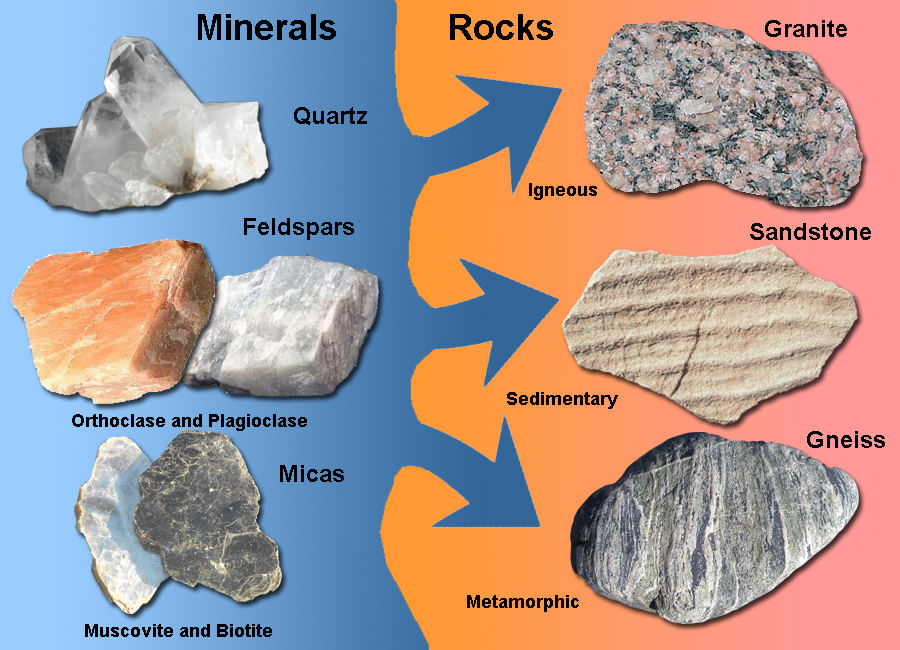
Some Common Minerals And Rocks
What exactly are Minerals and Rocks?
Minerals
- A mineral is a naturally occurring substance that can be either organic or inorganic.
- It has an orderly atomic structure along with definite chemical composition and physical properties.
- A mineral is made up of two or more elements. For example, Quartz is made up of two elements: oxygen and silicon.
- However, single-element minerals like sulphur, copper, silver, gold, graphite etc. are also found.
Rocks
- Two or more minerals are combined together through geological processes to form rocks.
- It is categorized by the minerals & chemical composition and the way in which it is formed.
- The science dealing with the study of rocks is called Petrology.
- There are three main types of rock namely: sedimentary rocks, igneous rocks, and metamorphic rocks.
|
|
|
|---|---|
| Major Minerals | Metallic Minerals |
| Non Metallic Minerals | Types of Rocks |
Physical Characteristics of Minerals
- External Crystal Form: It is determined by the internal arrangement of the molecules - cubes, octahedrons, hexagonal prisms, etc.
- Cleavage: It is the tendency to break in given directions producing relatively plane surfaces - the result of the internal arrangement of the molecules — that may cleave in one or more directions and at any angle to each other.
- Fracture: It is an internal molecular arrangement so complex there are no planes of molecules; the crystal will break in an irregular manner, not along planes of cleavage.
- Lustre: Lustre is the appearance of material without regard to colour; each mineral has a distinctive lustre like metallic, silky, glossy etc.
- Colour: Some minerals have characteristic colour determined by their molecular structure - malachite, azurite, chalcopyrite etc., and some minerals are coloured by impurities. For example, because of impurities quartz may be white, green, red, yellow etc.
- Streak: The colour of the ground powder of any mineral. It may be of the same colour as the mineral or may differ — malachite is green and gives a green streak, and fluorite is purple or green but gives a white streak.
- Transparency: Transparency is the tendency of light rays to pass through so that objects can be seen plainly.
- Structure: It is the particular arrangement of the individual crystals; fine, medium or coarse-grained; fibrous - separable, divergent, radiating.
- Hardness: Hardness is the relative resistance that is being scratched; ten minerals are selected to measure the degree of hardness from 1-10. They are: 1. Talc; 2. Gypsum; 3. Calcite; 4. Fluorite; 5. Apatite; 6. Feldspar; 7. Quartz; 8. Topaz; 9. Corundum; 10. Diamond.
- Specific Gravity: Specific gravity is the ratio between the weight of a given object and the weight of an equal volume of water. Objects are weighed in air and then weighed in water and divided by weight in the air by the difference between the two weights.
Some Major Minerals and their Characteristics
Feldspar
- Half of the earth’s crust is made up of alkali feldspar (12%) and feldspar (39%).
- It has a light cream to salmon pink colour.
- Silicon and oxygen are major elements of all types of feldspar.
- Feldspar is a common raw material used in glass, ceramics and to some extent in paints, plastics and rubbers.

Feldspar
Quartz
- Quartz is a hard mineral that is virtually insoluble in water.
- It is usually white or colourless.
- It consists of silica and is one of the most important components of sand and granite.
- Used in the manufacturing of radar, radio, oscillators for watches, and video games.

Quartz
Pyroxene
- Pyroxene forms 10% of the earth’s crust and is usually found in meteorites.
- Pyroxene minerals are minor to secondary additives of a few rocks which are used as beaten stone and measurement stone
- It is usually found in green or black colour.
- A few pyroxene minerals are used as gem materials.

Pyroxene
Amphibole
- Amphibole forms 7% of the earth’s crust and is generally green or black in colour.
- Aluminium, magnesium calcium, silicon and iron are significant elements of it.
- It is mainly used in asbestos industries.
- Hornblende is another form of amphibole.

Amphibole
Mica
- Mica consists of potassium, aluminium, magnesium, iron, silica, etc.
- It forms 4% of the earth’s crust.
- It is commonly found in igneous and metamorphic rocks.
- Mica is widely used in electronic instruments.

Mica
Olivine
- Olivine consists of magnesium, iron and silica.
- It is a greenish crystal, often found in basaltic rocks.
- Other minerals such as chlorite, calcite, magnetite, haematite, bauxite, and barite are present in small amounts in the rocks in addition to these primary minerals.
- Olivine is used commonly in jewellery.

Olivine
Types of Minerals
Metallic Minerals
- Metallic minerals contain metal content and can be subdivided into three types:
- Precious metals: gold, silver, platinum etc.
- Ferrous metals: contains iron mixed with other minerals
- Non-ferrous metals: they do not have any trace of iron in them.
Non-Metallic Minerals
- Non-metallic minerals do not contain a metal content.
- Sulphur, phosphates and nitrates are some examples.
- Cement is a mixture of non-metallic minerals.

Rocks and their Classification
- The earth's crust is made up of rocks. A rock is a mineral aggregate made up of one or more minerals.
- Rock can be firm or soft, and it can come in a variety of colours.
- Granite, for example, is hard, whereas soapstone is soft.
- Quartzite is milky white while gabbro is black.
- Rocks lack a distinct mineral constituent composition.
- Rocks differ in their properties, the size of particles and mode of formation and accordingly can be classified into three families:
- Igneous Rocks
- Sedimentary Rocks
- Metamorphic Rocks

Igneous rock
- Igneous rocks are called primary rocks or parent rocks as they are formed by highly heated molten fluid magma and lava.
- Most of the igneous rocks are hard and resistant and hence used for road constructions and polished as monuments and gravestones.
- Granite, gabbro, pegmatite, basalt, and volcanic breccias are some examples of it.
* To read more about this topic, click on Igneous Rocks
Sedimentary Rocks
- Sedimentary rocks are developed by the accumulation of sediments over time.
- These sediments include eroded debris from any previously existing rock, including igneous, metamorphic, and ancient sedimentary rocks.
- The particles that form sedimentary rocks may be brought by winds, streams, glaciers and even animals.
* To read more about this topic, click on Sedimentary Rocks
Metamorphic Rocks
- Metamorphic rocks are formed due to the transformation of pre-existing rocks through the process of metamorphism in which recrystallisation and reorganization of minerals occur within a rock.
- Metamorphism occurs mainly due to lava inflow, geodynamic forces or mountain building.
- Slate and marble are common examples of metamorphic rocks.
* To read more about this topic, click on Metamorphic Rocks
Difference Between Minerals and Rocks
| Characteristic | Minerals | Rocks |
|---|---|---|
| Definition | A mineral, like a rock, is a solid, inorganic material with a distinct crystalline structure and chemical content. | A rock is an inorganic material that formed naturally and has no chemical composition or atomic structure. |
| Composition | Minerals have a definite chemical composition. | Rocks do not have a definite chemical composition. |
| Formation | Natural geological processes, such as crystallization from magma or precipitation from solution, are responsible for its formation. | Formed through a variety of geological processes, including magma cooling and solidification, sediment compaction and cementation, and rock alteration. |
| Shape | Minerals have distinctive shapes and colors. | Rocks have an uneven shape and a diversity of colors. |
| Uses | Industrial minerals (such as sand, gravel, and clay), gemstones, and fertilizer are examples. | Materials for construction, road paving, jewelry, and ornamental stones. |
| Examples | Quartz, feldspar, mica, olivine, and calcite are examples of minerals. | Granite, basalt, limestone, and sandstone are all examples of rocks. |
Conclusion
A mineral is a natural or inorganic substance, having an orderly atomic shape and a particular chemical composition and bodily properties. The rocks can be made up of one mineral or diverse minerals. Rocks don’t have a particular composition of mineral materials and can be hard or soft.
|
|
|
|---|---|
| Geography Notes | Physical Geography |
| Geomorphology | Different Layers of the Earth |
| Distribution of Oceans and Continents Basins | Geomorphic Processes |
FAQs
Question: What are the main types of minerals?
Answer: The main types of minerals can be broadly classified into two categories:
- Silicate Minerals: These minerals contain silicon and oxygen and are the most abundant in the Earth's crust. Examples include quartz, feldspar, and mica.
- Non-silicate Minerals: These do not contain silicon and oxygen as their primary components. Examples include calcite, gypsum, and halite. Non-silicate minerals often form in sedimentary environments and have significant economic importance.
Question: How are igneous rocks formed?
Answer: Igneous rocks are formed from the cooling and solidification of molten rock, or magma. This process can occur in two main environments:
- Intrusive (Plutonic) Igneous Rocks: Formed when magma cools slowly beneath the Earth's surface, allowing large crystals to develop. An example is granite.
- Extrusive (Volcanic) Igneous Rocks: Formed when lava erupts onto the surface and cools rapidly, resulting in smaller crystals. An example is basalt.
Question: What are sedimentary rocks, and how do they form?
Answer: Sedimentary rocks are formed from the accumulation and compaction of sediments, which can include mineral fragments, organic materials, and chemical precipitates. The formation process involves:
- Weathering and Erosion: Breakdown of pre-existing rocks into smaller particles.
- Transport: Movement of sediments by water, wind, or ice to new locations.
- Deposition: Accumulation of sediments in layers, often in bodies of water like rivers, lakes, and oceans.
- Compaction and Cementation: Over time, layers of sediment are compressed and cemented together, forming sedimentary rocks such as sandstone, limestone, and shale.
Question: What processes lead to the formation of metamorphic rocks?
Answer: Metamorphic rocks are formed from the transformation of existing rocks—igneous, sedimentary, or other metamorphic rocks—due to changes in temperature, pressure, or chemically active fluids. The processes involved include:
- Heat: Increased temperatures can cause minerals to recrystallize, resulting in new mineral forms.
- Pressure: Increased pressure can lead to foliation, where minerals align under stress, creating distinct layers.
- Chemically Active Fluids: The presence of fluids can facilitate chemical reactions that change the mineral composition of the rock.
Question: Why are minerals and rocks important in geology and resource management?
Answer: Minerals and rocks are essential in geology and resource management for several reasons:
- Natural Resources: Many minerals are vital for industry, including metals (e.g., iron, copper), non-metals (e.g., gypsum, salt), and energy resources (e.g., coal, oil).
- Understanding Earth's Processes: Studying minerals and rocks helps geologists understand geological processes such as plate tectonics, erosion, and sedimentation.
- Environmental Impact: Knowledge of mineral deposits is crucial for sustainable resource management and minimizing environmental impact.
- Cultural Significance: Rocks and minerals are also significant in cultural contexts, with many societies using them in art, construction, and symbolism.
- Geological History: Rocks preserve evidence of Earth's history, including past climates, life forms, and geological events.
MCQs
1. What are the primary categories of minerals?
A) Organic and inorganic
B) Metallic and non-metallic
C) Silicate and non-silicate
D) Hard and soft
Answer: (C) See the Explanation
Explanation: The primary categories of minerals are silicate and non-silicate, based on their chemical composition.
2. Which type of rock is formed from the cooling of molten magma?
A) Sedimentary
B) Metamorphic
C) Igneous
D) Fossilized
Answer: (C) See the Explanation
Explanation: Igneous rocks are formed from the cooling and solidification of molten magma.
3. What process leads to the formation of sedimentary rocks?
A) Melting and cooling
B) Weathering and erosion
C) Heat and pressure
D) Recrystallization
Answer: (B) See the Explanation
Explanation: Sedimentary rocks are formed through the processes of weathering, erosion, deposition, compaction, and cementation of sediments.
4. How are metamorphic rocks formed?
A) From cooling magma
B) From the accumulation of sediments
C) From heat and pressure applied to existing rocks
D) From volcanic eruptions
Answer: (C) See the Explanation
Explanation: Metamorphic rocks are formed when existing rocks undergo changes due to increased heat, pressure, or chemically active fluids.
5. Why are minerals significant in geology?
A) They are aesthetically pleasing
B) They are only found in caves
C) They provide insights into Earth's processes and resources
D) They have no importance in geology
Answer: (C) See the Explanation
Explanation: Minerals are significant in geology as they provide insights into Earth's processes, geological history, and are essential for various natural resources.
GS Mains Questions and Model Answers
Q1: Discuss the role of minerals in Earth's geological processes.
Answer: Minerals play a vital role in Earth's geological processes, serving as the building blocks of rocks and influencing a wide array of geological phenomena. They are formed through processes such as crystallization, precipitation, and metamorphism, contributing to the diversity of the Earth's lithosphere. Minerals undergo weathering, which breaks them down into smaller particles, thus participating in soil formation and nutrient cycling essential for ecosystems. They also act as indicators of geological conditions, with their presence and composition providing insights into past environments, tectonic activities, and resource availability. Understanding minerals allows geologists to interpret geological history, predict geological hazards, and manage natural resources sustainably. Overall, minerals are integral to both the Earth's structure and the dynamic processes that shape it.
Q2: Analyze the economic significance of rocks and minerals in contemporary society.
Answer: The economic significance of rocks and minerals in contemporary society is substantial, impacting various industries and contributing to national economies. Minerals are vital raw materials for manufacturing processes, including metals like iron, copper, and aluminum used in construction, transportation, and technology. Non-metallic minerals such as limestone and gypsum are essential for cement and drywall production, respectively. Furthermore, the energy sector relies on fossil fuels and uranium, derived from specific rock formations, for power generation. The mining industry generates employment opportunities and stimulates local economies, although it also presents environmental challenges that necessitate sustainable practices. As society continues to evolve, the demand for minerals and rocks remains crucial for technological advancement, infrastructure development, and economic growth.
Q3: Evaluate the environmental impacts of mineral extraction and how they can be mitigated.
Answer: Mineral extraction can lead to significant environmental impacts, including habitat destruction, soil erosion, water pollution, and landscape alteration. These activities often result in the degradation of ecosystems and loss of biodiversity. Additionally, mining operations can contaminate local water supplies with heavy metals and toxins, posing risks to human health and aquatic life. To mitigate these impacts, sustainable mining practices must be adopted, including responsible land-use planning, minimizing waste production, and implementing effective water management systems. Rehabilitation and reclamation of mined lands are essential to restore ecological balance. Furthermore, adopting advanced technologies and regulations that prioritize environmental protection can reduce the negative consequences of mineral extraction. Overall, a balance must be struck between meeting resource demands and preserving the environment for future generations.
Previous Year Questions on Minerals and Rocks
1. UPSC CSE Prelims 2021:
Question: Which of the following types of rocks are formed through cooling and solidification of magma?
A) Sedimentary rocks
B) Igneous rocks
C) Metamorphic rocks
D) Fossils
Answer: (B)
Explanation: Igneous rocks are formed through the cooling and solidification of magma.
2. UPSC CSE Mains 2019 (GS Paper 1):
Question: "Assess the role of rocks and minerals in the geological and economic context."
Answer: Rocks and minerals are foundational to both geological processes and economic development. They contribute to the structure and composition of the Earth's crust, influencing landscape formation and ecosystem dynamics. Economically, minerals serve as essential raw materials for various industries, driving technological advancements and infrastructure development. The extraction and processing of minerals support local economies but also pose environmental challenges. A balanced approach that promotes sustainable practices is necessary to ensure that mineral resources are managed effectively while minimizing ecological impacts.
Download the PREPP App and attempt FREE IAS Exam Mock Tests and get complete study material!

Full Test - 04: UPSC CSE Prelims CSAT (Paper-II)
Full Test - 03: UPSC CSE Prelims CSAT (Paper-II)
UPSC CSE Prelims 2026 GS Paper 1 Question Paper (24-May-2026)
UPSC CSE Prelims 2026 CSAT Paper 2 Question Paper (24-May-2026)

17 February 2025 | The Hindu Must Read Articles | Current Affairs

16 February 2026 | The Hindu Must Read Articles | Current Affairs

13 February 2026 | The Hindu Must Read Articles | Current Affairs









Comments