Igneous Rocks - Types of Rocks - Geography Notes
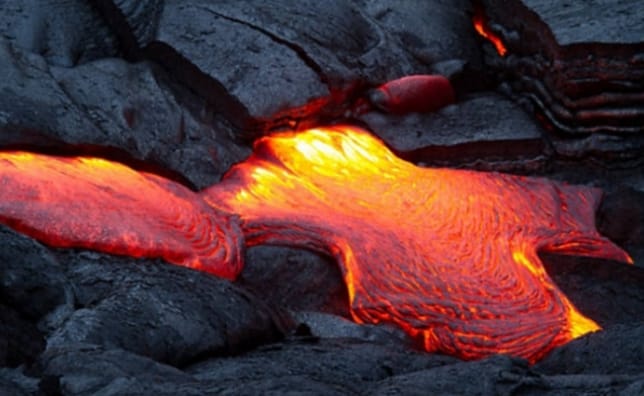
Igneous rocks, also called primary rocks are rocks that are formed when magma cools and solidifies. About 95% part of the earth's crust is made up of igneous rocks. Magma (molten rock) cools and crystallises at volcanoes on the Earth’s surface or when the melted rock is still inside the crust, igneous rocks are formed. Depending on the magma from which they cooled, igneous rocks can have a wide range of compositions. Igneous rocks are of two types namely: intrusive or extrusive igneous rocks. This topic is an important part of the geography syllabus of the IAS exam.
|
Table of Contents |
Igneous Rocks
What are Igneous Rocks?
- Igneous rocks are formed from magma and lava from the earth's interior. When magma cools and solidifies, igneous rocks are created.
- The cooling and solidification process might take place in the earth's crust or on the surface.
- Mineral grains can be exceedingly big if molten material is cooled slowly at enormous depths.
- Small, smooth grains result from rapid cooling (at the surface).
- Intermediate cooling conditions might result in intermediate grain sizes in igneous rocks.
- Granite, gabbro, pegmatite, basalt, volcanic breccia and tuff are some examples of igneous rocks.
- Depending on where the molten rock solidifies, igneous rocks are classified as intrusive or extrusive.
- Depending on mineral composition, igneous rockets can be classified as acid igneous rocks and basic igneous rocks.
| Other Relevant Links | |
|---|---|
| Types of Rocks | Rock Cycle |
| Sedimentary Rocks | Metamorphic Rocks |
Classification of Igneous Rocks - On the Basis of Location
Intrusive Igneous Rocks (Plutonic Rocks)
- When magma is trapped deep within the Earth, intrusive or plutonic igneous rock occurs. Molten rock in large globs rises to the surface.
- Some of the magma may fuel volcanoes on the surface, but the majority is confined beneath the surface, where it cools slowly over decades or millions of years before solidifying.
- It has a coarse-grained structure.
- These rocks appear on the surface only after being uplifted and denuded.
- Intrusive rocks are often coarse-grained and highly hard in nature.
- Intrusive igneous rocks include diabase, diorite, gabbro, granite, pegmatite, peridotite etc.
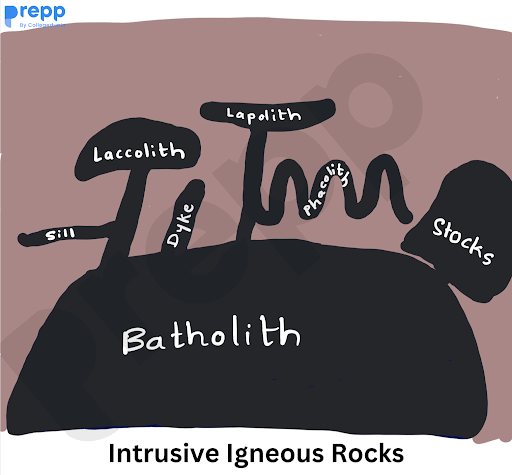
Batholith
-
Batholiths
- The cooling component of magma chambers is known as batholiths.
- It is a vast body of magmatic material that forms large domes when it cools in the crust's deeper layers.
- They only appear on the surface once the surrounding materials have been removed by denudation processes.
- This is a granitic body.
- Examples include batholith-granitic formations that make up much of the Sierra Nevada in California.

A granite monolith in Yosemite National Park
-
Laccoliths
- These are huge dome-shaped intrusive bodies with a level base that are connected from below by a pipe-like canal.
- It is similar to the composite volcano's surface volcanic domes, although it is located at a deeper depth.
- It can be thought of as a localised lava source.
- The Karnataka plateau is characterised by granite dome hills.
- Other Examples: Solidified magma chamber of Torres del Paine (Patagonia).

A laccolith
-
Lopolith
- When lava travels upward, a portion of it prefers to move horizontally if it encounters a weak plane.
- It can be re-energized in a variety of ways.
- It is called lopolith if it grows into a saucer shape that is concave to the sky body.
- Examples: Duluth gabbro, the Sudbury igneous complex of Ontario, and the Bushveld igneous complex of South Africa.

A lopolith
-
Phacolith
- In the folded igneous country, it is a wavy mass of intrusive rocks found at the base of synclines or the top of anticlines.
- The youngest rocks are found in the core of a syncline (i.e., closest to the fold axis), while the oldest rocks are found in the core of an anticline.
- In the form of magma cavities, these wavy materials have a clear outflow to the source beneath them.
- Examples: Omey pluton in Ireland, near Bayalan, Ajmer district, Rajasthan in India.

A Phacolith
-
Sills
- Sills are the near-horizontal masses of intrusive igneous rocks.
- Sills refer to the thicker horizontal deposits, whilst sheets refer to the thinner ones.
- Examples: Duluth intrusive complex of the Superior District, and the Stillwater igneous complex of the United States.
-
Dykes
- Dykes are the most common intrusive formations.
- The lava solidifies practically perpendicular to the earth as it travels through fractures and fissures.
- This is cooled in the same spot, resulting in the formation of a wall-like structure. Dykes are the name for such formations.
- These are thought to be the feeders for the volcanic eruptions that resulted in the formation of the Deccan traps.
- Examples: Pilanesberg ring dyke complex, Dark dykes of Baranof cross-island trail, Alaska.

Sills and Dikes
Extrusive Igneous Rocks (Volcanic Rocks)
- Volcanic rocks are formed when sudden cooling of magma occurs on the surface.
- It has a fine-grain structure and is denser and dark in colour.
- The Deccan Traps in the Indian peninsular region are of basaltic origin.
- Basic rocks are denser and darker in colour because they contain a higher proportion of basic oxides, such as iron, aluminium, and magnesium.
- Volcanic rocks are generated when molten lava ejected from a volcano cools on the surface.
- The magma (lava) cools faster on the surface, forming fine-grained igneous rocks.
- Extrusive igneous rocks include pumice, obsidian, andesite, rhyolite, basalt, etc.
Classification of Igneous Rocks - On the Basis of Chemical Composition
Igneous rocks can be further divided into two types based on chemical composition.
Acidic Igneous Rocks
- These contain a high proportion of silica and are lighter in colour than basic rocks. It is less dense.
- Acidic magma cools quickly due to the abundant silicon, and it does not flow or spread far.
- High mountains are formed by these kinds of rocks.
- Acid rocks are hard, compact, massive, and resistant to weathering.
- Examples: Quartz, granite, microgranite and rhyolite are rich in silica and contain the minerals quartz, feldspar and biotite.

Acidic Igneous Rock
Basic Igneous Rocks
- These contain low proportions of silica and are dark in colour and denser than acid igneous rocks.
- Due to low silica content, the parent material of such rocks cools slowly, causing them to flow and spread out across a large area. This flow and cooling give rise to plateaus.
- The presence of heavy elements imparts a dark colour to these rocks.
- Not being very hard, these rocks are weathered relatively easily.
- Examples: Basic rocks such as gabbro, dolerite, and basalt are low in silica and contain the minerals olivine, pyroxene, feldspar, and/or quartz, among others. They are also high in magnesium and iron and are referred to as "mafic" rocks.

Basic Igneous Rocks
Significance of Igneous Rocks
- Resistant to Weathering and Erosion: Igneous rocks like basalt and granite are resistant to weathering and erosion as compared to sedimentary rocks Therefore sculptures, statues, buildings, and decorations will last longer if they were made from sedimentary rocks.
- Cost-effective: Granite is cost-effective as well as stunning in appearance. Moreover, as a natural stone, granite is heat and scratch-resistant, making it one of the ideal kitchen countertop options. Hence, heavy and durable granite slabs are a premium choice for building countertops.
- Jewellery: Peridot, a kind of olivine used in jewellery, is sometimes mined from peridotite.
- Skin and Dental Aids: Pumice is a stone that can be used to polish skin or scrape away grime around the house. To act as an abrasive material to scrape teeth, ground-up pumice stone is occasionally added to toothpaste.
- Concrete Products: Another use of pumice stone is the production of lightweight concrete blocks and other lightweight concrete products.
- Landscaping and Horticulture: It is also used in landscaping and horticulture. The pumice is used as a decorative ground cover in landscaping and planters.
- Drainage Rock and Soil Conditioner: It is used as a drainage rock and soil conditioner in plantings. Pumice and scoria are also popular rocks for use as substrates in hydroponic gardening.
- Making Roads: Basalt and dolerite are used for road making.
- Cash Crops: Deccan trap in India made up of basaltic igneous rocks is extensively used for the cultivation of cash crops like cotton, etc.
Conclusion
Magma is the major source of metal ores many of which are present in igneous rocks. Magnetic iron, nickel, copper, lead, zinc, chromite, manganese, gold, diamond, and platinum are found in igneous rocks which are of great economic importance. These crystallised minerals or metals are abundant in the old rocks of the large Indian peninsula. Many igneous rocks, such as granite, are utilized as building materials because of their stunning colours.
|
|
|
|---|---|
| Geography Notes | Physical Geography |
| Geomorphology | Different Layers of the Earth |
| Distribution of Oceans and Continents Basins | Minerals and Rocks |
FAQs
Q1: What are igneous rocks?
Answer: Igneous rocks form from the solidification of molten magma or lava. They are known as primary rocks since other rock types derive from them through various geological processes.
Q2: How are igneous rocks classified?
Answer: They are broadly classified into two categories: intrusive (plutonic) rocks, formed beneath the Earth's surface, and extrusive (volcanic) rocks, formed on the surface.
Q3: What is the difference between intrusive and extrusive igneous rocks?
Answer: Intrusive rocks, such as granite, cool slowly beneath the Earth's surface, resulting in coarse-grained textures. Extrusive rocks, like basalt, cool quickly on the surface, leading to fine-grained textures.
Q4: What are some common examples of igneous rocks?
Answer: Granite, basalt, pumice, obsidian, and gabbro are popular examples of igneous rocks.
Q5: What role do igneous rocks play in the rock cycle?
Answer: Igneous rocks act as the foundation of the rock cycle, as they can weather into sediments, which eventually form sedimentary rocks or undergo transformation to become metamorphic rocks.
MCQs
- Which of the following is an intrusive igneous rock?
a) Basalt
b) Granite
c) Pumice
d) Obsidian
Answer: (B) See the Explanation
- What texture is typical of extrusive igneous rocks?
a) Coarse-grained
b) Fine-grained
c) Foliated
d) Glassy
Answer: (B) See the Explanation
- Which of the following rocks is known for its glassy texture?
a) Gabbro
b) Granite
c) Obsidian
d) Pumice
Answer: (C) See the Explanation
- Which rock type is formed from magma that cools slowly underground?
a) Basalt
b) Obsidian
c) Granite
d) Pumice
Answer: (C) See the Explanation
- What makes pumice different from other igneous rocks?
a) Coarse-grained texture
b) Vesicular structure with air pockets
c) Glassy texture
d) High density
Answer: (B) See the Explanation
GS Mains Questions and Model Answers
Q1: Explain the formation process of igneous rocks.
Answer: Igneous rocks form through the cooling and solidification of molten material from beneath or on the Earth’s surface. Intrusive rocks, like granite, solidify slowly underground, forming coarse-grained textures. In contrast, extrusive rocks, such as basalt, cool quickly on the surface, resulting in fine-grained textures. This process is integral to the rock cycle, as igneous rocks can weather into sediments or undergo metamorphism.
Q2: How do igneous rocks contribute to the Earth’s crust?
Answer: Igneous rocks make up a significant portion of the Earth's crust. Basalt, an extrusive igneous rock, constitutes most oceanic crust, while granite, an intrusive rock, forms much of the continental crust. Their mineral composition provides essential elements, such as silica and iron, which influence soil fertility and the formation of sedimentary rocks.
Q3: Analyze the differences between plutonic and volcanic igneous rocks.
Answer: Plutonic (intrusive) rocks, like granite and gabbro, form slowly beneath the Earth's surface, resulting in large, visible crystals. Volcanic (extrusive) rocks, such as basalt and pumice, solidify quickly on the surface, creating fine-grained or glassy textures. While plutonic rocks reveal geological processes occurring deep underground, volcanic rocks provide insights into surface volcanic activities.
Previous Year Questions on Igneous Rocks
1. UPSC CSE 2018
Question: "Explain how the cooling rate influences the texture of igneous rocks."
Answer: The cooling rate plays a crucial role in determining the texture of igneous rocks. When magma cools slowly beneath the Earth's surface, as with intrusive rocks like granite, large crystals have time to develop, resulting in a coarse-grained texture. In contrast, lava that cools rapidly on the surface forms fine-grained textures, as seen in basalt. Obsidian, which has a glassy texture, is an example of extremely rapid cooling, preventing crystal formation altogether. Understanding cooling rates helps in identifying the environment of formation, whether deep underground or on the Earth’s surface.
2. UPSC CSE 2021
Question: "Discuss the role of igneous rocks in the rock cycle."
Answer: Igneous rocks are fundamental to the rock cycle, as they form directly from molten magma or lava. Over time, these rocks undergo weathering and erosion, breaking down into sediments that accumulate and form sedimentary rocks. Additionally, igneous rocks subjected to heat and pressure can transform into metamorphic rocks. The constant recycling of rocks, involving the creation, destruction, and transformation of igneous rocks, illustrates how geological processes shape the Earth’s crust.
Download the PREPP App and attempt FREE IAS Exam Mock Tests and get complete study material!

Full Test - 04: UPSC CSE Prelims CSAT (Paper-II)
Full Test - 03: UPSC CSE Prelims CSAT (Paper-II)
UPSC CSE Prelims 2026 GS Paper 1 Question Paper (24-May-2026)
UPSC CSE Prelims 2026 CSAT Paper 2 Question Paper (24-May-2026)

17 February 2025 | The Hindu Must Read Articles | Current Affairs

16 February 2026 | The Hindu Must Read Articles | Current Affairs

13 February 2026 | The Hindu Must Read Articles | Current Affairs









Comments