Distribution of Oceans and Continents - Geography Notes
The relative position of landmass and ocean basins is referred to as the distribution of continents and oceans. The movement of tectonic plates causes these to shift over millions of years. Tectonic plates move at a rate of 2-10 cm per year, but these slow shifts translate into movements of hundreds to tens of thousands of kilometers over tens to hundreds of millions of years, changing the size, shape, and depth of ocean basins and the distribution of oceans and continents on the Earth, affecting global climate and ecosystems. In this article, we will discuss Distribution of Oceans and Continents which will be helpful for UPSC/IAS exam preparation.
|
Table of Contents |

The maps above show how the distribution of continents and oceans has changed over the last 250 million years
Distribution of Oceans and Continents
- The oceans comprise 69% of the earth’s surface whereas continents comprise 29% of the earth’s surface. Mountains, basins, plateaus, ridges, canyons, and trenches can all be found beneath the ocean's surface.
- Moreover, it is now a well-accepted fact that the position of oceans and the continent is not permanent, it changes over a period of time.
- There were many theories developed over a period of time that explain the position of continents and oceans.
- The following major theories were proposed during different times regarding the distribution of Oceans and Continents
- Continental Drift Theory (1912)
- Seafloor Spreading Theory(1960)
- Plate Tectonics Theory (1967)
|
|
|
|---|---|
| Continental Drift Theory | Convectional Current Theory |
| Concept of Seafloor Spreading | Plate Tectonic Theory |
| Divisions of the Ocean Floor | Different Layers of the Earth |
Continental Drift Theory
- Continental drift theory was proposed by German scientist Alfred Wegener in 1912 to explain the distribution of oceans and continents.
- According to Wegener: PANGAEA is the term given to all of the continents that were developed from a single landmass or supercontinent. The mega ocean known as PANTHALASSA surrounded the supercontinent.
- The supercontinent began to divide 200 million years ago.
- It is first divided into two landmasses: Laurasia on the north side and Gondwanaland in the south.
- Many land masses were divided by Laurasia and Gondwana land.
- From Laurasia, the following landmasses were created:
- North America
- Europe
- Asia except for the Indian subcontinent
- From Gondwanaland:
- South America
- Africa
- Indian continent
- Australia


Evidence of Fossils supporting continental drift theory
*To read more on this topic click the following link Continental Drift Theory
Seafloor Spreading Theory
- The seafloor spreading hypothesis was proposed by the American geophysicist Harry H. Hess in 1960.
- The seafloor spreading theory states that oceanic crust forms along submarine mountain zones, collectively known as the mid-ocean ridge system, and spreads out laterally away from them is known as seafloor spreading.
- This concept was crucial in the development of plate tectonics theory, which transformed geologic thought in the last part of the twentieth century.
- The process of seafloor spreading happens at mid-ocean ridges, where new oceanic crust is generated by volcanic activity and then progressively travels away from the ridge.

- Harry Hess suggested the theory that the seafloor moves (and carries the continents with it) as it expands from a central axis.
- According to this idea, the great heat generated by radioactive chemicals in the mantle (100-2900 km below the earth's surface) seeks a way out and causes convection currents to emerge in the mantle.
- Oceanic ridges form on the seafloor where the rising limbs of these currents meet, while trenches form where the failing limbs meet.
- New material is added to the ocean floor, while older materials are pushed away from the crest.
- As molten material erupts from the mantle, it spreads out and pushes older rocks to the surface, forming a new ocean floor along with breaches in the ocean crust.
- The process of sea-floor spreading continues to add additional ocean floor.
Problems Solved by Theory of Seafloor Spreading
- Many of the outstanding problems were solved as a result of seafloor spreading.
- It solved the dilemma of finding younger crust at the mid-oceanic ridges and older rocks as we moved out from the ridges' center.
- It also explained why the sediments in the cores of the oceanic ridges are so thin.
- The spreading of the seafloor also supported Alfred Wegener's hypothesis of continental drift and aided in the development of plate tectonics.
Plate Tectonic Theory

Plate Tectonic Theory
- McKenzie, Parker, and Margin coined the term "plate tectonics" in 1967. The base theories that help to conceptualize plate tectonics are seafloor theory and convection current theory.
- Plate tectonics theory explains the large-scale motions of the earth’s lithosphere. The term plate was first coined by JT Wilson in 1965.
- Though this theory was proposed by Harry Hess in 1962, it was explained scientifically by other important thinkers like Morgan, McKenzie, Parker, and Holmes.
- According to this theory, the crust of the earth is divided into several big and small fragments called plates. These lithospheric plates are about 100km thick.
- A tectonic plate, also known as a lithospheric plate, is a huge, irregularly shaped solid plate that can be composed entirely of continents, oceans, or both which flow horizontally across the asthenosphere.
- These plate boundaries are further classified into Convergent, Divergent, and Transform Boundaries.
- These plates are floating over the semi-molten asthenosphere. Which is responsible for the present state of the distribution of oceans and continents on the Earth.
*To read more on this topic, click the following link Plate Tectonic Theory
Movement of the Indian Plate
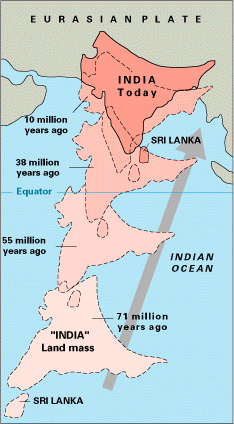
- The Indian plate is comprised of the Indian subcontinent and Australia.
- Around 200 million years ago, the Indian subcontinent was an island surrounded by the Tethys Sea.
- 50 million years ago, it collided with Eurasia and a subduction zone was created along with the Himalayas.
- During a movement toward the Eurasian plate, a major event happened such as the outpouring of lava and the formation of the Deccan trap around 60 million years ago.
- Movement is still happening, the Himalayas are rising even now.
*To read more on this topic click the following link Movement of Indian Plate
Conclusion
The distribution of oceans and continents is not a mere accident of geography but a result of intricate geological processes and Earth's dynamic history. Their distribution has played a pivotal role in shaping climate patterns, biodiversity, human civilizations, trade, and more. India, strategically positioned between the East and the West, boasts a rich maritime legacy that intertwines with its continental history. Understanding the distribution of oceans and continents is paramount for addressing modern challenges like climate change, sea-level rise, and sustainable marine resource management.
|
|
|
|---|---|
| Geography Notes | Physical Geography |
| Geomorphology | Different Layers of the Earth |
| Geomorphic Processes | Minerals and Rocks |
FAQs
Question: What is the Continental Drift Theory?
Answer: The Continental Drift Theory, proposed by Alfred Wegener, suggests that all continents were once part of a supercontinent called Pangaea that gradually drifted apart to form the continents we see today.
Question: How does the theory of plate tectonics explain the distribution of continents and oceans?
Answer: The Plate Tectonics Theory explains that Earth's crust is divided into plates that float on the molten mantle. The movement of these plates at various boundaries causes the formation of continents, oceans, and other geological features.
Question: What is sea-floor spreading, and how does it affect ocean formation?
Answer: Sea-floor spreading occurs at mid-ocean ridges, where new oceanic crust forms as magma rises from beneath the Earth's surface. This process expands the ocean floor, pushing continents apart.
Question: Which is the largest ocean on Earth?
Answer: The Pacific Ocean is the largest ocean on Earth, covering more than one-third of the planet's surface.
Question: What evidence supports the theory of plate tectonics?
Answer: Evidence for plate tectonics includes sea-floor spreading, paleomagnetism, and the distribution of earthquakes and volcanic activity along plate boundaries.
MCQs
1. Who proposed the Continental Drift Theory?
A) Harry Hess
B) Alfred Wegener
C) James Hutton
D) Charles Darwin
Answer: (B) See the Explanation
Alfred Wegener proposed the Continental Drift Theory in 1912, suggesting that continents were once part of a single landmass called Pangaea.
2. What is the process of new oceanic crust formation called?
A) Subduction
B) Plate collision
C) Sea-floor spreading
D) Erosion
Answer: (C) See the Explanation
Sea-floor spreading occurs at mid-ocean ridges, where magma rises to form new oceanic crust, pushing older crust away.
3. Which of the following is NOT one of Earth's major oceans?
A) Pacific Ocean
B) Atlantic Ocean
C) Southern Ocean
D) Mediterranean Sea
Answer: (D) See the Explanation
The Mediterranean Sea is a large sea but not one of Earth's five major oceans. The major oceans are the Pacific, Atlantic, Indian, Southern, and Arctic.
4. Which continent is the smallest in terms of land area?
A) Europe
B) Africa
C) Australia
D) Antarctica
Answer: (C) See the Explanation
Australia is the smallest continent in terms of land area, comprising the mainland and numerous smaller islands.
5. Which geological theory explains the movement of Earth’s lithospheric plates?
A) Continental Drift
B) Sea-floor Spreading
C) Plate Tectonics
D) Paleomagnetism
Answer: (C) See the Explanation
The Plate Tectonics Theory explains the movement of Earth's lithospheric plates and how they interact at their boundaries, shaping continents and oceans.
GS Mains Questions and Model Answers
Q1: Explain the significance of the Plate Tectonics Theory in understanding the distribution of oceans and continents.
Answer: The Plate Tectonics Theory revolutionized our understanding of the distribution of oceans and continents by explaining how Earth's lithosphere is divided into several large plates that float on the molten mantle. The movement of these plates at divergent, convergent, and transform boundaries causes the formation of various geological features, including mountains, ocean basins, and mid-ocean ridges. The theory explains processes like sea-floor spreading, which creates new oceanic crust, and continental drift, which shifts continents over geological time scales. Plate tectonics is fundamental to explaining the Earth's dynamic surface and how continents and oceans have evolved.
Q2: Analyze the role of sea-floor spreading in shaping the modern distribution of oceans.
Answer: Sea-floor spreading is a key process that shapes the modern distribution of oceans. Occurring at mid-ocean ridges, magma rises from beneath Earth's surface to create new oceanic crust, pushing older crust away. This process gradually widens ocean basins and moves continents apart, as seen in the Atlantic Ocean, which continues to expand. Sea-floor spreading provides evidence for plate tectonics and helps explain the formation and expansion of oceans over millions of years. The process also creates undersea mountain ranges and deep ocean trenches, contributing to the overall topography of the ocean floor.
Q3: Discuss the evidence supporting the Continental Drift Theory and how it laid the foundation for the Plate Tectonics Theory.
Answer: The Continental Drift Theory, proposed by Alfred Wegener, suggested that continents were once part of a supercontinent called Pangaea and have since drifted apart. Evidence supporting this theory includes the fit of the continents, particularly how South America and Africa appear to fit together like puzzle pieces. Fossil evidence, such as identical species found on separate continents, and geological similarities between mountain ranges across continents further supported the theory. Although initially rejected due to a lack of mechanism, the theory laid the groundwork for the Plate Tectonics Theory, which provided the mechanism—lithospheric plate movement—that explained how continents could drift. The discovery of sea-floor spreading and the study of paleomagnetism further validated the concept.
Previous Year Questions on Distribution of Oceans and Continents
1. UPSC CSE Prelims 2020
Question: Which of the following is evidence supporting the theory of sea-floor spreading?
A. The presence of deep-sea trenches
B. The distribution of earthquakes along plate boundaries
C. The age of rocks on either side of mid-ocean ridges
D. The occurrence of volcanic activity along divergent boundaries
Answer: C
Explanation: The age of rocks on either side of mid-ocean ridges provides evidence for sea-floor spreading, as younger rocks are found near the ridges and older rocks are found farther away, indicating the creation of new crust.
2. UPSC CSE Mains 2019 (GS Paper 1)
Question: Explain the process of sea-floor spreading and its role in plate tectonics.
Answer: Sea-floor spreading is the process by which new oceanic crust forms at mid-ocean ridges as magma rises from beneath the Earth's surface. The newly formed crust pushes the older crust away from the ridge, causing the ocean floor to expand. This process plays a crucial role in plate tectonics, as it explains how tectonic plates move and interact. The creation of new oceanic crust at divergent plate boundaries leads to the widening of ocean basins, while subduction at convergent boundaries consumes old crust. Sea-floor spreading is a fundamental concept that helps explain the dynamic nature of Earth's surface and the formation of ocean basins.
Download the PREPP App and attempt FREE IAS Exam Mock Tests and get complete study material!

Full Test - 04: UPSC CSE Prelims CSAT (Paper-II)
Full Test - 03: UPSC CSE Prelims CSAT (Paper-II)
UPSC CSE Prelims 2026 GS Paper 1 Question Paper (24-May-2026)
UPSC CSE Prelims 2026 CSAT Paper 2 Question Paper (24-May-2026)

17 February 2025 | The Hindu Must Read Articles | Current Affairs

16 February 2026 | The Hindu Must Read Articles | Current Affairs

13 February 2026 | The Hindu Must Read Articles | Current Affairs









Comments