Convectional Current Theory by Arthur Holmes - Geography Notes
Convectional Current Theory talks about the possibilities of mantle convection currents. Radioactive elements in the mantle cause thermal variations, which generate these currents. In the 1930s, Arthur Holmes proposed this Theory.

According to Holmes, the entire mantle region contains a system of similar currents. This was an attempt to explain the question of force, which led to the rejection of the continental drift theory by contemporary scientists as Alfred Wegener was unable to explain the reason for the movements of plates in the western direction. In this article, we will discuss Convectional Current Theory which will be helpful for UPSC exam preparation.
|
Table of Contents |

Convectional Current
- Convection is a heat transfer process that involves the movement of fluids between various temperature zones.
- A convection current is a process in which energy is transferred from one location to another. It is also known as convection heat transfer.
- Convection currents cannot occur in solids.
- Reason: The particles within the solids cannot easily flow, and most of the free movement is due to a difference in density generated by a large heat transfer between the plates.

Movements of Convection Current
| Other Relevant Links | |
|---|---|
| Divisions of the Ocean Floor | Continental Drift Theory |
| Concept of Seafloor Spreading | Plate Tectonic Theory |
Convectional Current Theory
- In the 1930s, Arthur Holmes proposed the Convectional Current Theory. It is the soul of Seafloor Spreading Theory.
- According to this theory, the extreme heat generated by radioactive chemicals in the mantle (100-2900 km beneath the earth's surface) seeks a way to escape and causes convection currents to emerge in the mantle.
- Under the solid lithosphere, the fluid asthenosphere circulates as convection currents.
- Divergent convective currents pull crustal blocks away from each other in opposite directions, forming seas and oceans.
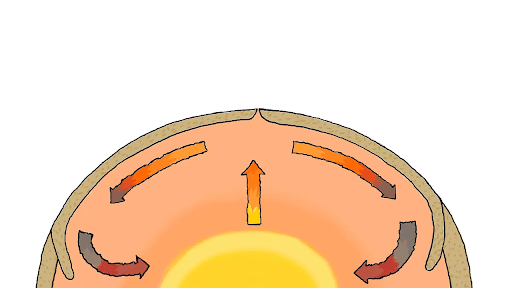
Divergent convective currents
- East African Rift system, the Mid-Atlantic Ridges, and so on are examples.
- Convergent convective currents generate subsidence in the crustal zones, resulting in geosynclines and sea closure, resulting in the construction of island arcs, mountains, and other features.
- Convection currents run through the mantle's molten rock, acting as a conveyor belt for the plates.
- The total change in the lithospheric materials is constant since these currents are closed in nature.
Criticism of Convectional Current Theory
- The entire process of convection currents is based on heat generated by radioactive materials in the substratum (now mantle), however numerous scientists have questioned whether the needed amount of heat generated by radioactive elements is available.
- Convective currents may not be formed if heat is insufficient, and so the entire mechanism and working of the theory will be impossible.
- It's also worth noting that rising currents condense their heat into the crust. This process also results in heat loss, which could cause currents to weaken.
- Because of a lack of heat to generate these currents, the horizontal flow of thermal convection currents beneath the continental and oceanic crusts is likewise a dubious phenomenon.
- If the convergent movement of convective currents cannot flow horizontally, the descending column will not exist, and the mountain will not develop.
Conclusion
Arthur Holmes' theory of thermal convection currents, which he developed roughly 80 years ago, demonstrated its utility in the 1960s, when scientists were hunting for a force that might explain plate movement. Now, the process of mountain formation may be satisfactorily explained using convective currents, though not in the way that Arthur Holmes envisioned in 1928-29, but rather along the lines of plate tectonics.
| Other Relevant Links | |
|---|---|
| Geography Notes | Physical Geography |
| Geomorphology | Different Layers of the Earth |
| Distribution of Oceans and Continents Basins | Minerals and Rocks |
FAQs
Question: What is the Convectional Current Theory by Arthur Holmes?
Answer: Arthur Holmes proposed that the movement of tectonic plates is driven by convection currents in the Earth's mantle, where hotter material rises and cooler material sinks.
Question: When was the Convectional Current Theory proposed?
Answer: Arthur Holmes introduced this theory in the 1920s, contributing to the understanding of plate tectonics.
Question: How do convection currents affect tectonic plates?
Answer: Convection currents in the mantle create a drag force that moves tectonic plates, leading to phenomena like earthquakes, volcanic activity, and the creation of mountains.
Question: What is the significance of Holmes' theory?
Answer: Holmes' theory provided a mechanism for continental drift and laid the groundwork for modern plate tectonic theory.
Question: What are the key components of mantle convection?
Answer: The key components are the asthenosphere and mantle, where temperature differences cause material to circulate, driving plate movements.
MCQs
- Who proposed the Convectional Current Theory?
a) Alfred Wegener
b) Harry Hess
c) Arthur Holmes
d) James Hutton
Answer: (C) See the Explanation
Arthur Holmes introduced the idea that convection currents in the Earth's mantle drive the movement of tectonic plates.
- What is the primary mechanism behind the movement of tectonic plates according to Holmes' theory?
a) Gravitational pull
b) Ocean currents
c) Convection currents in the mantle
d) Volcanic activity
Answer: (C) See the Explanation
According to Holmes, convection currents in the Earth's mantle create a drag force, moving the plates.
- Which layer of the Earth is responsible for generating convection currents?
a) Crust
b) Inner core
c) Mantle
d) Lithosphere
Answer: (C) See the Explanation
The mantle, especially the asthenosphere, is where convection currents occur, driving tectonic activity.
- What geological features are influenced by convection currents according to Holmes' theory?
a) River deltas
b) Mountain ranges
c) Ocean tides
d) Coastal erosion
Answer: (B) See the Explanation
Convection currents can cause the movement of tectonic plates, leading to the formation of mountain ranges.
- Which phenomenon can be explained by the Convectional Current Theory?
a) Formation of glaciers
b) Continental drift
c) Wind patterns
d) Ocean currents
Answer: (B) See the Explanation
The Convectional Current Theory provides a mechanism for continental drift, explaining the movement of continents.
GS Mains Questions and Model Answers
Q1: Evaluate the contribution of Arthur Holmes' Convectional Current Theory to the development of modern geology.
Answer: Arthur Holmes' Convectional Current Theory played a transformative role in modern geology by providing a plausible mechanism for the movement of tectonic plates. This theory laid the foundation for plate tectonic theory, which explains phenomena like continental drift, earthquakes, and mountain formation. Holmes proposed that convection currents in the mantle, driven by heat from the Earth's core, create forces that move tectonic plates. This concept revolutionized the understanding of Earth's structure and processes, making Holmes a key figure in the history of geology.
Q2: Discuss the role of mantle convection in the context of the Convectional Current Theory and its relevance to plate tectonics.
Answer: Mantle convection is the central mechanism in Arthur Holmes' Convectional Current Theory, where the rising of hot material and sinking of cooler material within the Earth's mantle creates convection currents. These currents generate forces that move tectonic plates, explaining the movement of continents, the formation of mid-ocean ridges, and the occurrence of subduction zones. This theory, later integrated into plate tectonic theory, provided a scientific explanation for many geological processes, and its relevance persists in understanding seismic activities and the Earth's dynamic behavior.
Q3: Analyze the impact of the Convectional Current Theory in explaining the distribution of earthquakes and volcanic activities.
Answer: The Convectional Current Theory is crucial in explaining the distribution of earthquakes and volcanic activity along plate boundaries. The convection currents in the mantle cause tectonic plates to move, collide, and interact, leading to the formation of fault lines and volcanic arcs. Subduction zones, where one plate is forced under another due to mantle convection, are hotspots for earthquakes and volcanic eruptions. Holmes’ theory helped geologists understand that these natural disasters are not random but occur along active plate margins driven by convection currents.
Previous Year Questions on Convectional Current Theory by Arthur Holmes
1. UPSC CSE Prelims 2018:
Question: What drives the movement of tectonic plates according to Arthur Holmes' theory?
A. Wind currents
B. Convection currents in the mantle
C. Solar radiation
D. Ocean tides
Answer: B
Explanation: Arthur Holmes’ theory attributes the movement of tectonic plates to convection currents within the Earth’s mantle.
2. UPSC CSE Mains 2017 (GS Paper 1):
Question: Discuss the significance of Arthur Holmes' Convectional Current Theory in the development of plate tectonic theory.
Answer: Arthur Holmes' Convectional Current Theory, proposed in the 1920s, was a groundbreaking idea that explained the mechanism driving continental drift. It suggested that mantle convection—the circulation of hotter material rising and cooler material sinking—creates forces that move tectonic plates. This theory was essential in shaping modern plate tectonic theory, which explains various geological processes such as earthquakes, volcanic activity, and mountain formation. Holmes' work laid the foundation for a deeper understanding of Earth's dynamic systems.
3. UPSC CSE Prelims 2017:
Question: What is the key process behind plate movement according to the Convectional Current Theory?
A. Ocean currents
B. Volcanic eruptions
C. Mantle convection
D. Wind erosion
Answer: C
Explanation: The key process driving plate movement in Arthur Holmes' theory is mantle convection, where rising and sinking currents in the mantle move tectonic plates.
*email: contactus@prepp.in
Download the PREPP App and attempt FREE IAS Exam Mock Tests and get complete study material!

Live Test : UPSC CSE Prelims CSAT (Paper-II) (Oct 20 - 23)
Full Test - 04: UPSC CSE Prelims CSAT (Paper-II)
Full Test - 03: UPSC CSE Prelims CSAT (Paper-II)
UPSC CSE Prelims 2026 GS Paper 1 Question Paper (24-May-2026)
UPSC CSE Prelims 2026 CSAT Paper 2 Question Paper (24-May-2026)

17 February 2025 | The Hindu Must Read Articles | Current Affairs

16 February 2026 | The Hindu Must Read Articles | Current Affairs

13 February 2026 | The Hindu Must Read Articles | Current Affairs









Comments