Continental Drift Theory – Wegener - Geography Notes
The Continental Drift Theory by Wegener introduced the concept of shifting of continents for the first time in 1915. Until the early twentieth century, the continents were assumed to be fixed geographical masses. Wegener claimed that the Earth must have once been a single supercontinent before fragmenting into various continents. This article will explain the concepts of continental drift theory- Wegener, which is an important part of the geography syllabus in the UPSC Exams and other competitive exams.
|
Table of Contents |
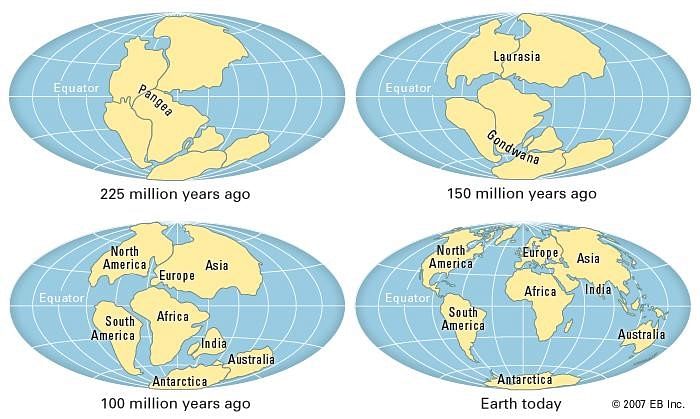
Various Stages of Continental Drift Theory
Continental Drift Theory
- Continental Drift: The movement of continents across the ocean bed is known as continental drift. This drifting takes millions of years to complete this process.
- Continental drift theory was given by Alfred Wegener in 1915. This theory has explained the origin of continents and ocean basins.
- However, it was a Dutch cartographer, Abraham Ortelius, who was the first to work on the concept of symmetrical coasts on the Atlantic Ocean's sides.
- According to Wegener, all the continents formed a single continental mass which is called “Pangaea'' which means all earth. This supercontinent was surrounded by a mega ocean called “Panthalassa '' meaning all water.
- Subsequently, Laurasia and Gondwanaland continued to break into various smaller continents that exist today. Thus, Wegener proposed that continents are floating and constantly drifting on the earth’s surface.
- His hypothesis, later on, became the basis of present-day plate tectonic theory.
|
|
|
|---|---|
| Divisions of the Ocean Floor | Convectional Current Theory |
| Concept of Seafloor Spreading | Plate Tectonic Theory |

Various Stages of Continental Drift Theory
- First Stage: The first stage occurred during the Carboniferous period, when Pangea, a supercontinent, was encircled by Panthalassa, a mega-ocean.
- Second Stage: In the second stage around 200 million years ago in the Jurassic period, the supercontinent, Pangaea, began to split. Pangaea first broke into large continental masses as Laurasia and Gondwanaland formed the northern and southern components respectively.
- Third Stage: In the third stage, the Tethys Sea progressively filled the area between Laurasia and Gondwanaland during the Mesozoic epoch, and it gradually broadened.
- Fourth Stage: In the fourth stage around 100 million years ago when North and South America drifted westward, resulting in the emergence of the Atlantic Ocean. The Rockies and Andes were formed by the westward drift of North and South America.
- Orogenetic Stage: The Orogenetic Stage in which mountain-building activity took place is the fifth stage.
Note: The Himalayas and Alps were constructed by the folding of Tethys Sea deposits.
Forces Responsible for Continental Drift
There are two factors that are responsible for continental drift which is as follows:
- The continental drift was equatorward due to the combined action of gravitational forces, pole-fleeing force, and buoyancy force because the planet is not perfectly round and has a bulge at the equator.
- Note: The 'pole-fleeing force' is caused by an increase in centrifugal force from the poles towards the equator.
- The continental drift was westward due to tidal currents caused by the earth's rotation.
- However, these two factors were eventually discovered to be insufficient reasons for continent drifting, which is considered a criticism of Wegener's theory.
Evidence Supporting Continental Drift Theory
Alfred Wegener provided some evidence to support his theory, which is mentioned below:
- The Matching of Continents (Jig-Saw-Fit): When facing one another, the shorelines of South America and Africa form a similarity. Similarly, when matched, Africa, Madagascar, and India's east coast all fit together.
- Rocks of Same Age Across the Oceans: Radiometric dating techniques have been used to correlate rock development across continents. It suggests that the 2,000 million-year-old strip of ancient rocks off the coast of Brazil corresponds to the mountain ranges of Western Africa.
- Similarities can also be found between the Caledonian and Appalachian mountains.
- It also implies that the early marine deposits along Africa's and South America's coastlines date from the Jurassic period, implying that the ocean did not exist before then.
- Tillite: Tillite is a type of sedimentary rock formed by glacier deposits. The Gondwana system of sediments from India has been discovered to have parallels in six different landmasses of the Southern Hemisphere, including Africa, the Falkland Islands, Madagascar, Antarctica, Australia, and India. It reveals that the antiquity of both landmasses was strikingly similar.
- Placer Deposits: Gold placer deposits can be discovered along the Ghana coast (West Africa). However, there is no source rock in the immediate vicinity. The fact that gold-bearing veins may be found in Brazil is incredible.
- When the two continents are laid side by side, it appears that Ghana's gold reserves are sourced from the Brazil plateau.
- Distribution of Fossils: Identical species and animals were found on both sides of the marine barrier. For example, Mesosaurus, a freshwater crocodile-like reptile that lived between 286 and 258 million years ago, is only found in Southern Africa and Eastern South America.

Fossils remain across different continents supporting the continental drift theory
Criticisms of Continental Drift Theory
- Wegener discusses how buoyancy, tidal currents, and gravity all play a role. These, however, were insufficient to move continents.
- He favors westward or equatorial travel, but movements have occurred in all directions.
- Alfred Wegener was unable to explain the pre-carboniferous period of time. He didn't say why the drift started in the Mesozoic era and not earlier.
- Oceans were not taken into account in the theory.
- Oceanic ridges and Island arcs were not explained by the idea.
- Large-scale motions are thought to be impossible due to the rigidity of the Earth's crust.
- Wegener's theories failed to provide a convincing mechanism for supporting the displacement of bigger masses during long voyages.
Conclusion
The Continental Drift Theory was rejected by the majority of scientists, and it was intensely disputed for decades following his death in 1930. The concept of conventional currents in the upper mantle was conceived in the 1920s. However, due to his early death, Alfred Wegener was unable to add the concept of conventional currents as the most compelling rationale for continental movement. Although the Continental Drift theory is no longer valid, the central premise of the theory was the driving force behind all subsequent modern hypotheses, such as plate tectonics and seafloor spreading.
|
|
|
|---|---|
| Geography Notes | Physical Geography |
| Geomorphology | Different Layers of the Earth |
| Geomorphic Processes | Minerals and Rocks |
FAQs
Question: What is the Continental Drift Theory?
Answer: The Continental Drift Theory was proposed by Alfred Wegener in 1912 and suggests that all continents were once part of a supercontinent called Pangaea, which gradually broke apart and drifted to form the current continents.
Question: What evidence supports the Continental Drift Theory?
Answer: Evidence supporting the theory includes fossil records, geological formations, and paleoclimatic data, all indicating that continents were once connected.
Question: What was the main reason for the initial rejection of the Continental Drift Theory?
Answer: The main reason for the initial rejection of the theory was Wegener’s inability to explain the mechanism behind the drift, as his hypothesis of centrifugal forces and tidal pull was not convincing to the scientific community.
Question: How did the discovery of seafloor spreading support the Continental Drift Theory?
Answer: The discovery of seafloor spreading in the 1960s provided a mechanism for the movement of continents, supporting Wegener’s idea that continents drifted apart over millions of years.
Question: What are Laurasia and Gondwana in the context of the Continental Drift Theory?
Answer: Laurasia and Gondwana were the two large landmasses formed after the breakup of Pangaea. These landmasses further fragmented to form the continents we know today.
MCQs
1. Who proposed the Continental Drift Theory?
A. Charles Darwin
B. Alfred Wegener
C. Isaac Newton
D. Harry Hess
Answer: (B) See the Explanation
The Continental Drift Theory was proposed by Alfred Wegener in 1912, suggesting that continents were once part of a single landmass called Pangaea.
2. What was the name of the supercontinent in the Continental Drift Theory?
A. Gondwana
B. Laurasia
C. Pangaea
D. Eurasia
Answer: (C) See the Explanation
Pangaea was the name of the supercontinent that existed around 200 million years ago, as proposed by the Continental Drift Theory.
3. What type of evidence supports the Continental Drift Theory?
A. Fossil records
B. Temperature data
C. Ocean currents
D. Wind patterns
Answer: (A) See the Explanation
Fossil records provide evidence for the Continental Drift Theory, as identical species have been found on continents now separated by oceans, indicating that these landmasses were once connected.
4. Which theory provided a mechanism that supported the Continental Drift Theory?
A. Quantum Theory
B. Seafloor Spreading
C. Darwin’s Theory of Evolution
D. Relativity Theory
Answer: (B) See the Explanation
The discovery of Seafloor Spreading in the 1960s provided the mechanism that supported Wegener’s Continental Drift Theory, explaining how continents drift apart over time.
5. What are Laurasia and Gondwana?
A. Ancient oceans
B. Two major landmasses formed after the breakup of Pangaea
C. Early human civilizations
D. Types of rocks
Answer: (B) See the Explanation
Laurasia and Gondwana were the two large landmasses formed after the breakup of Pangaea, which later fragmented to form the present-day continents.
GS Mains Questions and Model Answers
Q1: Discuss the significance of Alfred Wegener’s Continental Drift Theory in understanding the evolution of Earth’s continents.
Answer: Alfred Wegener’s Continental Drift Theory was groundbreaking in understanding the evolution of Earth's continents. Proposed in 1912, the theory suggested that all continents were once part of a supercontinent called Pangaea, which gradually drifted apart. Wegener’s hypothesis was supported by fossil evidence, geological formations, and paleoclimatic data, but it lacked a mechanism for explaining the drift. The theory laid the foundation for the later development of Plate Tectonics, which provided a robust explanation for the movement of continents through seafloor spreading and tectonic plate interactions. This theory revolutionized Earth sciences and explained various geological phenomena such as the formation of mountains, earthquakes, and volcanic activity.
Q2: Analyze the evidence supporting the Continental Drift Theory and its importance in the development of modern plate tectonics.
Answer: Several lines of evidence support the Continental Drift Theory, including fossil records, which show identical species on continents now separated by oceans, indicating they were once connected. Geological evidence, such as the matching mountain ranges in South America and Africa, further supports this idea. Additionally, paleoclimatic data, such as coal deposits found in Antarctica, suggest that these landmasses were once in different climatic zones. This evidence was critical in developing the Plate Tectonics Theory, which provided the mechanism of seafloor spreading and plate movements, offering a comprehensive understanding of how continents drift over geological time.
Q3: Evaluate the challenges faced by Alfred Wegener in gaining acceptance for his Continental Drift Theory. How was his theory eventually validated?
Answer: Alfred Wegener faced significant challenges in gaining acceptance for his Continental Drift Theory due to the lack of a convincing mechanism for how continents could move. His explanation, which involved centrifugal forces and tidal pull, was not accepted by the scientific community at the time. Additionally, his background as a meteorologist made it difficult for geologists to take his ideas seriously. However, with the discovery of seafloor spreading in the 1960s, the theory gained validation. The development of Plate Tectonics Theory provided a robust mechanism, explaining that continents drift due to the movement of tectonic plates, driven by mantle convection. This shift in understanding made Wegener’s theory a cornerstone of modern geology.
Previous Year Questions on Continental Drift Theory
1. UPSC CSE Prelims 2019
Question: What evidence supports Alfred Wegener’s Continental Drift Theory?
A. Fossil records
B. Solar radiation patterns
C. Magnetic anomalies
D. Ocean currents
Answer: A
Explanation: Fossil records are one of the main pieces of evidence supporting Wegener’s Continental Drift Theory, as identical fossils have been found on continents that are now widely separated by oceans.
Download the PREPP App and attempt FREE IAS Exam Mock Tests and get complete study material!

Full Test - 04: UPSC CSE Prelims CSAT (Paper-II)
Full Test - 03: UPSC CSE Prelims CSAT (Paper-II)
UPSC CSE Prelims 2026 GS Paper 1 Question Paper (24-May-2026)
UPSC CSE Prelims 2026 CSAT Paper 2 Question Paper (24-May-2026)

17 February 2025 | The Hindu Must Read Articles | Current Affairs

16 February 2026 | The Hindu Must Read Articles | Current Affairs

13 February 2026 | The Hindu Must Read Articles | Current Affairs









Comments