Types of Rocks - Minerals and Rocks - Geography Notes
A rock is a solid combination of minerals. The earth’s crust is made up of rocks that are different from one another in texture, structure, colour, permeability, mode of occurrence, and degree of resistance to denudation. Feldspar and quartz are the most common minerals found in rock. There are three main types of rocks: igneous, sedimentary, and metamorphic rocks. In this article, we will learn about types of rocks which is part of Geomorphology, an integral part of the Geography Syllabus.
|
Table of Contents |
What exactly are Rocks?
- Two or more minerals are combined together through geological processes to form rocks.
- It is categorized by the minerals & chemical composition and the way in which it is formed.
- Rocks can be hard or soft, and they come in a variety of colours.
- Rocks form the basis for soil, to some extent determine the type of natural vegetation and land use.
- Rocks occupy most of the terrain and there is a close relationship between rock and terrain.
- The most prevalent minerals found in all types of rocks are feldspar and quartz.
- The science dealing with the study of rocks is called Petrology.
|
|
|
|---|---|
| Igneous Rocks | Rock Cycle |
| Sedimentary Rocks | Metamorphic Rocks |
Types of Rocks
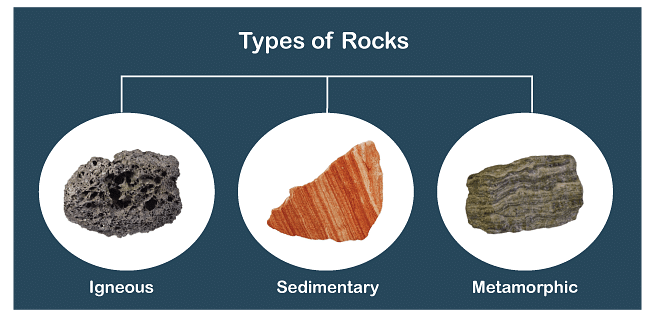
- There are many distinct types of rocks, which are classified into three categories based on their way of development. They are:
- Igneous Rocks — solidified from magma and lava
- Sedimentary Rocks — formed due to deposition of rock fragments by exogenous processes
- Metamorphic Rocks — formed from existing rocks undergoing recrystallization
Igneous Rocks
- Igneous rocks are referred to as primary rocks since they are generated from magma and lava from the earth's interior.
- When magma cools and solidifies igneous rocks (Ignis in Latin means "fire") form.
- They can form above ground when magma erupts as lava from a volcano.
- They can also form deep below the Earth's crust and then be exposed at the surface by the erosion of the underlying rocks. Igneous rocks include crystals with angular forms.
- They have not been eroded or squashed like sedimentary or metamorphic rocks.
- Their mineral content and texture — the size and form of their mineral grains — distinguish them.
- The pace of cooling determines texture: magma that cools slowly deep within the Earth makes rock with massive crystals, whereas lava that cools quickly on the surface forms fine-grained rock.
- The majority of igneous rocks are exceptionally hard and resistant to erosion.
- They are quarried for road building and polished as monuments and gravestones.
- Because igneous rocks are formed from super-heated magmatic elements, they do not contain fossils.
- Igneous rocks include granite, gabbro, pegmatite, basalt, volcanic breccia, and tuff, to name a few.

Igneous Rocks
Types of Igneous Rocks
Extrusive Rocks (Volcanic Rocks)
- When magma escapes and cools above (or very near) the Earth's surface, extrusive or volcanic igneous rock is formed.
- These are the rocks that emerge when volcanoes erupt and crevices ooze.
- When exposed to the relatively cool temperature of the atmosphere, magma, also known as lava molten rock erupts on the surface, cools and solidifies practically instantaneously.
- Because mineral crystals don't have much time to form because to the rapid cooling, these rocks have a highly fine-grained or even glassy structure.
- Hot gas bubbles are frequently trapped in quenched lava, resulting in a bubbly, vesicular texture.
- Extrusive igneous rocks include pumice and basalt.
Intrusive Rocks (Plutonic Rocks)
- When magma is imprisoned deep within the Earth, intrusive, or plutonic, igneous rock occurs. Massive globs of molten rock rise to the surface.
- Some of the magma may fuel volcanoes on Earth's surface, but the majority remains trapped below, where it slowly cools over decades or millions of years until it hardens.
- Because of the slow cooling, the individual mineral grains have a very long time to grow, allowing them to grow to a reasonably enormous size.
- Intrusive rocks are often coarse-grained and highly hard in nature.
- Intrusive igneous rocks include gabbro and granite.
Sedimentary Rocks
- Sedimentary rocks develop from previously existing rocks or fragments of once-living organisms.
- They occur as a result of deposits accumulating on the Earth's surface. Layering or bedding in sedimentary rocks is common.
- Some form when rock and mineral particles settle out of water or air. Others occur when minerals precipitate out of water directly.
- Minerals and texture distinguish sedimentary rocks.
- Many of the scenic views of the desert southwest feature mesas and arches formed by layered sedimentary rock.
- Water is forced out by the weight of the overlying pile as the sediments build up, and minerals precipitate around the sediment particles, cementing them into rock. This is known as lithification.
- They have a layered or stratified structure as a result of successive depositions and are so-known as Stratified Rocks.
- Classification of sedimentary rocks is done according to their age and different kinds of rocks formed during the same period are grouped together.
- Most of the solid surface of our planet (roughly 70%) is represented by sedimentary rocks.
- Sandstone, Limestone, and Shale are some examples of sedimentary rocks.

Sedimentary Rocks
Types of Sedimentary Rocks
- Mechanically Formed
- Organically Formed
- Chemically Formed
Mechanically Formed Sedimentary Rocks
- Mechanical agents such as moving water, wind, ocean currents, ice, and so on shape them.
- Arenaceous sedimentary rocks are hard and permeable, with more sand and larger particles. For example, sandstone.
- More clay is found in argillaceous rocks, which are fine-grained, softer, and mainly impermeable (mostly non-porous or have very tiny pores).
- Claystone and shales, for example, are mostly argillaceous.
Organically Formed Sedimentary Rocks
- The formation of these rocks is due to the buildup of living creatures such as corals and shellfish.
- There is a lot of organic stuff in these rocks.
- The most well-known calcareous rocks, such as Chalk, are created in this manner.
- Carbonaceous rocks, on the other hand, are created organically, but from vegetative matter.
- Geyserite, chalk, limestone, coal, etc. are some examples of organically formed sedimentary rocks.
Chemically Formed Sedimentary Rocks
- When standing water evaporates, leaving dissolved minerals behind, many of these forms.
- Mineral components in the solution become supersaturated and inorganically precipitate, forming sedimentary rocks.
- Chemically produced sedimentary rocks include chert, limestone, halite, potash, and others.
Metamorphic Rocks
- The term "metamorphic" refers to a change in form.
- When rocks are subjected to high heat, high pressure, hot mineral-rich fluids, or, more typically, some combination of these variables, metamorphic rocks develop.
- Such conditions can be encountered deep within the Earth or where tectonic plates collide.
- The minerals and texture of these rocks help to identify them.
- New minerals grow during metamorphism, having different sizes, shapes, and orientations than the initial minerals.
- The chemical composition of the original rock may also alter as fluids moving through the rocks carry away some elements and add others.
- Metamorphosis happens when tectonic processes move rocks to lower levels or when molten magma rising through the crust comes into touch with crustal rocks.
- Metamorphism does not melt rocks but rather converts them into denser, more compact rocks.
- New minerals are formed either by mineral component rearrangement or through interactions with fluids that enter the rocks.
- Even previously metamorphosed rocks can undergo changes due to pressure or temperature.
- Squished, smeared out, and folded metamorphic rocks are common.
- Some rocks' grains or minerals are arranged in layers or lines during metamorphism. Foliation or lineation is the term for this type of layout.
- Minerals or materials from several groups are sometimes placed in alternating thin and thick layers. Banding is a term for construction like this.
- Metamorphic rocks include gneissic, slate, schist, marble, quartzite, and others.

Metamorphic Rocks
Types of Metamorphic Rocks
- Thermal Metamorphism
- Dynamic Metamorphism
Thermal Metamorphism
- Thermal Metamorphism is the process of changing from one state to another.
- Thermal metamorphism is the change in form or re-crystallization of minerals in sedimentary and igneous rocks caused by high temperatures.
- The peak of Mount Everest, which is made up of metamorphosed limestone, was formed by a magmatic intrusion that caused thermal metamorphism.
- Sandstone becomes quartzite and limestone becomes marble as a result of thermal metamorphism.
Dynamic Metamorphism
- Dynamic Metamorphism is a type of metamorphism that occurs over time.
- The formation of metamorphic rocks under high pressure is known as dynamic metamorphism
- High pressure is sometimes accompanied by high temperatures and chemically charged liquids.
- Metamorphism is a powerful process that occurs when directed pressure and heat combine to induce more or less complete recrystallization of rocks and the formation of new structures.
- Dynamo thermal metamorphism is the term for this process.
Conclusion
These rocks, beyond their geological significance, also provide insights into India's rich mineral resources, landform development, and geological hazards. Each rock, whether formed from magma, accumulated sediments, or transformational pressures, tells a unique story of our planet's ever-changing nature.
|
|
|
|---|---|
| Geography Notes | Physical Geography |
| Geomorphology | Different Layers of the Earth |
| Distribution of Oceans and Continents Basins | Minerals and Rocks |
FAQs
Q1: What are the three major types of rocks?
Answer: The three major types of rocks are Igneous rocks, Sedimentary rocks, and Metamorphic rocks.
Q2: How are igneous rocks formed?
Answer: Igneous rocks are formed from the cooling and solidification of magma or lava. They are classified into intrusive (formed inside the Earth’s surface) and extrusive (formed on the Earth’s surface).
Q3: What is the difference between sedimentary and metamorphic rocks?
Answer: Sedimentary rocks are formed by the accumulation and compaction of sediments, while metamorphic rocks are formed by the transformation of existing rocks under heat and pressure.
Q4: What are some examples of igneous rocks?
Answer: Common examples of igneous rocks include granite, basalt, and pumice.
Q5: How are sedimentary rocks classified?
Answer: Sedimentary rocks are classified into three types: Clastic (formed from mechanical weathering debris), Chemical (formed from dissolved minerals), and Organic (formed from the remains of plants and animals).
MCQs
- Which type of rock is formed from the cooling and solidification of magma?
a) Igneous
b) Sedimentary
c) Metamorphic
d) None of the above
Answer: (A) See the Explanation
Igneous rocks are formed from the cooling and solidification of molten rock, either magma (below the surface) or lava (above the surface).
- What is the primary agent in the formation of sedimentary rocks?
a) Heat
b) Sedimentation
c) Pressure
d) Melting
Answer: (B) See the Explanation
Sedimentary rocks are formed from sediments that accumulate and compact over time, which is why sedimentation is the primary process involved.
- Which of the following is an example of a metamorphic rock?
a) Limestone
b) Granite
c) Marble
d) Basalt
Answer: (C) See the Explanation
Marble is a metamorphic rock that forms when limestone is subjected to heat and pressure.
- What is the main characteristic of extrusive igneous rocks?
a) They have large crystals
b) They form inside the Earth's surface
c) They have fine grains due to rapid cooling
d) They are formed under high pressure
Answer: (C) See the Explanation
Extrusive igneous rocks, like basalt, form when lava cools quickly on the Earth’s surface, resulting in fine grains.
- Which process is responsible for the formation of metamorphic rocks?
a) Melting and cooling
b) Weathering and erosion
c) Heat and pressure
d) Compaction and cementation
Answer: (C) See the Explanation
Metamorphic rocks are formed when existing rocks are transformed due to exposure to intense heat and pressure.
GS Mains Questions and Model Answers
Q1. Discuss the processes involved in the formation of sedimentary rocks.
Answer: Sedimentary rocks are formed through the accumulation and compaction of sediments over time. This process typically begins with weathering, where rocks are broken down into smaller particles. These particles are then transported by agents like water, wind, and ice in a process known as erosion. The sediments eventually settle in layers, often in water bodies, through deposition. Over time, the accumulated layers undergo compaction and cementation, where mineral crystals bind the sediments together to form solid rock. Sedimentary rocks are classified as clastic, chemical, or organic based on their origin and composition.
Q2. Explain the difference between intrusive and extrusive igneous rocks, with examples.
Answer: Intrusive igneous rocks form when magma cools slowly beneath the Earth’s surface, leading to the formation of large crystals. An example of intrusive igneous rock is granite. On the other hand, extrusive igneous rocks form when lava cools quickly on the Earth’s surface, resulting in fine-grained textures. Basalt is an example of extrusive igneous rock. The cooling rate is the key factor that determines the texture and crystal size of these rocks.
Q3. Describe how metamorphic rocks are formed and provide examples.
Answer: Metamorphic rocks are formed from the transformation of pre-existing rocks due to exposure to high temperatures, pressure, or chemically active fluids. This process, called metamorphism, alters the mineral composition and texture of the rock without melting it. For example, limestone transforms into marble under heat and pressure, and shale becomes slate. The degree of metamorphism can vary, resulting in different rock types with distinct characteristics.
Previous Year Questions on types of rocks
1. UPSC CSE Prelims 2016
Question. Which of the following is a sedimentary rock?
Answer: Limestone
Explanation: Limestone is a common sedimentary rock primarily composed of calcium carbonate (CaCO₃). It forms in marine environments through the accumulation of shell, coral, algal, and fecal debris, or through direct chemical precipitation from water. Over time, these sediments undergo compaction and cementation, turning into solid rock. Sedimentary rocks like limestone are formed in layers and often contain fossils, which provide valuable information about past environmental conditions and life forms. Sedimentary rocks are crucial in geological studies because they help scientists understand the Earth’s history, including changes in climate, sea levels, and biological evolution. Limestone is extensively used in the construction industry and for producing cement. Its formation is typically associated with shallow, warm, marine environments, where organisms like corals and mollusks thrive. Understanding sedimentary rocks like limestone is important for UPSC aspirants because such questions often appear in both the Prelims and Mains exams, testing knowledge of earth sciences and geography.
2. UPSC CSE Mains 2017
Question. Which type of rock is marble formed from?
Answer: Marble is a metamorphic rock formed from limestone.
Explanation: Marble is a metamorphic rock that forms when limestone is subjected to high temperatures and pressures, typically deep within the Earth's crust. During this process, known as metamorphism, the original carbonate minerals in the limestone recrystallize to form a denser, more crystalline structure. Marble’s fine texture and attractive appearance make it highly valued as a building and sculptural material. The transformation from limestone to marble results in a change in texture, hardness, and appearance. Marble is often used in construction and art, especially for sculptures and monuments. Famous structures like the Taj Mahal and the Parthenon have used marble extensively. From a geological perspective, understanding metamorphic rocks like marble is essential for grasping the broader concepts of rock cycle and mineralogical changes. The UPSC syllabus often includes questions about rock types, their formation processes, and their significance in understanding Earth's geological history, making such topics highly relevant for both Prelims and Mains.
Download the PREPP App and attempt FREE IAS Exam Mock Tests and get complete study material!

Full Test - 04: UPSC CSE Prelims CSAT (Paper-II)
Full Test - 03: UPSC CSE Prelims CSAT (Paper-II)
UPSC CSE Prelims 2026 GS Paper 1 Question Paper (24-May-2026)
UPSC CSE Prelims 2026 CSAT Paper 2 Question Paper (24-May-2026)

17 February 2025 | The Hindu Must Read Articles | Current Affairs

16 February 2026 | The Hindu Must Read Articles | Current Affairs

13 February 2026 | The Hindu Must Read Articles | Current Affairs









Comments