Major Minerals - Minerals and Rocks - Geography Notes
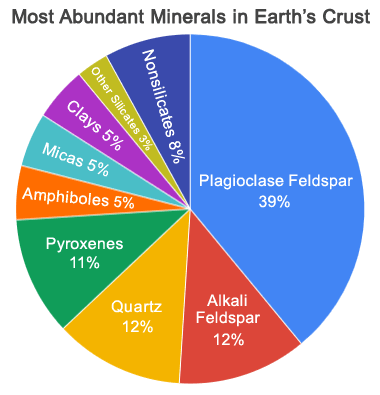
Major minerals are the minerals that are found abundantly in the Earth’s crust. The Earth's crust is made up of eight primary elements: oxygen, silicon, aluminium, iron, calcium, sodium, potassium, and magnesium, which account for 98% of its mass.
The remaining 2% consists of trace elements such as titanium, hydrogen, phosphorus, sulfur, carbon, etc. These elements are mostly found in mixed states with other elements to form compounds, referred to as minerals. Major minerals also include fossil fuels consisting of coal, lignite, petroleum, and natural gas, as well as metallic and non-metallic minerals. In this article, we will discuss Major Minerals that will be helpful for UPSC/IAS exam preparation.
|
Table of Contents |
What exactly are Major Minerals?
- This mineral can also be defined as a naturally occurring organic or inorganic material with certain chemical and physical features.
- Minerals can have two or more elements in their composition.
- However, some minerals, such as sulphur, copper, silver, gold, graphite, and others, are made up of single elements.
- Approximately 2,000 minerals have been named so far, although the majority of these minerals are composed of six major mineral groupings known as major rock-building minerals.
|
|
|
|---|---|
| Non Metallic Minerals | Metallic Minerals |
| Types of Rocks | Igneous Rocks |
| Sedimentary Rocks | Metamorphic Rocks |
Major Minerals
Bauxite Ore (Aluminium)
- Used in the metallurgical and chemical industries as a raw material for construction and road aggregates.
- The main states with bauxite deposits are Orissa, Andhra Pradesh, and Chhattisgarh, the East Coast Bauxite deposits of Orissa and Andhra Pradesh contain the majority of the reserves.
- Guinea has the largest bauxite reserves in the world.
- Australia, Guinea, and China are some of the dominant countries in the production of bauxite mines.

Bauxite Ore (Aluminium)
Copper
- Copper is an easily malleable base metal and is often added to precious metals to improve elasticity, flexibility, hardness, color, and corrosion resistance.
- Along with copper, gold is one of the most frequently alloyed metals.
- It is also used in electrical components for wiring.
- Chile has the largest copper reserves in the world, followed by Peru and China.
- The districts of Singhbhum (Jharkhand), Balaghat (Madhya Pradesh), Jhunjhunu (Jharkhand) and Alwar (Rajasthan) all have major copper ore resources.

Copper
Gold
- Gold is widely used in dentistry and medicine along with electronics and jewelry.
- Kolar Gold Fields in Kolar district, Hutti Gold Field in Raichur district (both in Karnataka), and Ramgiri Gold Field in Anantapur district (Andhra Pradesh) are the three most prominent goldfields in the country.
- China is the largest producer of Gold in the world followed by Australia and Russia.

Gold
Iron Ore
- The main use of iron ore is in the production of iron.
- Most of the iron produced is then used to make steel.
- Steel is used in the manufacture of cars, locomotives, ships, building stanchions, furniture, paper clips, tools, rebar, bicycles, and thousands of other items.
- The Bailadila sector of Chhattisgarh, and to a lesser extent the Bellary-Hospet area of Karnataka, the Barajamda sector in Jharkhand and Orissa, have very high-grade ore.
- Australia is the largest producer followed by Brazil and China.

Iron Ore
Lead-Zinc
- Lead is widely used in automotive batteries, pigments, ammunition, and cable coatings, whereas the industrial use of zinc is an electroplating process that prevents rust on steel and iron.
- Rajasthan, West Bengal, Andhra Pradesh, Gujarat, Madhya Pradesh, Uttar Pradesh, Orissa, Maharashtra, Meghalaya, Tamil Nadu, and Sikkim all have lead-zinc resources.
- Zinc is mined in more than 50 countries, with Canada being the main producer, followed by Russia, Australia, Peru, United States, and China.

Lead Zinc
Manganese
- Manganese is used in the production of clear glass, desulfurization, deoxidation of steel in steel production, and reduction of the octane number of gasoline.
- It is also used as a black-brown pigment for paints and as a filler for dry batteries.
- Karnataka has the largest reserves, followed by Orissa, Madhya Pradesh, Maharashtra, and Goa.
- Manganese is found in small amounts in Andhra Pradesh, Jharkhand, Gujarat, Rajasthan, and West Bengal.
- South Africa, China, and Australia are significant producers of manganese.

Manganese
Diamond
- Diamond is considered the hardest non-metal in the world and is used to cut metal and glass.
- Diamonds are also used to heat sinks, which are used to draw heat from sensitive parts of microelectronics.
- The Panna belt in Madhya Pradesh, the Muntimadugu-Banganapalle conglomerate in Kurnool district, the Wajrakarur Kimberlite pipe in Anantapur district, and the Krishna river basin gravels in Andhra Pradesh are the main diamond-bearing locations in India.
- Russia is the key producer of diamonds in the world followed by Botswana and Australia.

Diamond
Limestone
- It is majorly used as a building material.
- It is used to make cement by heating limestone powder with clay.
- It is an important ingredient in toothpaste.
- Limestone is also used to remove impurities from steel-making blast furnaces.
- Madhya Pradesh, Chhattisgarh, Andhra Pradesh, and Gujarat produce the majority of limestone.
- China represents the largest producer of limestone in the world followed by the United States and India.

Limestone
Mica
- The main use of sheets and block mica is in the electrical insulation of electronic devices.
- It is also used for foundations as a filler for cement and asphalt.
- Its shiny, glittery look makes it the ultimate toothpaste and cosmetic.
- India is the world's largest sheet mica producer, accounting for over 60% of worldwide mica trade.
- Andhra Pradesh, Jharkhand, Bihar, and Rajasthan have significant mica-bearing pegmatite deposits.
- China and Finland are major mica producing countries in the world.

Mica
Magnesite
- Magnesite is used as a refractory material, as a catalyst and filler in the production of synthetic rubber, and as a material in the production of magnesium chemicals and fertilizers.
- Magnesite is found in large quantities in Uttaranchal, Tamil Nadu, and Rajasthan, with smaller amounts in Jammu and Kashmir, Karnataka, Himachal Pradesh, and Kerala.
- Russia is the major producer followed by China and Slovakia.

Magnesite
Feldspar
- The most common elements in all types of feldspar are oxygen and silicon.
- Sodium, potassium, calcium, aluminum, etc. are found in different varieties of feldspar.
- It is the most abundant mineral group on Earth.
- Its color ranges from light cream to salmon pink.
- It is mostly used for ceramics and glass-making industries.

Feldspar
Quartz
- Granite and sand contain quartz as one of their major constituents.
- It is a very hard mineral consisting of silica.
- It is mostly used in communication equipment like radio and radar.
- It can also be used in forming glass.
- It is also used as an abrasive.
- It is also used in Petroleum industries.
- It is an important component of Sand Granite.

Quartz
Pyroxene
- Pyroxene comprises aluminum, iron, calcium, magnesium, and silica.
- It is present in the quantity of 10 percent of the total crust of the earth.
- It is usually found in meteorites.
- It generally occurs in green or black color.

Pyroxene
Amphibole
- The main elements of amphiboles are calcium, iron, aluminum, silica, and magnesium.
- It covers 7% of the total crust of the earth.
- It is generally green or black colour.
- Its main uses are in the asbestos industry.
- Amphiboles can also be found in the Hornblende form.

Amphibole
Olivine
- The main elements of olivine are magnesium, iron, and silica.
- It is mostly used in the jewelry and fashion industry.
- It generally occurs in a greenish crystal form.
- It is found in basaltic rocks.

Olivine
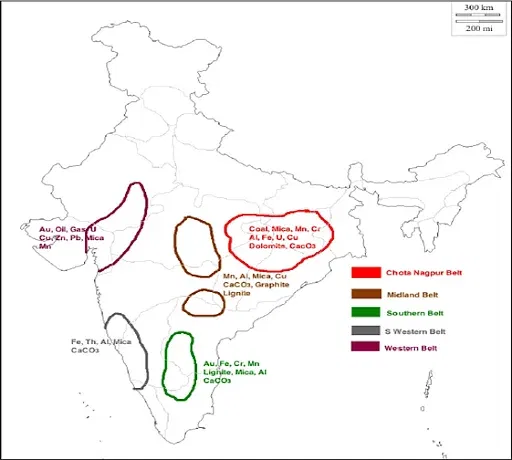
Major Mineral Belts in India
Minerals are generally concentrated in three broad belts in India, which are:
The North-Eastern Plateau Region
- This belt covers the area of Chotanagpur (Jharkhand), Orissa Plateau, West Bengal, and parts of Chhattisgarh.
- The North-Eastern region is rich in a variety of minerals like iron ore, coal, manganese, bauxite, and mica.
The South-Western Plateau Region
- The southwestern region covers major parts of Karnataka, Goa, Tamil Nadu uplands, and Kerala.
- This belt contains high-grade iron ore, manganese, and limestone, as well as ferrous metals and bauxite.
The North-Western Region
- The north-western region extends along Aravali in Rajasthan and parts of Gujarat.
- The minerals are associated with the Dharwar system of rocks.
- Rajasthan is rich in building rocks whereas Gujarat is known for its petroleum deposits.
- Copper, lead, zinc, and cobalt are all found in the Himalayan belt, which is found on both the eastern and western sides.
Conclusion
Due to its diverse geological structure, India is blessed with a diverse range of mineral resources. The majority of precious minerals are found in peninsular India's metamorphic and igneous rocks. The vast alluvial plains of north India are devoid of economically valuable minerals. Mineral resources offer the required foundation for the country's industrial development. Minor minerals, particularly dimensional and ornamental stones, have risen to prominence as a significant contribution to mineral production and exports.
|
|
|
|---|---|
| Geography Notes | Physical Geography |
| Geomorphology | Different Layers of the Earth |
| Distribution of Oceans and Continents Basins | Minerals and Rocks |
FAQs
Question: What are major minerals?
Answer: Major minerals are those minerals that are found in significant quantities and are economically valuable. They are essential for various industries and are crucial for the economy. In India, major minerals include iron ore, bauxite, coal, manganese, copper, and limestone, among others. These minerals play a vital role in infrastructure development, manufacturing, and energy production, contributing significantly to the country's industrial base.
Question: What is the classification of minerals?
Answer: Minerals are primarily classified into two categories:
- Metallic Minerals: These minerals contain metals in their raw form. Examples include iron, copper, and bauxite. They are typically used in construction, manufacturing, and technology.
- Non-Metallic Minerals: These do not contain metals and are used for industrial purposes. Examples include limestone, marble, and gypsum. They are commonly used in the production of cement, glass, and fertilizers.
Question: How are rocks classified?
Answer: Rocks are classified into three main types based on their formation processes:
- Igneous Rocks: Formed from the solidification of molten magma. Examples include granite and basalt.
- Sedimentary Rocks: Formed from the accumulation of sediments. They often contain fossils. Examples include sandstone and limestone.
- Metamorphic Rocks: Formed from the alteration of existing rocks due to heat, pressure, or chemical processes. Examples include marble (from limestone) and schist.
Question: What are the economic uses of major minerals?
Answer: Major minerals have diverse economic uses, including:
- Iron Ore: Primarily used in steel manufacturing.
- Coal: Used as a primary energy source for electricity generation and industrial processes.
- Bauxite: The main ore of aluminum, used in the production of aluminum metal.
- Manganese: Essential in steel production and alloy manufacturing.
Question: What is the significance of mineral resources in India?
Answer: Mineral resources are significant for India’s economic development. They support the manufacturing sector, provide employment opportunities, and are crucial for infrastructure development. The availability of minerals influences the country’s economic growth and competitiveness in the global market. Additionally, minerals like coal and iron ore are vital for energy security and industrialization, making them key components in India's developmental strategy.
MCQs
1. Which of the following is a major metallic mineral?
A) Gypsum
B) Limestone
C) Iron ore
D) Mica
Answer: See the Explanation
Explanation: Iron ore is a major metallic mineral used primarily in steel manufacturing.
2. What type of rock is granite?
A) Sedimentary
B) Metamorphic
C) Igneous
D) None of the above
Answer: See the Explanation
Explanation: Granite is classified as an igneous rock, formed from the cooling and solidification of magma.
3. Which mineral is primarily used in cement production?
A) Coal
B) Bauxite
C) Limestone
D) Manganese
Answer: See the Explanation
Explanation: Limestone is primarily used in cement production and is a key non-metallic mineral.
4. What is the main use of bauxite?
A) Steel production
B) Aluminum production
C) Energy generation
D) Fertilizer manufacturing
Answer: See the Explanation
Explanation: Bauxite is the main ore of aluminum and is primarily used in aluminum production.
5. Which type of rock forms from the accumulation of sediments?
A) Igneous
B) Metamorphic
C) Sedimentary
D) None of the above
Answer: See the Explanation
Explanation: Sedimentary rocks form from the accumulation and compaction of sediments over time.
GS Mains Questions and Model Answers
Q1: Discuss the importance of major minerals in the economic development of India.
Answer: Major minerals play a critical role in India's economic development as they are fundamental to various industries. Minerals such as iron ore, coal, and bauxite are integral to the manufacturing sector, particularly in steel production and energy generation. The mining and processing of these minerals contribute significantly to GDP, provide employment opportunities, and enhance the overall industrial capacity of the country. Furthermore, the availability of mineral resources influences infrastructure development, such as roads, railways, and buildings, facilitating further economic activities. By ensuring sustainable management of these resources, India can bolster its economic growth while addressing environmental concerns.
Q2: Evaluate the impact of mineral resource extraction on the environment.
Answer: The extraction of mineral resources has significant environmental impacts that need careful management. Mining operations often lead to deforestation, soil erosion, and loss of biodiversity as land is cleared for mining activities. The disruption of ecosystems can have long-term consequences on local flora and fauna. Additionally, mining operations can result in water pollution due to the leaching of toxic substances, affecting surrounding water bodies and communities reliant on these resources for drinking water and agriculture. It is essential to adopt sustainable mining practices, including proper waste management and rehabilitation of mined areas, to mitigate these environmental effects and preserve ecological integrity.
Q3: Analyze the role of the government in the management of mineral resources in India.
Answer: The government of India plays a crucial role in the management of mineral resources through policy formulation, regulation, and oversight. The Ministry of Mines is responsible for implementing mining policies, promoting sustainable mining practices, and ensuring compliance with environmental regulations. The government also issues licenses and permits for mineral exploration and extraction, thus regulating the sector. By promoting research and development in mining technologies and facilitating investment in the sector, the government aims to enhance the efficiency of mineral resource utilization. Additionally, initiatives for the rehabilitation of mining-affected communities and the promotion of alternative livelihoods reflect the government's commitment to balanced development and social responsibility in mineral resource management.
Previous Year Questions on Major Minerals and Rocks
1. UPSC CSE Prelims 2021:
Question: Which of the following is classified as a major non-metallic mineral?
A) Iron ore
B) Manganese
C) Gypsum
D) Bauxite
Answer: (C)
Explanation: Gypsum is classified as a major non-metallic mineral used primarily in the production of plaster and cement.
2. UPSC CSE Mains 2019 (GS Paper 1):
Question: "Discuss the challenges and opportunities in mineral resource management in India." Analyze its implications for sustainable development.
Answer: Mineral resource management in India presents both challenges and opportunities. The challenges include environmental degradation due to mining activities, socio-economic impacts on local communities, and the need for regulatory compliance to ensure sustainable practices. Conversely, the opportunities lie in the potential for economic growth through responsible mineral extraction, technological advancements in mining processes, and the promotion of sustainable mining practices. By addressing the challenges through robust policy frameworks and stakeholder engagement, India can harness its mineral resources effectively while ensuring environmental protection and community welfare. This balance is crucial for achieving sustainable development goals and enhancing the long-term viability of mineral resources.
Download the PREPP App and attempt FREE IAS Exam Mock Tests and get complete study material!

Full Test - 04: UPSC CSE Prelims CSAT (Paper-II)
Full Test - 03: UPSC CSE Prelims CSAT (Paper-II)
UPSC CSE Prelims 2026 GS Paper 1 Question Paper (24-May-2026)
UPSC CSE Prelims 2026 CSAT Paper 2 Question Paper (24-May-2026)

17 February 2025 | The Hindu Must Read Articles | Current Affairs

16 February 2026 | The Hindu Must Read Articles | Current Affairs

13 February 2026 | The Hindu Must Read Articles | Current Affairs









Comments