Seismic Activity (Earthquake Waves) - Geography Notes
Seismic activity is the vibration and oscillation of the Earth’s surface. Volcanic eruptions, explosions, landslides, avalanches, and even rushing rivers can also cause seismic waves. Seismic activity or earthquake waves is one of the most important sources of information about the interior of the earth. Earthquake waves are waves of energy caused by earthquakes or an explosion. An instrument called a seismograph records the waves reaching the earth's surface which are caused by earthquakes or other sources. Seismic activity is a very important concept of the geomorphology syllabus of the UPSC exam geography syllabus. We will study the same in this article.
|
Table of Contents |

What is Seismic Activity?
- Seismic activity refers to the frequency, type, and size of earthquakes experienced over a period of time.
- The term can also refer to the array of earthquake occurrences in a specific area or globally.
- This activity is driven by the release of energy from sudden dislocations of segments of the Earth's crust, or by the eruption of volcanoes.
- The energy released radiates in all directions from its source, the focus, in the form of seismic waves.
- When these waves reach the Earth's surface, they can cause ground shaking, a phenomenon commonly associated with earthquakes.
How is Seismic Activity Measured?
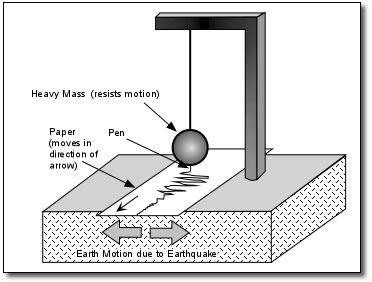
- The main equipment for measuring earthquakes is a seismograph.
- Sensitive seismographs are used in seismic monitoring to measure ground motion caused by earthquakes or other sources.
- The seismograph records the ground motion induced by seismic waves in a digital graphic format.
- The location, origin time, and magnitude (along with other properties) of earthquakes can be determined using seismograms from seismic monitoring stations.
Seismic Waves or Earthquake Waves
- Seismic waves are the vibrations or oscillations that travel through the Earth's interior and across its surface in response to various sources of energy release, such as earthquakes, volcanic activity, or human-induced events.
- These waves carry energy and information about the Earth's subsurface and are crucial for understanding the planet's interior structure, seismic activity, and geological processes.
- These seismic waves travel as vibrations through the earth. The vibrations are recorded and measured by a device known as a seismometer.
- The seismometer generates a graph called a Seismograph that depicts these vibrations. These waves travel at different speeds through various materials.
- Earthquake waves are caused by the rapid release of energy along a fault (a sharp rupture in the crustal layer).
- The force exerted on the rock layers along a fault causes them to move in opposite directions, but they are held in place by the frictional force exerted by the above rock strata.
- Over time, the pressure on the rock strata builds up and exceeds the frictional barrier, causing an abrupt movement that generates shockwaves (seismic waves) in all directions.
- Focus: The focus or hypocentre of an earthquake is the location where the energy is released.
- Epicenter: Epicenter refers to the place on the surface directly above the focus.
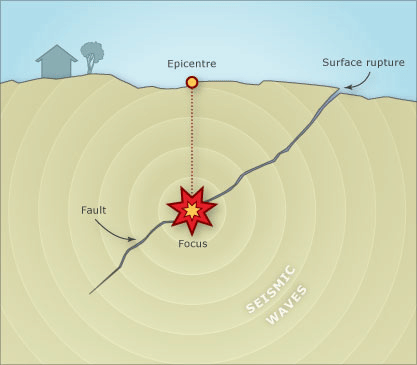
- There are two main types of Seismic Waves i.e. Body Waves and Surface Waves.
- Body waves are generated due to the release of energy at the focus and move in all directions traveling through the body of the earth.
- Surface waves are generated when body waves interact with the surface rocks. These waves move along the surface.


Body Waves
- Body waves are seismic waves that travel through the Earth's interior.
- They are generated by the sudden release of energy from events such as earthquakes, volcanic eruptions, or even man-made explosions.
- Since they move through the Earth, they are instrumental in providing information about the Earth's internal structure, including layer densities, thicknesses, and states of matter.
- By analyzing the travel times and paths of these waves, seismologists can infer a lot about the Earth's interior structure and the properties of different layers.
- The variations in the speed and direction of body waves as they interact with different materials inside the Earth help scientists construct models of the Earth's interior, including the identification of the core, mantle, and crust layers.
- There are two primary types of body waves: Primary Waves (P-waves) and Secondary Waves (S-waves)
Primary Waves (P-waves)
- They are the fastest among seismic waves and thus reach the recording instruments first.
- P-waves are compressional or longitudinal waves, which means the ground particles move in the direction of the wave propagation (similar to sound waves).
- They can travel through solid, liquid, and gaseous materials, which means they can pass through the Earth's crust, mantle, outer core, and inner core.
- When they pass through the Earth's surface, they can shake the ground in the direction of their movement, often feeling like a sudden jolt during an earthquake.
Secondary Waves (S-waves)
- They are slower than P-waves and arrive at the recording instruments after P-waves.
- S-waves are shear or transverse waves, which means the ground particles move perpendicular to the direction of wave propagation.
- They can only travel through solid materials. This characteristic of S-waves has provided critical evidence that the Earth's outer core is liquid because S-waves do not pass through it.
- They cause more intense shaking than P-waves, moving the ground up and down and side-to-side, and are generally responsible for the damage and destruction during earthquakes.

Surface Waves (L Waves)
- When body waves interact with surface rocks, a new set of waves known as surface waves is created. These waves propagate across the earth's surface.
- Surface waves are transverse waves in which particle motion is perpendicular to the propagation of the wave. As a result, they create crests and troughs in the material they pass through.
- Surface waves travel more slowly through Earth's material and are generally lower in frequency than body waves.
- Deeper earthquakes produce weaker surface waves; shallow earthquakes produce stronger surface waves.
- Wave velocity changes as they travel through different densities of materials. The higher the velocity, the denser the material.
- When they come into contact with materials of varying densities, their direction changes as they reflect or refract.
- Because they cover the greatest distances of any seismic wave, they are also known as Long Period Waves or "L" waves.
- They are the last to reach the surface of the Earth and are the most powerful and destructive seismic waves.
- Surface waves are classified into two types: Rayleigh waves and Love waves.
Rayleigh Waves
- Rayleigh waves are another type of earthquake surface wave that causes both vertical and horizontal motion of particles.
- Rayleigh waves create an elliptical, rolling motion of particles. This motion includes both vertical and horizontal components.
- Rayleigh waves travel along the Earth's surface and are typically slower than Love waves.
- Rayleigh waves can have larger amplitudes than body waves like P and S waves, contributing to ground displacement and shaking.
- The vertical motion of Rayleigh waves can cause uplift and subsidence of the ground, leading to ground cracks and surface deformations.
Love Waves
- Love waves are a type of earthquake surface wave that causes horizontal, side-to-side motion of particles parallel to the Earth's surface.
- Love waves cause particles to move in a horizontal, snake-like motion similar to the way a snake slithers across the ground.
- These waves propagate along the Earth's surface, primarily within the uppermost layers of the crust.
- Love waves can have large amplitudes, contributing to significant ground shaking during earthquakes.
- The side-to-side motion of Love waves can cause structural damage to buildings, bridges, and other infrastructure, particularly if the structures are not well-designed to withstand horizontal shaking.

Emergence of Shadow Zone

- Seismographs installed in remote regions record earthquake waves. There are, however, some regions where the waves are not reported. The 'shadow zone' is a term used to describe such a region.
- The examination of several disasters demonstrates that each earthquake has a distinct shadow zone.
- It was discovered that seismographs placed within 105 degrees of the epicenter recorded both P and S-wave arrivals.
- Seismographs placed beyond 145 degrees from the epicenter, on the other hand, record the arrival of P-waves but not S-waves.
- As a result, the shadow zone for both types of waves was found as a zone between 105° and 145° from the epicenter.
Seismic Zones in India
- India is one of the most earthquake-prone countries because of the existence of technically active young fold mountains in the Himalayas.
- The Bureau of Indian Standards has grouped the country into four seismic zones viz. Zones-II, III, IV, and V.
- Zone V is the most seismically active region while Zone II is the least.
- The Modified Mercalli (MM) intensity, which measures the impact of the earthquakes on the surface of the earth, broadly associated with various zones is as follows:

| Seismic Zone Intensity | On MM Scale |
|---|---|
| II (Low intensity zone) | VI (or less) |
| III (Moderate intensity zone) | VII |
| IV (Severe intensity zone) | VIII |
| V (Very severe intensity zone) | IX (and above) |
- Zone-V comprises entire north-eastern India, parts of Jammu and Kashmir, Himachal Pradesh, Uttarakhand, Rann of Kutch in Gujarat, part of North Bihar and Andaman and Nicobar Islands.
- Zone-IV covers the remaining parts of Jammu and Kashmir and Himachal Pradesh, Delhi, Sikkim, the northern part of Uttar Pradesh, Bihar, West Bengal, parts of Gujarat, a small portion of Maharashtra near the west coast and Rajasthan.
- Zone-III comprises Kerala, Goa, Lakshadweep, and the remaining parts of Uttar Pradesh, Gujarat, and West Bengal, parts of Punjab, Rajasthan, Madhya Pradesh, Bihar, Jharkhand, Chhattisgarh, Maharashtra, Odisha, Andhra Pradesh, Tamil Nadu, and Karnataka.
- Zone-II covers the remaining parts of the country.
Conclusion
Seismic activity, though destructive, has been instrumental in understanding our planet's inner composition and structure. It is a natural process resulting from the dynamic movement of the Earth's tectonic plates. Understanding this activity is essential for both predicting potential earthquakes and mitigating their impacts.
FAQs
Question: What is seismic activity and how is it measured?
Answer: Seismic activity refers to the occurrence of earthquakes or other ground vibrations caused by the movement of tectonic plates. It is measured using seismographs, which record the intensity, duration, and frequency of seismic waves. These measurements are then used to calculate the magnitude and location of earthquakes. The Richter scale and the moment magnitude scale are commonly used to quantify the magnitude of an earthquake, while the Mercalli intensity scale is used to measure the intensity of the shaking felt at different locations.
Question: What are the different types of seismic waves?
Answer: There are three primary types of seismic waves: P-waves (Primary waves), S-waves (Secondary waves), and surface waves. P-waves are the fastest and travel through solids, liquids, and gases. They are compressional waves that move the ground in the same direction as the wave. S-waves are slower than P-waves and can only travel through solids. They move the ground perpendicular to the direction of wave propagation. Surface waves travel along the Earth's surface and cause the most damage during an earthquake, as they have the highest amplitude and energy.
Question: How do earthquakes affect the Earth's surface?
Answer: Earthquakes cause the Earth's surface to shake and often lead to significant structural damage, including the rupture of roads, buildings, and bridges. The ground can crack, and landslides may occur in hilly areas. Earthquakes can also generate tsunamis, especially when they occur under the ocean, displacing large amounts of water and sending waves towards coastal areas. The intensity of the surface shaking and the type of soil or rock in an area determine the extent of the damage. Seismic activity also leads to the formation of fault lines, which can cause long-term geological changes.
Question: What is the difference between the Richter scale and the Moment Magnitude scale?
Answer: The Richter scale and Moment Magnitude scale are both used to measure the size or magnitude of an earthquake, but they do so in different ways. The Richter scale, developed in 1935, measures the amplitude of seismic waves recorded on a seismograph. It is logarithmic, meaning each whole number increase on the scale represents a tenfold increase in amplitude. The Moment Magnitude scale, developed in the 1980s, is a more modern and accurate measure. It calculates the energy released by an earthquake, considering factors such as the area of the fault that slipped and the amount of movement along the fault. The Moment Magnitude scale is more reliable for measuring larger earthquakes.
Question: How do seismic waves contribute to earthquake damage?
Answer: Seismic waves are responsible for the shaking that causes damage during an earthquake. P-waves are the first to arrive and cause a slight shaking, followed by the stronger S-waves, which produce more intense ground motion. Surface waves, which move along the Earth's crust, are the most destructive, as they cause rolling motions that can result in the collapse of buildings, landslides, and cracks in the ground. The amplitude and duration of the seismic waves, combined with the local geological conditions, determine the extent of the damage caused by an earthquake.
MCQs
1. What type of seismic wave is the fastest?
A) P-waves
B) S-waves
C) Surface waves
D) Rayleigh waves
Answer: (A) See the Explanation
Explanation: P-waves (Primary waves) are the fastest seismic waves and are the first to be detected by seismographs. They travel through solids, liquids, and gases, and cause minimal ground movement compared to other seismic waves.
2. Which seismic wave causes the most destruction during an earthquake?
A) P-waves
B) S-waves
C) Surface waves
D) Body waves
Answer: (C) See the Explanation
Explanation: Surface waves cause the most destruction during an earthquake. They travel along the Earth's surface and have the highest amplitude and energy, resulting in more intense shaking and greater damage to buildings and infrastructure.
3. Which scale is used to measure the intensity of an earthquake's shaking?
A) Moment Magnitude scale
B) Mercalli Intensity scale
C) Richter scale
D) Both B and C
Answer: (B) See the Explanation
Explanation: The Mercalli Intensity scale measures the intensity of an earthquake's shaking based on the observed effects on people, buildings, and the Earth's surface. Unlike the Richter scale, which measures magnitude, the Mercalli scale assesses the damage caused by the earthquake.
4. How do seismic waves help scientists predict earthquakes?
A) By measuring the magnitude of past earthquakes
B) By detecting changes in the Earth's magnetic field
C) By studying the speed and direction of seismic waves
D) By observing cloud formations before an earthquake
Answer: (C) See the Explanation
Explanation: Scientists study seismic waves to understand the Earth's internal structure and the potential for future earthquakes. By analyzing the speed and direction of seismic waves, they can determine the characteristics of the fault lines and the likelihood of an earthquake in a particular region.
5. What is the primary cause of earthquakes?
A) Volcanic eruptions
B) Movement of tectonic plates
C) Human activities like mining
D) Meteorite impacts
Answer: (B) See the Explanation
Explanation: Earthquakes are primarily caused by the movement of tectonic plates. When these plates collide, slide past, or move away from each other, the resulting stress leads to the release of energy in the form of seismic waves, causing the Earth to shake.
GS Mains Questions and Model Answers
Q1: Analyze the impact of seismic activity on human settlements. How can we reduce the risks associated with earthquakes?
Answer: Seismic activity, especially strong earthquakes, can have devastating effects on human settlements, causing widespread destruction of buildings, infrastructure, and loss of life. The primary risk comes from the shaking caused by seismic waves, which can collapse buildings, disrupt transportation, and damage utilities. To reduce risks, building codes should be strictly enforced to ensure that structures are earthquake-resistant. Early warning systems and improved monitoring of seismic activity can help communities prepare for impending quakes. Additionally, public education on earthquake preparedness and emergency response can mitigate the impact of seismic events.
Q2: Discuss the role of modern technology in monitoring and predicting seismic activity. What advancements have been made in this field?
Answer: Modern technology plays a critical role in monitoring and predicting seismic activity. Seismographs are used worldwide to detect and record seismic waves, providing real-time data on earthquake magnitude and location. Advances in satellite imaging and GPS technology allow scientists to monitor subtle changes in the Earth's crust, helping to predict the likelihood of earthquakes in certain regions. Additionally, the development of early warning systems, which use seismic data to issue alerts seconds before shaking begins, has the potential to save lives by giving people time to take cover. While predicting earthquakes with precise timing remains challenging, ongoing research and technological advancements are improving our understanding of seismic activity.
Q3: What are the long-term effects of seismic activity on the environment and infrastructure?
Answer: The long-term effects of seismic activity on the environment and infrastructure can be profound. Earthquakes can lead to the formation of new fault lines, altering the landscape and creating permanent geological features such as cracks in the Earth's surface and landslides. Over time, these changes can affect soil stability, making areas prone to flooding or further geological events. Infrastructure that is not designed to withstand seismic activity is often permanently damaged, leading to costly repairs and disruption. In the long run, seismic activity can hinder economic development, particularly in regions that are frequently affected by earthquakes.
Previous Year Questions on Seismic Activity and Earthquakes
1. UPSC CSE Prelims 2019:
Question: What is the main cause of most earthquakes on Earth?
A) Human activity
B) Tectonic plate movement
C) Volcanic eruptions
D) Meteorite impact
Answer: (B)
Explanation: Most earthquakes are caused by the movement of tectonic plates, which release stress that has built up along faults in the Earth's crust.
2. UPSC CSE Mains 2020 (GS Paper 1):
Question: "Examine the role of seismic waves in understanding the Earth's internal structure. How do these waves contribute to earthquake prediction?"
Answer: Seismic waves provide valuable data about the Earth's internal structure by revealing the composition and behavior of the Earth's layers. By studying how these waves travel through different materials, scientists can infer the presence of the Earth's core, mantle, and crust. Seismic waves are also crucial in monitoring and predicting earthquakes, as their patterns and movements can signal tectonic stress and potential fault activity. Ongoing advancements in seismic technology continue to enhance earthquake forecasting and improve our understanding of the planet's dynamic processes.
Download the PREPP App and attempt FREE IAS Exam Mock Tests and get complete study material!

Full Test - 04: UPSC CSE Prelims CSAT (Paper-II)
Full Test - 03: UPSC CSE Prelims CSAT (Paper-II)
UPSC CSE Prelims 2026 GS Paper 1 Question Paper (24-May-2026)
UPSC CSE Prelims 2026 CSAT Paper 2 Question Paper (24-May-2026)

17 February 2025 | The Hindu Must Read Articles | Current Affairs

16 February 2026 | The Hindu Must Read Articles | Current Affairs

13 February 2026 | The Hindu Must Read Articles | Current Affairs









Comments