S-Waves (Secondary Waves) - Geography Notes
S-waves means the vibration generated during an earthquake or any similar explosion. S-waves are the second waves that travel during an earthquake. S-waves travel perpendicular to the direction of wave propagation. S-waves are also known as secondary waves and shear waves. These are types of body waves that move through the body of an object. S-waves are slower than the P-waves hence they arrive at the surface with some time lag. This article will explain to you about S-Waves (Secondary Waves) which will be helpful in Geography preparation for the UPSC Civil service exam.
|
Table of Contents |
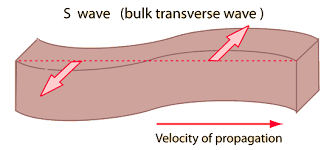
What exactly are S-waves?
- They are slower than P-waves and arrive at the recording instruments after P-waves.
- S-waves are shear or transverse waves, which means the ground particles move perpendicular to the direction of wave propagation.
- As a result, they leave troughs and crests in the material they move through (they distort the medium).
- They resemble water ripples or light waves in appearance.
- They can only travel through solid materials. This characteristic of S-waves has provided critical evidence that the Earth's outer core is liquid because S-waves do not pass through it.
- They cause more intense shaking than P-waves, moving the ground up and down and side-to-side, and are generally responsible for the damage and destruction during earthquakes.
- When compared to P-waves, these waves have a greater frequency and a somewhat larger destructive force.
- The earth's surface trembles from side to side as a result of these waves (horizontal).
- Fluids (liquids and gases) do not tolerate shear stresses, hence S-waves cannot flow through them.
- They move through the solid component of the Earth at variable speeds (proportional to shear strength).
Why do S-waves not travel through Liquid and Gaseous States?
- S-waves cannot travel through liquids or gases, which aided in the discovery that the outer core was liquid.
- Since liquid and gases are not rigid i.e., they have no shear stress, therefore S-waves cannot pass through them.
- Besides, they travel at varying velocities (proportional to shear strength) through the solid part of the Earth’s crust, mantle.
- These waves are of high frequency and possess slightly higher destructive power compared to P-waves.
- The trembling on the earth’s surface caused due to these waves is from side to side (horizontal).
Why do S-waves travel slower than P-waves?
- P-waves travel at 1.7 times the speed of S-waves.
- P-waves are compression waves that apply a force in the propagation direction, allowing them to easily convey their energy through the medium and move swiftly.
- S-waves, on the other hand, are transverse waves or shear waves (the motion of the medium is perpendicular to the wave's propagation direction) and are thus more difficult to transmit through the medium.
Emergence of Shadow Zone

- Seismographs installed in remote regions record earthquake waves. There are, however, some regions where the waves are not reported. The 'shadow zone' is a term used to describe such a region.
- The examination of several disasters demonstrates that each earthquake has a distinct shadow zone.
- It was discovered that seismographs placed within 105 degrees of the epicenter recorded both P and S-wave arrivals.
- Seismographs placed beyond 145 degrees from the epicenter, on the other hand, record the arrival of P-waves but not S-waves.
- As a result, the shadow zone for both types of waves was found as a zone between 105 ° and 145 ° from the epicenter.
Conclusion
S-wave is a disturbance that moves through a medium, transporting energy while avoiding the transport of matter. S-waves, secondary waves, or shear waves (sometimes called elastic S waves) are a type of elastic waves and one of the two main types of elastic body waves, so named because they move through the body of an object, as opposed to surface waves.
FAQs
Question. What are S-Waves?
Answer: S-Waves, also known as Secondary Waves, are seismic waves that move perpendicularly to the direction of wave propagation and are slower than P-Waves.
Question. How do S-Waves differ from P-Waves?
Answer: Unlike P-Waves, which are compressional and can travel through solids, liquids, and gases, S-Waves are transverse and can only travel through solids.
Question. What is the significance of S-Waves in seismology?
Answer: S-Waves help scientists determine the internal structure of the Earth, including the solid nature of the mantle and core properties, as they do not travel through liquid.
Question. Can S-Waves travel through the Earth's outer core?
Answer: No, S-Waves cannot travel through the Earth's outer core because it is liquid.
Question. How are S-Waves detected?
Answer: S-Waves are detected using seismographs, which measure ground movements caused by seismic activity.
MCQs
- What does the "S" in S-Waves stand for?
A) Surface
B) Secondary
C) Seismic
D) Slow
Answer: (B) See the Explanation
S-Waves are called Secondary Waves as they arrive after the Primary Waves during seismic activity.
- Through which of the following mediums can S-Waves propagate?
A) Solids only
B) Liquids only
C) Solids and liquids
D) Solids, liquids, and gases
Answer: (A) See the Explanation
S-Waves are transverse waves that require a rigid medium and cannot travel through liquids or gases.
- How do S-Waves move in relation to the direction of wave propagation?
A) Parallel
B) Perpendicular
C) Circular
D) Random
Answer: (B) See the Explanation
S-Waves move perpendicular to the direction of wave propagation, causing ground displacement.
- Which property of S-Waves helps determine the Earth's internal structure?
A) Speed
B) Inability to travel through liquids
C) Amplitude
D) Frequency
Answer: (B) See the Explanation
The inability of S-Waves to pass through the liquid outer core helps in studying the Earth's internal layers.
- What is the typical speed of S-Waves relative to P-Waves?
A) Faster
B) Slower
C) Equal
D) It depends on the medium
Answer: (B) See the Explanation
S-Waves are slower than P-Waves and arrive after them during seismic events.
GS Mains Questions and Model Answers
Q1: Explain the role of S-Waves in understanding the Earth's internal structure.
Answer: S-Waves, or Secondary Waves, are crucial for studying the Earth's internal structure. As transverse waves, they move perpendicular to the direction of propagation and only travel through solids, making them essential for understanding the Earth's composition. Their inability to pass through the liquid outer core reveals the existence and properties of this layer. Seismologists analyze S-Wave propagation and speed to infer details about the Earth's mantle and core, such as density and elasticity. The study of S-Waves also aids in determining the epicenter and magnitude of earthquakes. Overall, S-Waves are a fundamental tool in seismology for mapping the Earth's interior and enhancing our understanding of tectonic processes.
Q2: Differentiate between P-Waves and S-Waves with reference to their propagation and characteristics.
Answer: P-Waves, or Primary Waves, are compressional waves that travel faster than S-Waves and can propagate through solids, liquids, and gases. They move parallel to the wave direction, causing compression and rarefaction. In contrast, S-Waves, or Secondary Waves, are transverse waves that move perpendicular to the wave direction and travel only through solids. While P-Waves are the first to be recorded on a seismograph, S-Waves arrive later due to their slower speed. The inability of S-Waves to pass through the Earth's liquid outer core provides insights into its composition, making them vital for seismological studies. Both wave types are essential for understanding seismic events and the Earth's internal structure.
Q3: Discuss the significance of seismic waves in earthquake studies.
Answer: Seismic waves, including P-Waves and S-Waves, are vital for understanding earthquakes and the Earth's internal structure. P-Waves are the fastest and provide initial data about an earthquake's location and magnitude. S-Waves, with their transverse motion, help in assessing the intensity and impact of ground displacement. Their inability to travel through liquids aids in mapping the Earth's internal layers, such as the mantle and core. The analysis of seismic waves helps in locating the epicenter, understanding fault mechanics, and predicting aftershocks. Seismographs record these waves, providing crucial data for earthquake-resistant construction and disaster preparedness. Overall, seismic waves are indispensable for advancing knowledge in geophysics and minimizing earthquake risks.
Previous Year Questions on S-Waves
1. UPSC CSE 2020
Question: "What do S-Waves and P-Waves reveal about the Earth's interior?"
Answer: P-Waves and S-Waves provide crucial insights into the Earth's interior. P-Waves can travel through solids, liquids, and gases, revealing variations in density and composition. S-Waves, which only propagate through solids, indicate the presence of a liquid outer core. The differential propagation helps map the Earth's layers.
2. UPSC CSE 2019
Question: "Explain the differences between seismic waves and their role in earthquake studies."
Answer: Seismic waves include P-Waves, S-Waves, and surface waves. P-Waves are compressional and travel fastest, while S-Waves are slower transverse waves traveling only through solids. Surface waves cause maximum damage. Together, they aid in determining earthquake epicenters and studying Earth's internal structure.
Download the PREPP App and attempt FREE IAS Exam Mock Tests and get complete study material!

Full Test - 04: UPSC CSE Prelims CSAT (Paper-II)
Full Test - 03: UPSC CSE Prelims CSAT (Paper-II)
UPSC CSE Prelims 2026 GS Paper 1 Question Paper (24-May-2026)
UPSC CSE Prelims 2026 CSAT Paper 2 Question Paper (24-May-2026)

17 February 2025 | The Hindu Must Read Articles | Current Affairs

16 February 2026 | The Hindu Must Read Articles | Current Affairs

13 February 2026 | The Hindu Must Read Articles | Current Affairs









Comments