P-Waves (Primary Waves) - Geography Notes
P-Waves or Primary waves are compressional waves that are longitudinal in nature. P waves are the first to arrive at a seismograph. P waves are the most powerful seismic waves and can travel through solid, liquid, or gas. They leave a trail of compressions and rarefactions on the medium through which they move. As it is formed by alternating compressions and rarefactions, the name P wave can refer to either pressure wave. This article will explain to you about P-Waves (Primary Waves) which will be helpful in Geography preparation for the UPSC Civil service exam.
|
Table of Contents |

Seismic Waves or Earthquake Waves
- Seismic waves are the vibrations or oscillations that travel through the Earth's interior and across its surface in response to various sources of energy release, such as earthquakes, volcanic activity, or human-induced events.
- These waves carry energy and information about the Earth's subsurface and are crucial for understanding the planet's interior structure, seismic activity, and geological processes.
- These seismic waves travel as vibrations through the earth. The vibrations are recorded and measured by a device known as a seismometer.
- The seismometer generates a graph called a seismogram that depicts these vibrations. These waves travel at different speeds through various materials.
- Earthquake waves are caused by the rapid release of energy along a fault (a sharp rupture in the crustal layer).
- The force produced on the rock layers along a fault causes them to move in opposing directions, but they are kept in place by the frictional force exerted by the above rock strata.
- Over time, the pressure on the rock strata builds up and exceeds the frictional barrier, causing an abrupt movement that generates shockwaves (seismic waves) in all directions.
- Seismic waves are categorized into two main types: Body waves and Surface waves.
Body Waves
- Body waves are generated due to the release of energy at the focus and move in all directions traveling through the body of the earth.
- Body waves are seismic waves that travel through the Earth's interior.
- They are generated by the sudden release of energy from events such as earthquakes, volcanic eruptions, or even man-made explosions.
- Since they move through the Earth, they are instrumental in providing information about the Earth's internal structure, including layer densities, thicknesses, and states of matter.
- By analyzing the travel times and paths of these waves, seismologists can infer a lot about the Earth's interior structure and the properties of different layers.
- The variations in the speed and direction of body waves as they interact with different materials inside the Earth help scientists construct models of the Earth's interior, including the identification of the core, mantle, and crust layers.
- There are two primary types of body waves: Primary Waves (P-waves) and Secondary Waves (S-waves).

P-waves (Primary Waves)
- They are the fastest among seismic waves and thus reach the recording instruments first.
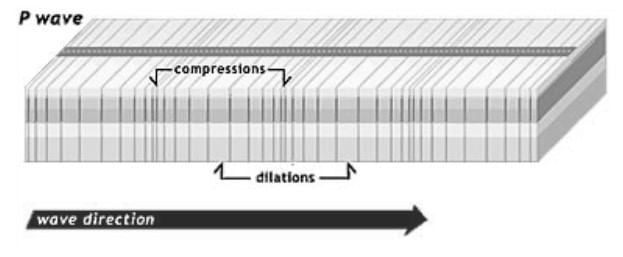
- P-waves are compressional or longitudinal waves, which means the ground particles move in the direction of the wave propagation (similar to sound waves).
- P-waves are also known as longitudinal waves because the displacement of the medium occurs in the same or opposite direction (parallel to) the wave's propagation direction.
- Compressional waves because they cause compression and rarefaction when travelling through a medium; and pressure waves because they cause pressure changes in the medium.
- P-waves cause density variations in the material, causing it to expand (rarefaction) and compress (compression).
- They can travel through solid, liquid, and gaseous materials, which means they can pass through the Earth's crust, mantle, outer core, and inner core.
- When they pass through the Earth's surface, they can shake the ground in the direction of their movement, often feeling like a sudden jolt during an earthquake.
- These waves have a low frequency and are the least damaging of the earthquake waves.
- The earth's surface trembles in an up-down motion as a result of these waves (vertical).
- They may pass through any medium, and their speed is determined by the medium's shear strength (elasticity).
- As a result, the P-wave velocity in Solids > Liquids > Gases.
- When these waves penetrate the atmosphere, they take the shape of sound waves.
- In earthquakes, the P-wave velocity ranges from 5 to 8 km/s.
- The precise speed varies depending on the region of the Earth's interior, ranging from less than 6 kilometres per second in the crust to 13.5 kilometres per second in the lower mantle and 11 kilometres per second in the inner core.
Why do P-waves travel faster than S-waves?
- P-waves travel at 1.7 times the speed of S-waves.
- P-waves are compression waves that apply a force in the propagation direction, allowing them to easily convey their energy through the medium and move swiftly.
- S-waves, on the other hand, are transverse waves or shear waves (the motion of the medium is perpendicular to the wave's propagation direction) and are thus more difficult to transmit through the medium.
- The speed of P-waves varies by about 8 km/s at the crust-mantle boundary.
- Because the earth's mantle, particularly below the asthenosphere, becomes more rigid and compressible as depth increases, the speed of P-waves increases with depth in the earth's interior.
Factors Affecting the Speed of P-Waves
- The speed of P-waves is determined by three factors: the medium's rigidity, compressibility, and density.
- Rigidity refers to a material's resistance to changes in size and shape caused by an external force. The faster the P-waves, the more rigid the material.
- Compressibility, on the other hand, refers to a material's ability to reduce or compact its volume in response to an external force. The faster the P-waves, the higher the compressibility of the material.
- Density is the amount of mass an object has per unit volume. The slower the P-waves, the higher the material's weight.
P-waves act as an Earthquake Warning
- The detection of non-destructive primary waves, which move faster through the Earth's crust than destructive secondary and surface waves, allows for early earthquake warning.
- The time between the arrival of the P-waves and the arrival of subsequent damaging waves might range from 60 to 90 seconds, depending on the depth of focus of the earthquake.
Emergence of Shadow Zones

- Seismographs installed in remote regions record earthquake waves. There are, however, some regions where the waves are not reported. The 'shadow zone' is a term used to describe such a region.
- The examination of several disasters demonstrates that each earthquake has a distinct shadow zone.
- It was discovered that seismographs placed within 105 degrees of the epicenter recorded both P and S-waves arrivals.
- Seismographs placed beyond 145 degrees from the epicenter, on the other hand, record the arrival of P-waves but not S-waves.
- As a result, the shadow zone for both types of waves was found as a zone between 105 ° and 145 ° from the epicenter.
Conclusion
P-waves, also known as primary waves, are a type of seismic wave that occurs during an earthquake. The term "primary wave" refers to the first wave detected by a seismometer during an earthquake. A P-wave is a disturbance that travels through a medium, transporting energy while avoiding the transport of matter. In seismology, a P wave (primary wave or pressure wave) is one of two types of elastic body waves known as seismic waves.
FAQs
Question: What are P-waves in the context of seismic waves?
Answer: P-waves, or primary waves, are one of the types of seismic waves generated by earthquakes or other seismic activity. They are the fastest seismic waves and are the first to be detected by seismographs. P-waves are compressional waves, meaning they move through the Earth by compressing and expanding the material they travel through. They can move through both solids and liquids, which makes them different from S-waves, another type of seismic wave. Due to their ability to travel through all layers of the Earth, P-waves are crucial for studying the Earth's internal structure.
Question: How do P-waves differ from S-waves?
Answer: The key difference between P-waves and S-waves lies in their speed, movement, and the materials they can travel through. P-waves are compressional waves that can travel through both solids and liquids, and they move faster than S-waves. S-waves, or secondary waves, are shear waves that move in a side-to-side motion, and they can only travel through solids. As a result, the study of P-waves and S-waves allows scientists to gain insights into the composition of the Earth's core and mantle.
Question: What is the speed of P-waves?
Answer: P-waves are the fastest seismic waves, traveling at speeds between 5 to 8 kilometers per second, depending on the medium they pass through. In the Earth's crust, the speed of P-waves is around 6 km/s, but it can be higher in the Earth's mantle and core, where the material is denser. Because of their speed, P-waves are the first seismic waves to be detected by seismographs, and they can provide crucial information about the internal structure of the Earth.
Question: Why are P-waves important in the study of earthquakes?
Answer: P-waves are important in the study of earthquakes because they are the first waves to arrive at seismic stations, providing valuable information about the location and depth of the earthquake's epicenter. Since P-waves can travel through both solids and liquids, their behavior also helps scientists understand the Earth's internal structure, including the nature of the Earth's core and mantle. By analyzing the speed and path of P-waves, geologists can make inferences about the materials that they pass through, such as the transition from the Earth's crust to the mantle.
Question: How do P-waves help in understanding the Earth's internal structure?
Answer: P-waves provide crucial information about the Earth's internal structure due to their ability to travel through both solids and liquids. By analyzing how P-waves move through the Earth, scientists can infer the composition and physical properties of the Earth's layers. For example, the fact that P-waves slow down significantly when they reach the outer core of the Earth suggests that the outer core is liquid. By studying the way P-waves are refracted and reflected inside the Earth, scientists can map the boundaries between the crust, mantle, and core.
MCQs
1. What is the primary characteristic of P-waves?
A) They move slower than S-waves
B) They are the fastest seismic waves
C) They can only travel through solids
D) They move in a side-to-side motion
Answer: (B) See the Explanation
Explanation: P-waves are the fastest seismic waves and are the first to be detected by seismographs. They travel at speeds faster than S-waves and are compressional in nature, moving through both solids and liquids.
2. P-waves are a type of seismic wave that:
A) Move in shear motion
B) Can travel through solids and liquids
C) Are slower than S-waves
D) Cannot travel through the Earth’s outer core
Answer: (B) See the Explanation
Explanation: P-waves are compressional waves that can travel through both solids and liquids. This ability differentiates them from S-waves, which can only travel through solids.
3. The study of P-waves helps scientists understand:
A) The Earth's magnetic field
B) The location of volcanoes
C) The Earth's internal structure
D) The Earth's atmosphere
Answer: (C) See the Explanation
Explanation: By studying the behavior of P-waves as they travel through the Earth, scientists can infer the composition and structure of the Earth’s interior, including the boundaries between the crust, mantle, and core.
4. Which layer of the Earth do P-waves travel through but are refracted upon reaching it?
A) Crust
B) Mantle
C) Outer core
D) Inner core
Answer: (C) See the Explanation
Explanation: P-waves travel through the Earth’s crust and mantle but are refracted when they reach the outer core, suggesting that the outer core is liquid. This refractive behavior helps scientists understand the properties of the Earth’s layers.
5. What is the main difference between P-waves and S-waves?
A) P-waves move faster than S-waves
B) P-waves can only travel through solids
C) P-waves travel in a shear motion
D) P-waves are slower than S-waves
Answer: (A) See the Explanation
Explanation: P-waves are faster than S-waves and are the first to arrive at seismic stations. P-waves are compressional waves, while S-waves are shear waves that can only travel through solids.
GS Mains Questions and Model Answers
Q1: Discuss the role of P-waves in seismic studies and their importance in understanding the Earth's structure.
Answer: P-waves play a crucial role in seismic studies as they provide valuable information about the Earth's internal structure. As the fastest seismic waves, they are the first to be detected by seismographs and help seismologists estimate the distance to an earthquake's epicenter. P-waves can travel through both solids and liquids, making them particularly useful in studying the Earth's layers. By analyzing the behavior of P-waves, scientists can determine the composition and state of materials in the Earth's crust, mantle, and core. For example, the way P-waves slow down and refract when they encounter the liquid outer core provides evidence that the outer core is not solid. Thus, P-waves are essential for understanding the Earth's internal structure and for mapping the boundaries between different layers of the planet.
Q2: How do P-waves help in understanding the Earth's core and mantle?
Answer: P-waves are instrumental in understanding the Earth's core and mantle due to their ability to travel through both solids and liquids. When P-waves travel through the Earth's layers, they behave differently depending on the state of the material. For instance, when P-waves reach the outer core, they slow down and refract, indicating that the outer core is liquid. This phenomenon helped scientists confirm the liquid state of the outer core long before it was directly observed. Additionally, P-waves travel faster through the mantle, providing information about its density and composition. By studying the speed and behavior of P-waves, scientists have been able to create detailed models of the Earth's internal structure, including the solid inner core, liquid outer core, and semi-solid mantle.
Q3: Evaluate the significance of P-waves in predicting earthquake intensity and assessing seismic risks.
Answer: P-waves play a significant role in predicting earthquake intensity and assessing seismic risks due to their rapid travel speed and early detection. Since P-waves are the first seismic waves to arrive at seismic stations, they help provide an early warning of an impending earthquake, allowing for prompt action to mitigate damage. By analyzing the arrival times of P-waves, seismologists can estimate the earthquake's epicenter and magnitude. The study of P-wave velocities also helps assess the potential severity of seismic events by revealing the properties of the Earth's layers, such as the presence of faults or geological anomalies. This information is vital for constructing earthquake-resistant infrastructure and developing effective disaster preparedness strategies in seismic regions.
Previous Year Questions on P-Waves
1. UPSC CSE Prelims 2021:
Question: P-waves are the first seismic waves to be detected because they:
A) Are the fastest seismic waves
B) Travel only through solids
C) Move in a shear motion
D) Are the slowest waves
Answer: (A)
Explanation: P-waves are the fastest seismic waves, which is why they are the first to be detected by seismographs during an earthquake. Their speed allows them to travel quickly through both solids and liquids.
2. UPSC CSE Mains 2019 (GS Paper 1):
Question: Explain the role of P-waves in the study of the Earth's internal structure.
Answer: P-waves play a crucial role in the study of the Earth's internal structure as they can travel through both solids and liquids. The behavior of P-waves as they pass through different layers of the Earth, such as slowing down and refracting at the outer core, provides valuable insights into the composition and state of these layers. By analyzing the speed and direction of P-waves, scientists have mapped the Earth's core, mantle, and crust, confirming the presence of a liquid outer core and a solid inner core. P-waves are thus essential for understanding the Earth's internal composition and for constructing models of its geological layers.
Download the PREPP App and attempt FREE IAS Exam Mock Tests and get complete study material!

Full Test - 04: UPSC CSE Prelims CSAT (Paper-II)
Full Test - 03: UPSC CSE Prelims CSAT (Paper-II)
UPSC CSE Prelims 2026 GS Paper 1 Question Paper (24-May-2026)
UPSC CSE Prelims 2026 CSAT Paper 2 Question Paper (24-May-2026)

17 February 2025 | The Hindu Must Read Articles | Current Affairs

16 February 2026 | The Hindu Must Read Articles | Current Affairs

13 February 2026 | The Hindu Must Read Articles | Current Affairs









Comments