Surface Waves (Long or L Waves) - Geography Notes
Surface waves are a type of seismic wave that propagates along the Earth's surface as a result of an earthquake or other sources of energy release. These waves are responsible for the shaking and ground motion felt during seismic events and can cause significant damage to buildings and infrastructure. Surface waves include Love waves and Rayleigh waves, each with distinct characteristics and effects. In this article we will discuss in detail about these waves and their importance in assessing the impact of earthquakes and enhancing disaster preparedness which will be helpful for UPSC exam preparation.
Table of Contents
What are Seismic Waves?
- Seismic waves are the vibrations or oscillations that travel through the Earth's interior and across its surface in response to various sources of energy release, such as earthquakes, volcanic activity, or human-induced events.
- These waves carry energy and information about the Earth's subsurface and are crucial for understanding the planet's interior structure, seismic activity, and geological processes.
- These seismic waves travel as vibrations through the earth. The vibrations are recorded and measured by a device known as a Seismometer.
- The seismometer generates a graph called a Seismograph that depicts these vibrations. These waves travel at different speeds through various materials.
- Seismic waves are categorized into three main types: primary waves (P waves), secondary waves (S waves), and surface waves.
- Seismic waves are the vibrations or oscillations that travel through the Earth's interior and across its surface in response to various sources of energy release, such as earthquakes, volcanic activity, or human-induced events.
- These waves carry energy and information about the Earth's subsurface and are crucial for understanding the planet's interior structure, seismic activity, and geological processes.
- These seismic waves travel as vibrations through the earth. The vibrations are recorded and measured by a device known as a seismometer.
- The seismometer generates a graph called a seismogram that depicts these vibrations. These waves travel at different speeds through various materials.
- Seismic waves are categorized into three main types: primary waves (P waves), secondary waves (S waves), and surface waves.
What are Surface Waves?
- When body waves interact with surface rocks, a new set of waves known as surface waves is created. These waves propagate across the earth's surface.
- Surface waves are transverse waves in which particle motion is perpendicular to the propagation of the wave. As a result, they create crests and troughs in the material they pass through.
- Surface waves travel more slowly through Earth material and are generally lower in frequency than body waves.
- Deeper earthquakes produce weaker surface waves; shallow earthquakes produce stronger surface waves.
- Wave velocity changes as they travel through different densities of materials. Denser the material higher the velocity.
- When they come into contact with materials of varying densities, their direction changes as they reflect or refract.
- Because they cover the greatest distances of any seismic wave, they are also known as Long Period Waves or "L" waves.
- They are the last to reach the surface of the Earth and are the most powerful and destructive seismic waves.
- Surface waves are classified into two types: Rayleigh waves and Love waves

Surface Waves
Types of Surface Waves
1) Love Waves
- Love waves are a type of earthquake surface wave that causes horizontal, side-to-side motion of particles parallel to the Earth's surface.
- They are named after the British mathematician A.E.H. Love, who predicted their existence in 1911.
- Key features of Love waves include:
- Particle Motion: Love waves cause particles to move in a horizontal, snake-like motion similar to the way a snake slithers across the ground.
- Propagation: These waves propagate along the Earth's surface, primarily within the uppermost layers of the crust.
- Amplitude and Ground Shaking: Love waves can have large amplitudes, contributing to significant ground shaking during earthquakes.
- Damaging Effects: The side-to-side motion of Love waves can cause structural damage to buildings, bridges, and other infrastructure, particularly if the structures are not well-designed to withstand horizontal shaking.
2) Rayleigh Waves
- Rayleigh waves are another type of earthquake surface wave that causes both vertical and horizontal motion of particles.
- These waves are named after John William Strutt, also known as Lord Rayleigh, who mathematically predicted the existence in 1885.
- Key features of Rayleigh waves include:
- Particle Motion: Rayleigh waves create an elliptical, rolling motion of particles. This motion includes both vertical and horizontal components.
- Propagation: Rayleigh waves travel along the Earth's surface and are typically slower than Love waves.
- Amplitude and Ground Displacement: Rayleigh waves can have larger amplitudes than body waves like P and S waves, contributing to ground displacement and shaking.
- Impact: The vertical motion of Rayleigh waves can cause uplift and subsidence of the ground, leading to ground cracks and surface deformations.
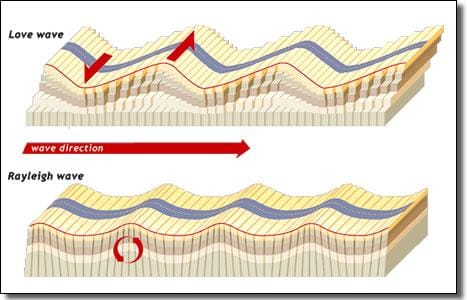
Rayleigh and Love Waves
Conclusion
Both Love Waves and Rayleigh Waves play important roles in the study of seismic Waves. This, in turn, aids in better forecasting earthquakes, revealing various facts about the earth's interior. Seismographs are used to study the Love and Rayleigh waves. The study of these Waves also aids in better understanding the structure of the earth by analysing the various patterns of movement that occur on its surface.
FAQs
Q1: What are surface waves?
Answer: Surface waves are seismic waves that travel along the Earth's surface, typically causing most of the damage during earthquakes due to their high amplitude and slow speed.
Q2: What are the two main types of surface waves?
Answer: The two primary types of surface waves are Love waves and Rayleigh waves. Love waves cause horizontal shifting, while Rayleigh waves result in a rolling motion, both impacting structures significantly.
Q3: How do surface waves differ from body waves?
Answer: Unlike body waves, which travel through the Earth’s interior, surface waves propagate along the Earth's crust, leading to more noticeable and destructive shaking on the surface.
Q4: Why are surface waves more destructive than other seismic waves?
Answer: Surface waves are more destructive because they have higher amplitudes and cause complex ground motion, including horizontal and vertical movements, impacting buildings and infrastructure heavily.
Q5: How are surface waves detected and measured?
Answer: Surface waves are detected using seismometers, which measure ground motion. Seismographs record the amplitude and duration of these waves, helping scientists analyze earthquake magnitude and location.
MCQs
- What type of motion is caused by Rayleigh waves?
A) Horizontal shifting
B) Vertical shifting only
C) Rolling motion
D) None of the above
Answer: (C) See the Explanation
Rayleigh waves create a rolling motion, causing both horizontal and vertical movements that contribute to structural damage during earthquakes.
- Which surface wave is known for causing horizontal displacement?
A) Rayleigh wave
B) Love wave
C) Primary wave
D) Secondary wave
Answer: (B) See the Explanation
Love waves cause horizontal shifting of the ground, which can damage the foundations of buildings.
- Why are surface waves slower than body waves?
A) They travel through denser materials
B) They encounter greater resistance on the surface
C) They carry more energy
D) They move in circular patterns
Answer: (B) See the Explanation
Surface waves move more slowly because they encounter resistance from irregularities and materials on the Earth's surface.
- Which instrument is used to detect surface waves?
A) Barometer
B) Seismometer
C) Thermometer
D) Anemometer
Answer: (B) See the Explanation
A seismometer records ground motion during earthquakes, helping detect surface waves.
- What makes surface waves particularly destructive?
A) Their high velocity
B) Their long wavelengths
C) Their complex ground motion
D) Their ability to penetrate deep layers
Answer: (C) See the Explanation
Surface waves are destructive due to the complex rolling and horizontal movements they induce, severely affecting structures on the surface.
GS Mains Questions and Model Answers
Q 1. Explain the role of surface waves in determining the impact of an earthquake.
Answer: Surface waves play a critical role in determining the severity of an earthquake's impact as they travel along the Earth's surface and exhibit high amplitudes. The two types of surface waves, Love and Rayleigh waves, induce horizontal and rolling motions respectively, which directly impact buildings and infrastructure.
Their destructive nature is a result of the combination of high amplitude and prolonged shaking, causing significant structural damage. Because surface waves travel slower than body waves, they arrive after the initial shock, often catching people off guard. The intensity of surface waves makes them a crucial focus for disaster preparedness and mitigation efforts.
Seismometers measure surface waves to help scientists determine the magnitude of earthquakes and predict the potential damage in affected regions. Thus, understanding surface waves is essential for effective earthquake monitoring and safety planning.
Q2. Analyze the differences between body waves and surface waves in seismic activity.
Answer: Body waves, including P-waves (primary) and S-waves (secondary), travel through the Earth's interior, while surface waves propagate along the Earth's crust. P-waves are the fastest seismic waves, followed by S-waves, both of which cause less surface damage than surface waves.
In contrast, surface waves, such as Love and Rayleigh waves, travel slowly but cause the most destruction due to their higher amplitude and complex motion. Surface waves produce significant horizontal and rolling movements that damage buildings, roads, and other infrastructure. Another key difference is in their detection; body waves help determine the earthquake's origin and depth, while surface waves provide insights into the intensity of ground shaking. Together, body and surface waves offer a comprehensive understanding of seismic events and are critical for designing earthquake-resistant infrastructure.
Q3. Discuss how seismographs contribute to the study of surface waves.
Answer: Seismographs play an essential role in the study of surface waves by recording the ground motion during seismic events. These instruments detect both horizontal and vertical movements, enabling scientists to analyze the characteristics of Love and Rayleigh waves.
Seismographs provide data on the amplitude, frequency, and duration of surface waves, which helps determine the magnitude of earthquakes and predict the damage potential. This information is crucial for designing building codes and developing early warning systems, especially in earthquake-prone areas. Additionally, seismographs help in earthquake prediction by monitoring seismic activity over time. The data collected also aids in mapping fault lines and understanding the dynamics of tectonic movements. In essence, seismographs are invaluable tools for mitigating earthquake risks and improving public safety.
Previous Year Questions on Surface Waves
1. UPSC CSE 2020
Question. "Explain the significance of seismic waves in understanding the Earth's interior structure."
Answer: Seismic waves provide crucial insights into the Earth's interior structure by traveling through different layers and reacting to changes in material density. Primary (P) waves and Secondary (S) waves are two types of body waves that propagate through the Earth. P-waves can travel through both solid and liquid layers, while S-waves only move through solids, indicating the presence of a liquid outer core. Surface waves, such as Love and Rayleigh waves, travel along the Earth's crust, providing valuable data about shallow structures and fault lines. By analyzing the speed and direction of these waves, scientists can determine the composition and density of various layers.
Seismic wave data is also essential in mapping tectonic plate boundaries, understanding mantle convection, and predicting volcanic activity. This knowledge plays a vital role in earthquake-resistant infrastructure planning and disaster preparedness.
2. UPSC CSE 2019
Question. "Analyze the role of seismic instruments in earthquake management and mitigation."
Answer: Seismic instruments, such as seismometers and seismographs, play a crucial role in earthquake management by providing early warning and real-time monitoring. These instruments detect seismic waves, including both body and surface waves, enabling scientists to assess the magnitude and potential impact of an earthquake.
The data collected helps in the quick identification of epicenters, allowing emergency services to focus relief efforts in the most affected areas. Seismographs also assist in studying fault lines and tectonic movements, contributing to long-term earthquake risk assessment.
Moreover, seismic instruments are instrumental in developing building codes and safety standards. The integration of seismometer networks with early warning systems has proven effective in mitigating earthquake-related damages and saving lives. Thus, seismic instruments are indispensable tools in disaster management and preparedness.
Download the PREPP App and attempt FREE IAS Exam Mock Tests and get complete study material!

Full Test - 04: UPSC CSE Prelims CSAT (Paper-II)
Full Test - 03: UPSC CSE Prelims CSAT (Paper-II)
UPSC CSE Prelims 2026 GS Paper 1 Question Paper (24-May-2026)
UPSC CSE Prelims 2026 CSAT Paper 2 Question Paper (24-May-2026)

17 February 2025 | The Hindu Must Read Articles | Current Affairs

16 February 2026 | The Hindu Must Read Articles | Current Affairs

13 February 2026 | The Hindu Must Read Articles | Current Affairs









Comments