Impact of Green Revolution - Agriculture Notes
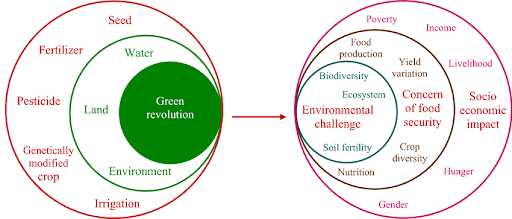
The term "green revolution" describes the dramatic rise in food grain output, particularly for wheat and rice, that began in the middle of the 20th century. It solved India's issue of food insecurity. The production of wheat and rice doubled after the Green Revolution, while that of other food crops, such as indigenous rice types and millets, decreased. Environmentalists have studied the long-term effects of the green revolution and claim that it exacerbated sociological, economic, and environmental issues like farmer suicides, rural indebtedness, and droughts. According to reports, the usage of pesticides has deteriorated the soil, which has caused many agricultural systems to fail across the nation, harming the farmers' livelihoods as well as the food and water supplies. This article will explain to you the Impacts of the Green Revolution which will help prepare the Agriculture Syllabus for the UPSC Civil Service exam.
|
Table of Contents |
Green Revolution and its Impact
What is Green Revolution in India?
- The term "green revolution" describes the dramatic rise in food grain output, particularly for wheat and rice, that began in the middle of the 20th century and was largely attributed to the introduction of new, high-yielding variety (HYV) seeds into developing nations.
- The goal of the green revolution was to produce enough food grains on its own.
- Large-scale alterations were made to conventional farming methods starting in the 1960s.
- Dr. M. S. Swaminathan, the advisor to India's minister of agriculture, extended an invitation to Norman Borlaug to visit.
- In India, M.S Swaminathan is regarded as the father of the Indian Green Revolution.
- The Green Revolution in India began in 1968, led by Prime Minister Indira Gandhi, and resulted in an increase in food grain output, particularly in Punjab, Haryana, and Uttar Pradesh.
- The development of new synthetic insecticides, herbicides, and chemical fertilizers occurred during this time. It solved India's issue of food insecurity.
- A number of institutional support programmes were put into place, including minimum support prices for food grains and procurement as well as public grain distribution (mostly rice and wheat).
- India began to export grains for food as a result. India is presently the second-largest producer of both rice and wheat in the world, as well as the biggest exporter of rice.
*To know more about the topic, click this link Green Revolution
Green Revolution - Objectives
- Short Term: During the second Five Year Plan, the revolution was started to address India's famine crisis.
- Long Term: A broad modernization of agriculture was one of the long-term goals, based on infrastructure, raw materials, industrial development, and rural development.
- Employment: To give both agricultural and industrial people employment.
- Scientific Studies: Growing plants that are more resilient to disease and harsh weather.
- Globalization of the Agricultural World: By establishing several firms in important agricultural regions and transferring technologies to less-industrialized countries.
Positive Impacts of Green Revolution
Massive Increase in Crop Production
- The Green Revolution led to a grain output of 131 million tonnes in 1978–1979, making India one of the largest agricultural producers in the world.
- During the Green Revolution, there was a significant increase in the crop area planted with high-yielding wheat and rice types.
Reduced Import of Food-Grains
- India was able to produce enough food to meet its own needs and maintain an adequate quantity in the national reserve.
- At times, India was even able to export food grains.
- Additionally, there are now more food grains available per person on a net basis.
Benefits to the Farmers
- Farmers were able to increase their income thanks to the onset of the Green Revolution.
- Farmers invested their extra money back into their fields to increase productivity.
- The major farmers who had more than 10 hectares of land gained the most from this revolution because they made significant financial investments in HYV seeds, fertilizer, machinery, etc. It supported capitalist farming as well.
Industrial Growth
- As a result of the Revolution's extensive farm mechanization, demand for various types of machinery such as tractors, harvesters, threshers, combines, diesel engines, electric motors, pumping sets, etc., increased.
- Additionally, there was significant growth in demand for chemical fertilizers, herbicides, insecticides, weedicides, etc.
- In numerous businesses designated as "agro-based industries," a number of agricultural products were also utilized as raw materials.
Rural Employment
- Due to fertilizer use and multiple cropping, there was a noticeable increase in the need for laborers.
- The Green Revolution produced a large number of jobs, both for industrial and agricultural people, by constructing facilities like factories and hydroelectric power plants.
Negative Impacts of Green Revolution
Non-Food Grains Left Out
- All food grains, such as wheat, rice, jowar, bajra, and maize, have benefited from the revolution; however, other crops, such as coarse cereals, pulses, and oilseeds, were excluded from the scope of the Green Revolution.
- Major cash crops including sugarcane, cotton, jute, tea, and cotton were also largely unaffected by the Green Revolution.
Limited Coverage of HYVP
- Only five crops were allowed under the High Yielding Variety Programme (HYVP): maize, wheat, rice, jowar, and bajra.
- Therefore, the new method did not apply to non-food grains.
- The HYV seeds in the non-food crops either hadn't been developed yet or weren't good enough for farmers to take a chance on using them.
Regional Disparities
- Growing regional and international economic imbalances are the result of the Green Revolution's technological advancements.
- Only 40% of the overall cultivated area has been impacted thus far, while 60% is still unaffected.
- Punjab, Haryana, and Western Uttar Pradesh in the north, and Andhra Pradesh and Tamil Nadu in the south, are the regions most severely impacted.
- The Eastern region, which includes Assam, Bihar, West Bengal, and Orissa, as well as the dry and semi-arid regions of Western and Southern India, have rarely been affected.
- Only those places that were already in a better position agriculturally were impacted by the Green Revolution.
- Thus the problem of regional inequality has further intensified as a result of the Green Revolution.
Excessive Usage of Chemicals
- Pesticides and synthetic nitrogen fertilizers were widely used during the Green Revolution to improve irrigation systems and crop types.
- To inform farmers about the substantial risk involved with the intensive use of pesticides, however, very little or no effort was taken.
- Typically, uneducated farm laborers sprayed pesticides on crops without taking any safety precautions or following any instructions.
- Crops suffer more harm than benefit from this, and it also pollutes the environment and soil.
Water Consumption
- The crops that were developed during the green revolution required a lot of water.
- Since most of these crops were cereals, they used close to 50% of the water used by humans daily.
- Groundwater levels were depleted as a result of the introduction of canal systems and irrigation pumps that drained groundwater out of the ground to irrigate crops like rice and sugarcane that require large amounts of water.
- Punjab is one of the most water-scarce areas in India because it is a significant wheat and rice-growing region.
Impacts on Soil and Crop Production
- The nutrients in the soil were depleted by repeated crop cycles meant to ensure higher crop yield.
- Farmers used more fertilizer to fulfill the needs of new varieties of seeds.
- The use of these alkaline compounds caused the pH level of the soil to rise.
- Beneficial pathogens were eliminated by toxic chemicals in the soil, which further decreased production.
Unemployment
- Farm mechanization brought about by the Green Revolution led to widespread unemployment among agricultural laborers in rural areas, with the exception of Punjab and to a lesser extent Haryana.
- The poor laborers who were without land were most negatively impacted.
Health Hazards
- Phosphamidon, Methomyl, Phorate, Triazophos, and Monocrotophos, among other chemical fertilizers and pesticides, are widely used and have been linked to a number of severe diseases, including cancer, renal failure, stillbirths, and birth deformities.
Conclusion
The green revolution gave India unprecedented food security and helped it escape a severe food crisis. The country's success story aided in its development of a market for food grains as well as self-sufficiency. But errors towards the end resulted from failing to consider the detrimental effects on the environment and Indian farmers' ignorance of heavy-duty chemical fertilizers. The nation's nutritional security must be ensured along with its food security, so it is important to recognize the benefits of indigenous crops and revitalize them.
FAQs
Question: What was the Green Revolution in India?
Answer: The Green Revolution in India was an agricultural reform movement initiated in the 1960s to increase food grain production, especially wheat and rice. It involved the introduction of high-yielding variety (HYV) seeds, increased use of chemical fertilizers, pesticides, and irrigation.
Question: Who is considered the father of the Green Revolution in India?
Answer: Dr. M.S. Swaminathan is regarded as the father of the Green Revolution in India. His efforts in promoting agricultural innovations played a pivotal role in boosting food grain production.
Question: What were the key technologies introduced during the Green Revolution?
Answer: The key technologies introduced during the Green Revolution included the use of high-yielding variety (HYV) seeds, chemical fertilizers, pesticides, and improved irrigation techniques, along with modern agricultural machinery.
Question: How did the Green Revolution impact food grain production in India?
Answer: The Green Revolution led to a significant increase in food grain production, particularly in wheat and rice. It helped India achieve self-sufficiency in food production and reduced the country's dependence on food imports.
Question: What were some of the negative environmental impacts of the Green Revolution?
Answer: The negative environmental impacts of the Green Revolution included soil degradation, depletion of water resources, increased use of chemical fertilizers and pesticides leading to pollution, and the reduction of biodiversity due to monoculture farming practices.
MCQs
- Which crop benefited the most from the Green Revolution in India?
a) Sugarcane
b) Wheat
c) Cotton
d) Pulses
Answer: (B) See the Explanation
Wheat production saw the most significant increase due to the introduction of high-yielding variety seeds and modern farming techniques during the Green Revolution.
- Who is considered the main architect of the Green Revolution in India?
a) Jawaharlal Nehru
b) Norman Borlaug
c) M.S. Swaminathan
d) Indira Gandhi
Answer: (C) See the Explanation
M.S. Swaminathan is regarded as the main architect of the Green Revolution in India due to his contributions to promoting agricultural innovations.
- Which of the following was NOT a component of the Green Revolution?
a) High-yielding variety seeds
b) Increased use of chemical fertilizers
c) Organic farming techniques
d) Modern irrigation methods
Answer: (C) See the Explanation
The Green Revolution focused on the use of chemical fertilizers and pesticides rather than organic farming techniques to boost crop production.
- What was one of the major negative effects of the Green Revolution on the environment?
a) Increase in agricultural diversity
b) Soil degradation due to excessive use of fertilizers
c) Decrease in crop production
d) Improvement in irrigation facilities
Answer: (B) See the Explanation
One of the major negative effects of the Green Revolution was soil degradation caused by the overuse of chemical fertilizers and pesticides.
- The Green Revolution in India primarily targeted which of the following regions?
a) Southern India
b) Eastern India
c) Northern and Northwestern India
d) Western India
Answer: (C) See the Explanation
The Green Revolution primarily benefited regions like Punjab, Haryana, and western Uttar Pradesh, where irrigation facilities were better developed.
GS Mains Questions and Model Answers
Q1: Critically assess the impact of the Green Revolution on Indian agriculture and its long-term sustainability.
Explanation: This question requires an assessment of both the positive and negative impacts of the Green Revolution on Indian agriculture. The answer should cover how the Green Revolution led to significant increases in crop production, particularly wheat and rice, improving food security and reducing dependency on imports. However, it should also discuss the environmental degradation, overuse of water and chemical inputs, and the regional disparity in its implementation. The answer should consider whether the benefits of the Green Revolution can be sustained in the long term, given the environmental challenges and growing population demands.
Q2: Discuss the role of the Green Revolution in shaping India’s agricultural policies and food security.
Explanation: This question requires an analysis of how the Green Revolution influenced India’s agricultural policies and food security strategies. The answer should explore the introduction of high-yielding variety seeds, the expansion of irrigation facilities, and the emphasis on increasing production through modern agricultural techniques. The role of the Green Revolution in ensuring food self-sufficiency should be discussed, along with its impact on India’s broader agricultural policies, including pricing, subsidies, and the focus on staple crops like wheat and rice.
Q3: “The Green Revolution had both socio-economic and environmental consequences for India.” Critically examine this statement.
Explanation: This question asks for a critical examination of the socio-economic and environmental consequences of the Green Revolution. The answer should discuss how the revolution boosted agricultural productivity, improved incomes for large farmers, and contributed to India’s food security. However, it should also address the unequal distribution of benefits, with small farmers and certain regions left behind. The environmental consequences, including soil degradation, water depletion, and loss of biodiversity, should be discussed in detail, along with their impact on future agricultural sustainability.
Previous Year Questions on Impact of Green Revolution
1. UPSC CSE 2018
Q1: Critically analyze the social and economic impact of the Green Revolution in India.
Answer: The Green Revolution had a significant social and economic impact on India. Economically, it transformed India from a food-deficit country to a self-sufficient one, particularly in wheat and rice production. It also led to increased income for farmers in regions where it was implemented, such as Punjab, Haryana, and western Uttar Pradesh. However, the benefits were not evenly distributed, and small and marginal farmers, especially in eastern and southern India, did not gain as much. Socially, the Green Revolution widened the income gap between wealthy landowners and small farmers, leading to inequality. Moreover, the focus on a few staple crops reduced biodiversity and negatively affected traditional agricultural practices.
2. UPSC CSE 2019
Q2: Discuss the environmental consequences of the Green Revolution in India.
Answer: The Green Revolution, while improving agricultural productivity, had several environmental consequences. The increased use of chemical fertilizers and pesticides led to soil degradation, water pollution, and a decline in soil fertility. The heavy reliance on irrigation caused the depletion of groundwater resources, particularly in regions like Punjab and Haryana. Monoculture farming, where farmers focused on wheat and rice, reduced biodiversity and made crops more vulnerable to pests and diseases. The excessive use of water and chemicals has led to long-term sustainability issues, including declining agricultural yields in some areas.
Download the PREPP App and attempt FREE IAS Exam Mock Tests and get complete study material!

Full Test - 04: UPSC CSE Prelims CSAT (Paper-II)
Full Test - 03: UPSC CSE Prelims CSAT (Paper-II)
UPSC CSE Prelims 2026 GS Paper 1 Question Paper (24-May-2026)
UPSC CSE Prelims 2026 CSAT Paper 2 Question Paper (24-May-2026)

17 February 2025 | The Hindu Must Read Articles | Current Affairs

16 February 2026 | The Hindu Must Read Articles | Current Affairs

13 February 2026 | The Hindu Must Read Articles | Current Affairs









Comments