Blue Revolution - Agriculture Notes
In India, the Blue Revolution, also known as Neel or Nili Kranti Mission, was started between 1985 and 1990 as part of the 7th Five-Year Plan. The primary goal is to expand, manage, and promote fisheries in order to double farmers' income. The Blue Revolution's goals are being managed by the Ministry of Fisheries, Animal Husbandry, and Dairy under the initiative Blue Revolution: Integrated Development and Management of Fisheries. This article will explain to you about Blue Revolution which will be helpful in preparing the Agriculture Syllabus for the UPSC Civil Service exam.
|
Table of Contents |
Blue Revolution of India
What is Blue Revolution?
- The government has launched a program called The Blue Revolution (Nili Kranti) to promote the aquaculture sector's expansion.
- The Fish Farmers Development Agency (FFDA), sponsored by the Central Government of India, spearheaded the Blue Revolution in India during the 7th Five Year Plan (1985-1990).
- The Intensive Marine Fisheries Program was then introduced during the 8th Five Year Plan (1992–1977), and over time, the fishing harbors in Vishakhapatnam, Kochi, Tuticorin, Porbandar, and Port Blair were also established.
- The Department of Animal Husbandry, Dairy, and Fisheries, along with the Ministry of Agriculture and Farmers Welfare, intended to restructure this program and the other ones already in place by merging them under the name "Blue Revolution."
- The Nili Kranti Mission aimed to enhance India's economic situation by expanding fisheries and so enhancing food and nutritional security.
- The Neel Kranti Mission employed water resources for the advancement of fisheries in a sustainable manner.
- It was overseen by the National Fisheries Development Board (NFDB), and centred on overall fisheries management and development.
Blue Revolution - Objectives
- To increase production and fully utilize India's potential for fish on both islands and in the maritime sector.
- To utilize new technologies and procedures to transform the fishing industry into a modern one.
- To double the income of fishers with improved post-harvest marketing infrastructure, including e-commerce, technologies, and world-class entrepreneurs.
- To guarantee that fish farmers and fishermen take an active role in income generation.
- By 2020, export revenue will have tripled, with a strong emphasis on advantages that encompass institutional systems.
- To enhance the country's food and nutritional security.
Blue Revolution - Components
The following are the components that are covered by the Blue Revolution Schemes:
- Activities of the National Fisheries Development Board (NFDB).
- Improvement of the Fisheries Sector's Database and Geographic Information System.
- Development of Aquaculture and Inland Fisheries.
- National Fishermen's Welfare Program.
- Infrastructure, Post-Harvest Operations, Marine Fisheries Development.
- Monitoring, Control, and Surveillance (MCS) and other Need-Based Interventions.
- Institutional Setup for the Fishing Industry.
Blue Revolution - Features
- Establishing appropriate connections and convergence with the "Sagarmala Project" of the Rashtriya Krishi Vikas Yojana (RKVY), the National Rural Livelihoods Mission (NRLM), the Ministry of Shipping, and the Mahatma Gandhi National Rural Employment Guarantee Scheme (MNREGA).
- The Blue Revolution program focuses primarily on increasing the output and productivity of inland and offshore fisheries and aquaculture.
- Encouraging those from economically disadvantaged groups, including women, members of Scheduled Castes and Tribes, and their cooperatives, to take up fishing.
- The Blue Revolution Scheme also supports the growth of private investment, public-private partnerships (PPP), and improved institutional financial leverage.
Blue Revolution in India - Outcomes
- The aquaculture and fishing industries underwent significant development as a result of the Blue Revolution's success.
- The following are some of the results that were attained through marketing, fish breeding, and fish rearing:
- The FFDA improved aquaculture by implementing new techniques for fish breeding, rearing, marketing, and export.
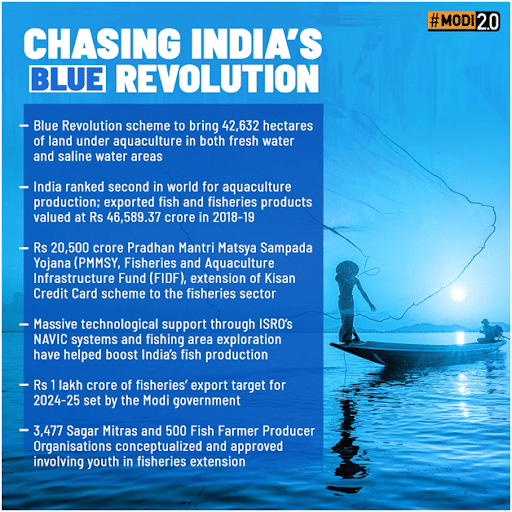
- Today, the Indian Fisheries Sector produces 4.7 million tonnes of fish, including 1.6 million tonnes from freshwater aquaculture, up from 60,000 tonnes 50 years ago.
- In the last decade, India's production of fish and fish products increased at a 14.8% annual rate, compared to a global average of 7.5%.
- Fisheries are India's single largest agricultural export, growing at a rate of 6-10% over the last five years. In comparison, the farm sector grew at a rate of around 2.5% during the same time period.
- Fishing is the primary source of income for many Indian communities, and India is the world's second-largest fish producer, with exports worth more than 47,000 crore rupees.
- Currently, the United States is the largest market for Indian seafood products, accounting for 26.46% of Indian seafood exports, followed by South East Asian countries (25.71%), and European Union nations (20.08%).
- Fisheries and aquaculture production contribute approximately 1% of India's GDP and more than 5% of agricultural GDP.
Indian Fisheries - Developmental Challenges
- High Input Cost: Because fish feed is so expensive, the cost of inputs per unit of fish weight is higher in intensive farming than it is in conventional farming. Cleaning nets requires frequent and labor-intensive work.
- Social Issues: Religious beliefs and social norms prohibit women or other groups from engaging in particular activities. Lack of family support for a less prominent profession is also a cause.
- Lack of Data: India lacks a trustworthy database for aquatic and fishery resources, as well as appropriate government laws and an enforcement body that is ineffective at keeping an eye on the supply of high-quality seeds and feeds.
- Lack of Finance: The products do not have suitable transportation or marketing infrastructure.
- Inadequate Family Labour: The multiple uses of pond water, particularly for home needs, limit commercial fish farming. Multiple land ownership is the root of conflict and differences of opinion. Ownership of aquatic areas is under question.
- Limited Options: Inability to offer value to increase profit margin. The domestic market for processed fish is small and primarily consists of fish cutlets, pickles, and other similar products.
- Technology-related Issues: The technology used in the production of fish is complicated. Lack of timely access to neighboring inputs, poor quality of local feed, outdated equipment tailored to the environment, and insufficient expertise in managing scientific fish farms.
Indian Fisheries - Developmental Strategies
- Exports are primarily responsible for the brackish aquaculture industry's growth.
- Concerns relating to the ecological and economic sustainability of brackish aquaculture and its comparative advantage need to be studied on a multidisciplinary and regional scale in order to maintain the momentum of expansion.
- In order to increase productivity, attention must be paid to advancements in breeding technology, disease prevention, feeds and nutrition, and low-impact production methods.
- Drafting of public and private policies to offer financial assistance, improve capabilities, and make farmers aware of and capable of engaging in sustainable aquaculture.
- For improved planning and monitoring, a focus on utilizing the most recent information technology is required.
- Only in places that are suitable for it can brackish aquaculture be promoted. To reduce issues with ecological pollution and social conflicts, these should be detected and defined with the aid of remote sensing and GIS technology.
- Create the necessary administrative and legal frameworks to control aquaculture operations in ecologically sensitive areas. The municipal government should put these into effect and enforce them.
- Apply quarantine regulations to fish feed and seed to ensure that imported goods are not pathogenic or undesirable.
- Financial institutions should increase loans to the aquaculture industry while still giving the environment and the legal system that oversees it appropriate respect.
- Strengthening the current database is necessary for efficient planning of freshwater and brackish water aquaculture since it is neither adequate nor readily adaptable to proper empirical policy analysis.
Pradhan Mantri Matsya Sampada Yojana
- By supporting infrastructure, marketing, and policy that is appropriate, this Scheme hopes to make India a hub for fish and aquatic products.
- With the Scheme, the government hopes to include all fishermen in social security and agricultural support programs.
- The Department of Fisheries will provide a strong framework for fisheries management through this plan.
- The modernization of infrastructure, traceability, production, productivity, post-harvest management, and quality control, will close a major gap in the value chain.
Conclusion
India's extensive coastline has the potential to become the country's economic engine, especially with the help of the Blue Revolution. India's economy might increase to 10 trillion dollars from its current 2.7 trillion dollars with the aid of the blue economy. India has to improve the science behind its fishing practices and other related areas like freezing and packaging.
FAQs
Question: What is the Blue Revolution?
Answer: The Blue Revolution refers to the significant increase in fish production and aquaculture practices aimed at enhancing the availability of aquatic food resources in India. Initiated in the late 20th century, it focuses on sustainable fishing practices, improving fish farming techniques, and promoting the conservation of aquatic ecosystems.
Question: What are the main objectives of the Blue Revolution?
Answer: The main objectives of the Blue Revolution include increasing fish production, improving the livelihoods of fishers and aquaculture farmers, promoting sustainable fishing practices, enhancing food security, and conserving biodiversity in aquatic habitats.
Question: How has the Blue Revolution impacted the Indian economy?
Answer: The Blue Revolution has had a positive impact on the Indian economy by boosting fish production and exports, creating employment opportunities, and contributing to the overall growth of the aquaculture sector. It has helped improve the income levels of fishers and farmers involved in aquaculture, thereby enhancing food security and nutrition.
Question: What role does technology play in the Blue Revolution?
Answer: Technology plays a crucial role in the Blue Revolution by introducing advanced aquaculture practices, better fish breeding techniques, and improved fish feed formulations. The use of innovative technologies such as water quality monitoring, aeration systems, and integrated farming systems has led to increased efficiency and productivity in fish farming.
Question: What challenges does the Blue Revolution face?
Answer: The Blue Revolution faces several challenges, including overfishing, habitat degradation, pollution of water bodies, and climate change. These factors threaten fish stocks and aquatic ecosystems. Additionally, there is a need for better regulatory frameworks, improved infrastructure, and access to financing for small-scale fish farmers to fully realize the potential of the Blue Revolution.
MCQs
1. What does the term "Blue Revolution" refer to in the context of agriculture?
A) Increase in cereal production
B) Advancement in irrigation techniques
C) Growth of aquaculture and fish production
D) Development of sustainable forestry
Answer: (C) See the Explanation
Explanation: The Blue Revolution specifically refers to the growth and improvement of aquaculture and fish production in India.
2. Which of the following is a primary goal of the Blue Revolution?
A) Reducing agricultural output
B) Promoting sustainable fishing practices
C) Limiting aquaculture expansion
D) Increasing land use for agriculture
Answer: (B) See the Explanation
Explanation: A primary goal of the Blue Revolution is to promote sustainable fishing practices to ensure the long-term viability of aquatic resources.
3. What impact has the Blue Revolution had on fish exports in India?
A) Decreased fish exports
B) Stabilization of fish exports
C) Increased fish exports
D) No impact on fish exports
Answer: (C) See the Explanation
Explanation: The Blue Revolution has led to increased fish exports, contributing positively to the economy and improving livelihoods for those in the fishing industry.
4. What technology is commonly used in modern aquaculture as part of the Blue Revolution?
A) Manual fishing
B) Water quality monitoring systems
C) Traditional farming techniques
D) Hand-crafted fishing nets
Answer: (B) See the Explanation
Explanation: Water quality monitoring systems are commonly used in modern aquaculture to ensure optimal conditions for fish growth and health.
5. Which of the following is a challenge faced by the Blue Revolution?
A) Abundance of aquatic resources
B) Overfishing and habitat degradation
C) Increased government support
D) Technological advancement
Answer: (B) See the Explanation
Explanation: Overfishing and habitat degradation are significant challenges that threaten the sustainability of aquaculture and fish production under the Blue Revolution.
GS Mains Questions and Model Answers
Q1: Evaluate the impact of the Blue Revolution on the livelihoods of fishing communities in India.
Answer: The Blue Revolution has significantly transformed the livelihoods of fishing communities in India by enhancing fish production and promoting aquaculture. Increased access to modern farming techniques, better quality feed, and advanced breeding practices has led to higher yields and improved income levels for fishers. This economic upliftment has contributed to food security and nutritional improvements within these communities. Moreover, the growth of the aquaculture sector has created job opportunities, reducing poverty and enhancing overall socio-economic conditions. The emphasis on sustainable practices under the Blue Revolution also encourages responsible fishing, ensuring that fishing communities can continue to thrive without depleting aquatic resources.
Q2: Discuss the technological advancements that have facilitated the success of the Blue Revolution.
Answer: Technological advancements have played a critical role in the success of the Blue Revolution. Innovations such as genetically improved fish strains, automated feeding systems, and aquaponics have enhanced productivity and efficiency in fish farming. Improved water quality management techniques, including aeration systems and filtration technologies, ensure optimal conditions for fish growth. Furthermore, the use of data analytics for monitoring environmental parameters and fish health has led to better management practices. Training programs that educate fishers about modern aquaculture techniques and sustainable practices have also been pivotal in realizing the potential of the Blue Revolution, fostering a more resilient and productive aquaculture sector.
Q3: Analyze the environmental challenges associated with the Blue Revolution and propose strategies for sustainable aquaculture practices.
Answer: While the Blue Revolution has enhanced fish production, it also poses environmental challenges such as overfishing, habitat destruction, and pollution from aquaculture farms. These issues can lead to biodiversity loss and degradation of aquatic ecosystems. To address these challenges, strategies for sustainable aquaculture should include the implementation of responsible fishing practices that limit catch sizes and preserve breeding stocks. Establishing marine protected areas can help restore and conserve critical habitats. Additionally, promoting integrated farming systems that combine aquaculture with agriculture can improve resource efficiency and reduce waste. Regular monitoring and regulation of aquaculture practices are essential to ensure compliance with environmental standards, ultimately leading to a balanced approach that supports both production and ecological health.
Previous Year Questions on the Blue Revolution
1. UPSC CSE Prelims 2021:
Question: What does the Blue Revolution primarily focus on?
A) Increasing cereal production
B) Enhancing fish production and aquaculture
C) Improving dairy farming
D) Boosting agricultural exports
Answer: (B)
Explanation: The Blue Revolution primarily focuses on enhancing fish production and promoting aquaculture practices in India.
2. UPSC CSE Mains 2020 (GS Paper 3):
Question: "Assess the impact of the Blue Revolution on food security and employment in India."
Answer: The Blue Revolution has positively impacted food security by significantly increasing fish production, which is a vital source of protein for the Indian population. The rise in aquaculture has also created numerous employment opportunities in rural areas, particularly for marginalized communities dependent on fishing for their livelihoods. As fish farming practices expand, the overall availability of fish in the market increases, contributing to better nutrition and economic stability. Additionally, the Blue Revolution promotes sustainable practices that ensure long-term productivity and environmental health, further securing food resources and enhancing the socio-economic conditions of fishing communities.
Download the PREPP App and attempt FREE IAS Exam Mock Tests and get complete study material!

Full Test - 04: UPSC CSE Prelims CSAT (Paper-II)
Full Test - 03: UPSC CSE Prelims CSAT (Paper-II)
UPSC CSE Prelims 2026 GS Paper 1 Question Paper (24-May-2026)
UPSC CSE Prelims 2026 CSAT Paper 2 Question Paper (24-May-2026)

17 February 2025 | The Hindu Must Read Articles | Current Affairs

16 February 2026 | The Hindu Must Read Articles | Current Affairs

13 February 2026 | The Hindu Must Read Articles | Current Affairs









Comments