Body Waves - Seismic Activity - Geography Notes
Body waves are seismic waves that travel through the earth's interior, as opposed to surface waves, which travel near the earth's surface. Body waves and surface waves are the two types of earthquake waves. Body waves are formed when energy is released at the focus and travels in all directions through the earth's body. This article will explain to you about Body Waves - Seismic Activity which will be helpful in Geography preparation for the UPSC Civil service exam.
|
Table of Contents |
Seismic Waves
- Seismic waves are the vibrations or oscillations that travel through the Earth's interior and across its surface in response to various sources of energy release, such as earthquakes, volcanic activity, or human-induced events.
- These waves carry energy and information about the Earth's subsurface and are crucial for understanding the planet's interior structure, seismic activity, and geological processes.
- These seismic waves travel as vibrations through the earth. The vibrations are recorded and measured by a device known as a seismometer.
- The seismometer generates a graph called a Seismograph that depicts these vibrations. These waves travel at different speeds through various materials.
- Earthquake waves are caused by the rapid release of energy along a fault (a sharp rupture in the crustal layer).
- The force produced on the rock layers along a fault causes them to move in opposing directions, but they are kept in place by the frictional force exerted by the above rock strata.
- Over time, the pressure on the rock strata builds up and exceeds the frictional barrier, causing an abrupt movement that generates shockwaves (seismic waves) in all directions.
- Seismic waves are categorized into two main types: Body waves and Surface waves.
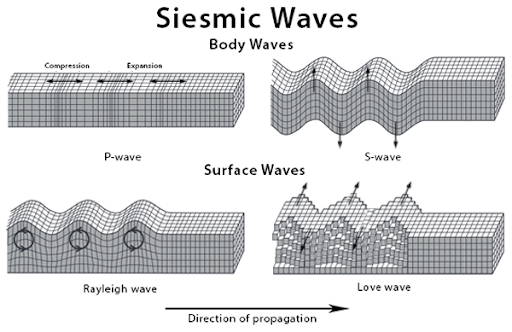
Seismic waves
| Other Relevant Links | |
|---|---|
| Direct Sources | Indirect Sources |
| Seismic Activity | Emergence of Shadow Zone |
| Gravitational Force | Magnetic Field |
| P waves | S waves |
| Surface Waves | Types of Earthquakes |
Body Waves
- Body waves are generated due to the release of energy at the focus and move in all directions traveling through the body of the earth.
- Body waves are seismic waves that travel through the Earth's interior.
- They are generated by the sudden release of energy from events such as earthquakes, volcanic eruptions, or even man-made explosions.
- Since they move through the Earth, they are instrumental in providing information about the Earth's internal structure, including layer densities, thicknesses, and states of matter.
- By analyzing the travel times and paths of these waves, seismologists can infer a lot about the Earth's interior structure and the properties of different layers.
- The variations in the speed and direction of body waves as they interact with different materials inside the Earth help scientists construct models of the Earth's interior, including the identification of the core, mantle, and crust layers.
- There are two primary types of body waves: Primary Waves (P-waves) and Secondary Waves (S-waves).

Body waves
P-waves
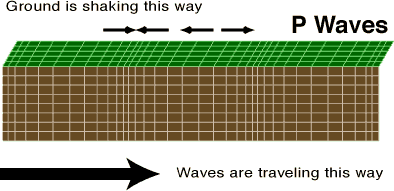
- They are the fastest among seismic waves and thus reach the recording instruments first.
- P-waves are compressional or longitudinal waves, which means the ground particles move in the direction of the wave propagation (similar to sound waves).
- P-waves are also known as longitudinal waves because the displacement of the medium occurs in the same or opposite direction (parallel to) the wave's propagation direction.
- Compressional waves because they cause compression and rarefaction when travelling through a medium; and pressure waves because they cause pressure changes in the medium.
- P-waves cause density variations in the material, causing it to expand (rarefaction) and compress (compression).
- They can travel through solid, liquid, and gaseous materials, which means they can pass through the Earth's crust, mantle, outer core, and inner core.
- When they pass through the Earth's surface, they can shake the ground in the direction of their movement, often feeling like a sudden jolt during an earthquake.
P-waves - Significance
- These waves have a low frequency and are the least damaging of the earthquake waves.
- The earth's surface trembles in an up-down motion as a result of these waves (vertical).
- They may pass through any medium, and their speed is determined by the medium's shear strength (elasticity).
- As a result, the P-wave velocity is of the order: Solids > Liquids > Gases.
- When these waves penetrate the atmosphere, they take the shape of sound waves.
- In earthquakes, the P-wave velocity ranges from 5 to 8 km/s.
- The precise speed varies depending on the region of the Earth's interior, ranging from less than 6 kilometres per second in the crust to 13.5 kilometres per second in the lower mantle and 11 kilometres per second in the inner core.
S-waves
- They are slower than P-waves and arrive at the recording instruments after P-waves.
- S-waves are shear or transverse waves, which means the ground particles move perpendicular to the direction of wave propagation.
- As a result, they leave troughs and crests in the material they move through (they distort the medium).
- They resemble water ripples or light waves in appearance.
- They can only travel through solid materials. This characteristic of S-waves has provided critical evidence that the Earth's outer core is liquid because S-waves do not pass through it.
- They cause more intense shaking than P-waves, moving the ground up and down and side-to-side and are generally responsible for damage and destruction during earthquakes.
S-waves - Significance
- When compared to P-waves, these waves have a greater frequency and a somewhat larger destructive force.
- The earth's surface trembles from side to side as a result of these waves (horizontal).
- Fluids (liquids and gases) do not tolerate shear stresses, hence S-waves cannot flow through them.
- They move through the solid component of the Earth at variable speeds (proportional to shear strength).
Difference Between S-Waves and P-Waves
| S-Waves | P-Waves |
|---|---|
| S-waves arrive after P-waves. | The first wave to strike the earth's surface is the P wave. |
| S-waves are nearly 1.7 times slower than P-waves. | P-waves travel at speeds ranging from 1.5 to 13 km/s |
| S-waves move in a transversal direction. | P-waves move in a straight line. |
| S-waves can only pass through solids. | P-waves are capable of travelling through solids, liquids, and gases. |
Shadow Zone
- The shadow zone is the area of the earth between 105° and 145° angular distance from an earthquake that does not receive any direct P waves.
- P waves are refracted by the liquid core, while S waves are entirely halted by the liquid core, resulting in the shadow zone.
- The shadow zone for both wave types was identified as a zone between 105° and 145° from the epicenter.
- S-waves are not received in the zone beyond 105°.
- S-wave shadow zones are bigger than P-wave shadow zones.
- The P-wave shadow zone appears as a ring around the globe, ranging from 105° to 145° out from the epicenter.

P-wave Shadow zone

S-wave Shadow zone
Conclusion
Body waves provide crucial insights into the Earth's internal layers. Their interaction with the Earth's internal materials helps create accurate models of the Earth's structure.
FAQs
Question. What are body waves in the context of seismic activity?
Answer: Body waves are seismic waves that travel through the interior of the Earth. They are generated by earthquakes and are classified into two main types: Primary (P) waves and Secondary (S) waves. Body waves are essential in studying the Earth's internal structure because they provide valuable information about the composition and state of materials beneath the Earth's surface. Unlike surface waves, body waves can travel through both solid and liquid layers of the Earth.
Question. What are Primary (P) waves and how do they behave during an earthquake?
Answer: Primary (P) waves are the fastest type of seismic wave, traveling through the Earth's interior at speeds ranging from 5 to 8 km/s. They are also known as compressional waves because they cause particles in the medium to move in the same direction as the wave, compressing and expanding the material as they pass through. P waves can travel through both solid and liquid materials, which makes them useful for studying the Earth's liquid outer core, as they pass through it without being absorbed.
Question. What are Secondary (S) waves and how do they differ from Primary (P) waves?
Answer: Secondary (S) waves are slower than P waves, traveling at speeds between 3 and 5 km/s. They are also known as shear waves because they move the particles of the medium perpendicular to the direction of the wave. S waves can only travel through solid materials, which is why they do not pass through the Earth's liquid outer core. This limitation helps scientists understand the Earth's internal structure, particularly confirming the existence of a liquid outer core.
Question. Why are body waves important in studying seismic activity?
Answer: Body waves are crucial in understanding seismic activity because they travel through the Earth's interior and can provide detailed information about the Earth's layers, including the crust, mantle, and core. The differences in how P and S waves travel through different materials help scientists map the internal structure of the Earth. The speed and path of these waves are used to identify the properties of materials inside the Earth, including their density and state (solid or liquid). This information is essential for understanding the behavior of earthquakes and the Earth's geological processes.
Question. How does seismic activity impact the Earth's surface and structures?
Answer: Seismic activity, caused by the release of energy from the Earth's interior, can have significant effects on the surface. The shaking caused by seismic waves can lead to surface ruptures, landslides, and tsunamis. In areas near the epicenter of an earthquake, the shaking can cause buildings and infrastructure to collapse, leading to loss of life and property. Understanding the nature of seismic waves, including body waves, helps in assessing earthquake hazards and developing building codes and engineering solutions to mitigate damage from seismic activity.
MCQs
- Which type of seismic wave is the fastest and can travel through both solid and liquid layers of the Earth?
A) S waves
B) P waves
C) Surface waves
D) Rayleigh waves
Answer: (B) See the Explanation
P waves are the fastest seismic waves and can travel through both solids and liquids, unlike S waves which only travel through solids.
- Which seismic waves are responsible for causing the most damage during an earthquake?
A) P waves
B) S waves
C) Surface waves
D) Primary waves
Answer: (C) See the Explanation
Surface waves are responsible for the most damage during an earthquake because they cause the ground to move in a rolling motion, which leads to severe shaking and destruction.
- What is the primary difference between Primary (P) waves and Secondary (S) waves?
A) P waves move faster than S waves
B) S waves can travel through liquids, while P waves cannot
C) S waves cause particle displacement parallel to wave movement
D) P waves only travel through solids
Answer: (A) See the Explanation
P waves travel faster than S waves and can pass through both solids and liquids, while S waves are slower and can only travel through solids.
- Which of the following layers of the Earth do Secondary (S) waves not pass through?
A) The Earth's mantle
B) The Earth's crust
C) The Earth's outer core
D) The Earth's inner core
Answer: (C) See the Explanation
S waves cannot pass through the liquid outer core of the Earth, while P waves can. This property is used to confirm the outer core's liquid state.
- Which of the following best describes the motion of P waves?
A) Particles move perpendicular to the direction of wave propagation
B) Particles move parallel to the direction of wave propagation
C) Particles move in a circular motion
D) Particles do not move
Answer: (B) See the Explanation
P waves are compressional waves, causing particles to move parallel to the direction of wave travel, compressing and expanding the material.
GS Mains Questions and Model Answers
Q1: Explain the role of seismic waves, particularly body waves, in understanding the internal structure of the Earth.
Answer: Seismic waves, particularly body waves (P and S waves), are crucial for understanding the internal structure of the Earth. As these waves travel through different layers of the Earth, their speed, direction, and interaction with various materials provide valuable insights into the Earth’s composition and structure. P waves, being the fastest, can travel through both solids and liquids, while S waves only travel through solids, which allows scientists to infer the liquid nature of the Earth's outer core. By studying the way seismic waves are refracted or absorbed as they move through different materials, geophysicists can create models of the Earth’s interior, mapping out the crust, mantle, and core. This method is one of the key tools used in seismology to understand the Earth’s geological processes, the causes of earthquakes, and the behavior of materials at extreme depths.
Q2: Analyze the significance of understanding seismic waves for earthquake preparedness and mitigation in earthquake-prone areas.
Answer: Understanding seismic waves, particularly body waves like P and S waves, is crucial for earthquake preparedness and mitigation, especially in areas prone to seismic activity. The study of how seismic waves travel through the Earth helps in identifying areas that are at risk of severe shaking, thus aiding in the design of earthquake-resistant infrastructure. By measuring the arrival times of P and S waves, seismologists can predict the arrival time of surface waves, which cause the most damage. This allows for early warning systems, providing communities with time to evacuate or take protective measures. Additionally, understanding seismic wave propagation helps in assessing the depth and magnitude of earthquakes, which are key in designing appropriate building codes and disaster response plans. By leveraging seismic wave data, governments and local authorities can implement targeted measures to minimize loss of life and property damage during seismic events.
Q3: Discuss the implications of seismic activity on the landscape and human settlements, and the role of seismic wave studies in disaster management.
Answer: Seismic activity has profound implications for both the landscape and human settlements. Earthquakes caused by seismic waves can lead to surface ruptures, landslides, tsunamis, and damages to infrastructure. The shaking caused by surface waves, in particular, can cause buildings, roads, and bridges to collapse, leading to widespread devastation. Understanding seismic waves, especially body waves (P and S waves), allows scientists to study how seismic energy propagates and identify vulnerable areas. The study of seismic waves also helps in assessing earthquake magnitude and predicting aftershocks, which are crucial for disaster management. By understanding the behavior and arrival times of seismic waves, early warning systems can be implemented, providing time for people to evacuate and for emergency services to mobilize. Seismic studies also aid in mapping fault lines and identifying seismic hazards, enabling better urban planning and more effective earthquake-resistant construction practices. In this way, seismic wave research plays a key role in minimizing the human and economic costs of seismic events.
Previous Year Questions on Body Waves
1. UPSC 2021
Question: Discuss the role of seismic waves in understanding the Earth’s internal structure and their significance in earthquake studies.
Answer: This question required candidates to explore how seismic waves, particularly body waves, are used to study the Earth’s internal structure. The explanation involved understanding how P and S waves help confirm the composition of the Earth's core, and how seismic waves are used in earthquake studies to assess risk, magnitude, and impact.
2. UPSC 2019
Question: Explain the significance of seismic waves in disaster management and their role in predicting earthquake behavior.
Answer: This question required an explanation of how seismic waves, including body waves, contribute to disaster management. Candidates needed to discuss how seismic waves are used in early earthquake warning systems and how they help in planning and preparation for earthquake-resistant infrastructure and effective emergency responses.
Download the PREPP App and attempt FREE IAS Exam Mock Tests and get complete study material!
UPSC IAS : CSAT - Mini Live Test

Live Test : UPSC CSE Prelims CSAT (Paper-II) (Oct 20 - 23)
Full Test - 04: UPSC CSE Prelims CSAT (Paper-II)
Full Test - 03: UPSC CSE Prelims CSAT (Paper-II)
UPSC CSE Prelims 2026 GS Paper 1 Question Paper (24-May-2026)
UPSC CSE Prelims 2026 CSAT Paper 2 Question Paper (24-May-2026)

17 February 2025 | The Hindu Must Read Articles | Current Affairs

16 February 2026 | The Hindu Must Read Articles | Current Affairs

13 February 2026 | The Hindu Must Read Articles | Current Affairs









Comments