Splash Erosion - Agriculture Notes
Soil erosion is a serious ecological and environmental problem, as well as the primary cause of land degradation in many ecosystems on a global scale. Splash erosion is the first stage in the soil erosion process is the detachment of soil particles caused by raindrop splash. Soil erosion is to blame for land degradation in many ecosystems on a global scale. Soil erosion is a natural process that causes the mobilisation, transport, and off-site sedimentation of mineral and organic soil particles, as well as associated chemicals and biota. In this article, we will discuss Splash Erosion which will be helpful for UPSC exam preparation.
|
Table of Contents |
What is Soil Erosion?
- Soil erosion is the loosening and displacement of topsoil from the land caused by agents such as wind and water.
- Topsoil is the most fertile layer of soil because it contains the most organic, nutrient-rich materials.
- In nature, soil erosion can be a slow process (geological erosion) or a fast process accelerated by human activities such as overgrazing and deforestation.
- Weathering and erosion cause 'degradation' and 'aggradation' to occur at the same time.
- Weathering is a static process, whereas erosion is a mobile process (there is no motion of disintegrated material except the falling down under the force of gravity).
- Water, wind, and tillage erosion all involve three distinct actions: soil detachment, movement, and deposition.
- Topsoil, which is rich in organic matter, fertility, and soil life, is either moved "on-site" where it accumulates over time or transported "off-site" where it fills drainage channels.
- Soil erosion reduces cropland productivity while also polluting nearby watercourses, wetlands, and lakes.
- Soil erosion can be a slow process that goes unnoticed for a long time, or it can happen quickly and cause significant loss of topsoil.
- Other serious soil degradation conditions that can accelerate the soil erosion process include soil compaction, low organic matter, loss of soil structure, poor internal drainage, salinisation, and soil acidity.
|
|
|
|---|---|
| Sheet erosion | Rill erosion |
| Micro Irrigation | Gully erosion |
| Desertification | Water logging |
What is Splash Erosion?
- Splash erosion is the first stage of erosion. It happens when raindrops hit bare soil.
- The explosive impact breaks up soil aggregates, causing individual soil particles to be 'splashed' onto the soil surface.
- The splashed particles can rise up to 60cm above the ground and travel up to 1.5 metres from the point of impact.
- The particles obstruct the spaces between soil aggregates, causing the soil to form a crust that reduces infiltration and increases runoff.
- Raindrops' impact loosens the material that holds it together, allowing small fragments to detach.
- If the rain continues, water collects on the ground, causing water flow on the land surface, which is referred to as surface water runoff.
Impact of Splash Erosion
- Depending on the soil, splash erosion can displace soil particles up to 1.5 m vertically and up to > 5 m horizontally with the help of the wind.
- Furthermore, if raindrops fall on bare soil surfaces, they can contribute to an increase in soil bulk density due to compaction and crusting.
- Although the crusting process usually results in a relatively smooth soil surface in the long run, the impact of raindrops and the resulting splash process can form miniature craters as a result of particle redistribution which increases the surface roughness of the soil.
- The size of these miniature craters is determined by the type of soil, texture, structure, and moisture.
- Crust impedes plant establishment by inhibiting germination and seedling growth and decreasing infiltration rates. Water may accumulate on the soil surface due to insufficient infiltration.
- Ponding, sheet and rill overland flow may shield the soil from raindrop impacts by acting as a protective layer of mulch, but these processes reduce infiltration rates and soil water availability for plant growth.
- Similarly, pre-detached soil particles may offer ephemeral protection to the underlying soil. Only superficial pre-detached material is splashed if the layer of pre-detached particles is too deep for raindrops to penetrate.
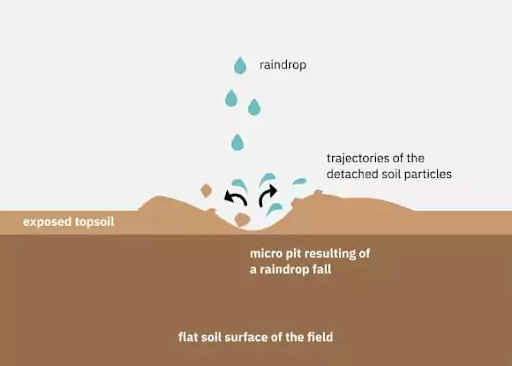
Effect of Splash Erosion on Flat Field
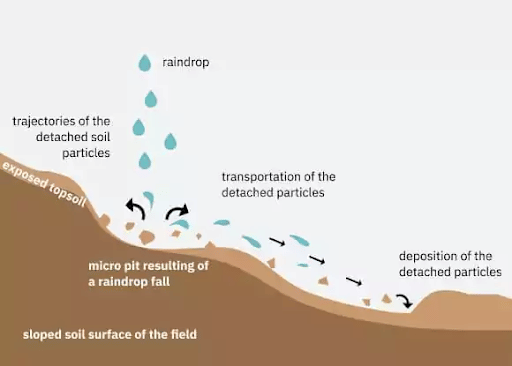
Effect of Splash Erosion on Sloped Field
Strategies to Prevent Splash Erosion
- According to research, ground cover must be maintained at or above 70% to prevent soil particle detachment and the initiation of sheet and rill erosion.
- Strategies such as vegetation cover or different mulch materials, have been found to be useful in preventing splash erosion because those materials can absorb the impact of raindrops and protect the ground surface.
- If the soil particles are not separated, they will not be transported by the sheet flow, and the sheet flow will not have enough potential to dislodge more soil particles from the bare surface.
- However, the intensity of splash erosion is primarily determined by the soil's resistance to erosion and the kinetic energy of the raindrops.
Conclusion
Detachment of soil particles by splash erosion may be considered the first step in water-induced soil erosion, which is why we must investigate the factors involved as well as the mechanisms that control splash erosion. Furthermore, splash plays an important role in the liberation of soil organic carbon because when runoff forms, carbon-enriched particles that were previously detached by splash erosion are transported.
FAQs
Question: What is splash erosion?
Answer: Splash erosion is the initial stage of soil erosion caused by the impact of raindrops. When raindrops strike the ground, they dislodge soil particles, causing them to splash and move over short distances. This type of erosion is more pronounced in areas with loose, fine soils and inadequate vegetation cover.
Question: What are the main causes of splash erosion?
Answer: The main causes of splash erosion include heavy rainfall, intense and frequent raindrops, dry and loose soil, and insufficient vegetation cover. Areas with compacted soils or soil with little organic matter are particularly vulnerable to splash erosion.
Question: How does splash erosion affect agricultural productivity?
Answer: Splash erosion reduces the soil’s ability to retain water and nutrients, leading to poor soil structure. This erosion can damage the topsoil, which is essential for agricultural productivity. It also increases the vulnerability of the land to further erosion, affecting crop growth and reducing yield potential.
Question: What preventive measures can be taken to reduce splash erosion?
Answer: Preventive measures for splash erosion include increasing vegetation cover, using cover crops, mulching, maintaining organic matter in the soil, and reducing soil compaction. Additionally, adopting contour plowing and terrace farming can help control water runoff and minimize soil displacement.
Question: How is splash erosion different from other forms of soil erosion?
Answer: Splash erosion is distinct from other forms of soil erosion, such as sheet and gully erosion, in that it is caused by the direct impact of raindrops on the soil surface. While splash erosion involves the displacement of individual soil particles, sheet erosion occurs when water flows uniformly over the land, and gully erosion involves the formation of channels or gullies due to water runoff.
MCQs
1. What causes splash erosion?
A) Soil erosion due to wind
B) Impact of raindrops on soil surface
C) Water flowing over a slope
D) Loss of soil due to agricultural practices
Answer: (B) See the Explanation
Explanation: Splash erosion is caused by the direct impact of raindrops on the soil surface, which displaces soil particles.
2. Which of the following is NOT a preventive measure for splash erosion?
A) Mulching
B) Increasing soil compaction
C) Using cover crops
D) Maintaining organic matter in soil
Answer: (B) See the Explanation
Explanation: Soil compaction increases the risk of splash erosion by making the soil less porous and reducing its ability to absorb water. It is not a preventive measure.
3. What is the primary effect of splash erosion on the soil?
A) It compacts the soil
B) It increases water retention
C) It removes the topsoil and reduces fertility
D) It enhances soil structure
Answer: (C) See the Explanation
Explanation: Splash erosion primarily removes the topsoil, which is crucial for fertility, and reduces the soil’s ability to retain water and nutrients.
4. Which of the following practices helps prevent splash erosion?
A) Growing a dense cover of vegetation
B) Using synthetic fertilizers
C) Overgrazing the land
D) Expanding irrigation systems
Answer: (A) See the Explanation
Explanation: Growing dense vegetation helps prevent splash erosion by protecting the soil from the direct impact of raindrops, reducing soil displacement.
5. What is the main difference between splash erosion and sheet erosion?
A) Splash erosion is caused by wind, while sheet erosion is caused by water
B) Splash erosion involves the direct impact of raindrops, while sheet erosion occurs due to water flowing uniformly across the surface
C) Sheet erosion removes the topsoil, while splash erosion does not
D) Splash erosion forms gullies, while sheet erosion does not
Answer: (B) See the Explanation
Explanation: Splash erosion involves soil particle displacement caused by raindrop impact, while sheet erosion occurs when water flows evenly across the land surface, gradually removing the topsoil.
GS Mains Questions and Model Answers
Q1: Discuss the causes and effects of splash erosion on agricultural lands.
Answer: Splash erosion occurs when raindrops hit the soil surface, causing soil particles to be displaced. It is primarily caused by heavy rainfall, high-intensity rainfall events, and poorly managed soil with low organic matter and vegetation cover. The effects of splash erosion are detrimental to agricultural lands, as it results in the loss of topsoil, which is crucial for plant growth. The removal of topsoil diminishes soil fertility, reduces the ability of the soil to retain water, and ultimately leads to lower agricultural productivity. It also increases the vulnerability of the soil to further erosion, exacerbating the loss of valuable land.
Q2: How can the impact of splash erosion be mitigated in regions prone to heavy rainfall?
Answer: To mitigate splash erosion in regions prone to heavy rainfall, several measures can be taken. These include maintaining adequate vegetation cover, such as grass and cover crops, to shield the soil from raindrop impact. Implementing contour farming and terracing can reduce runoff and prevent soil displacement. Additionally, mulching and adding organic matter to the soil helps increase its structure and water retention capacity, making it less susceptible to erosion. Education and awareness among farmers about the importance of soil conservation techniques are also key in preventing splash erosion.
Q3: Explain the relationship between splash erosion and soil fertility. How can conservation techniques help preserve soil fertility?
Answer: Splash erosion leads to the removal of the nutrient-rich topsoil, which is critical for maintaining soil fertility. When topsoil is displaced, the soil loses essential nutrients, moisture, and organic matter, which diminishes its productivity. This can result in reduced crop yields and poorer soil health. Conservation techniques such as crop rotation, mulching, cover cropping, and organic farming can help preserve soil fertility by maintaining the structure and organic matter content of the soil, preventing further erosion, and promoting sustainable land use practices.
Previous Year Questions on Erosion and Soil Conservation
1. UPSC CSE Prelims 2021:
Question: Which of the following is a primary cause of splash erosion?
A) Strong winds
B) Water runoff
C) Impact of raindrops on soil
D) Deforestation
Answer: (C)
Explanation: Splash erosion is caused by the impact of raindrops on the soil surface, leading to the displacement of soil particles.
2. UPSC CSE Mains 2020 (GS Paper 3):
Question: "Discuss the impact of various forms of soil erosion on agricultural productivity in India. What measures can be taken to mitigate the impact of splash erosion?"
Answer: Soil erosion, including splash erosion, significantly impacts agricultural productivity by removing the fertile topsoil, which is essential for crop growth. Splash erosion, in particular, is most damaging in areas with loose soil and inadequate vegetation cover. To mitigate this impact, practices like improving ground cover with crops, organic mulching, and adopting contour farming can be employed. These techniques help retain soil moisture, reduce water runoff, and prevent further erosion, leading to improved agricultural yields and sustainable farming practices.
Download the PREPP App and attempt FREE IAS Exam Mock Tests and get complete study material!

Full Test - 04: UPSC CSE Prelims CSAT (Paper-II)
Full Test - 03: UPSC CSE Prelims CSAT (Paper-II)
UPSC CSE Prelims 2026 CSAT Paper 2 Question Paper (24-May-2026)
UPSC CSE Prelims 2026 GS Paper 1 Question Paper (24-May-2026)

17 February 2025 | The Hindu Must Read Articles | Current Affairs

16 February 2026 | The Hindu Must Read Articles | Current Affairs

13 February 2026 | The Hindu Must Read Articles | Current Affairs









Comments