Gully Erosion - Agriculture Notes
Gully erosion occurs when concentrated surface water scours out the regolith and underlying rock, with the debris either deposited downslope or transported into river systems, causing significant downstream problems. The severity and shape of the gully are highly dependent on the rock type. The very severe to extreme gully erosion is limited to argillites (crushed), mudstone, and fine siltstones, each with its own distinct gully shape. In this article, we will discuss Gully Erosion which will be helpful for UPSC exam preparation.
|
Table of Contents |
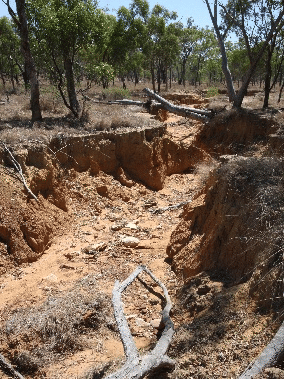
Gully Erosion
What is Soil Erosion?
- Soil erosion is the loosening and displacement of topsoil from the land caused by agents such as wind and water.
- Topsoil is the most fertile layer of soil because it contains the most organic, nutrient-rich materials.
- In nature, soil erosion can be a slow process (geological erosion) or a fast process accelerated by human activities such as overgrazing and deforestation.
- Weathering and erosion cause 'degradation' and 'aggradation' to occur at the same time.
- Weathering is a static process, whereas erosion is a mobile process (there is no motion of disintegrated material except the falling down under the force of gravity).
- Water, wind, and tillage erosion all involve three distinct actions: soil detachment, movement, and deposition.
- Topsoil, which is rich in organic matter, fertility, and soil life, is either moved "on-site" where it accumulates over time or transported "off-site" where it fills drainage channels.
- Soil erosion reduces cropland productivity while also polluting nearby watercourses, wetlands, and lakes.
- Soil erosion can be a slow process that goes unnoticed for a long time, or it can happen quickly and cause significant loss of topsoil.
- Other serious soil degradation conditions that can accelerate the soil erosion process include soil compaction, low organic matter, loss of soil structure, poor internal drainage, salinisation, and soil acidity.
|
|
|
|---|---|
| Splash erosion | Sheet erosion |
| Micro Irrigation | Rill erosion |
| Desertification | Water logging |
What is Gully?
- A gully is a landform formed by running water, mass movement, or a combination of the two eroding sharply into soil or other relatively erodible material, most commonly on a hillside or in river floodplains or terraces.
- Gullies look like large ditches or small valleys, but they are metres to tens of metres deep and wide, with a distinct 'headscarp' or 'headwall' and progress by headward (i.e. upstream) erosion.
- Gullies are frequently associated with intermittent or ephemeral water flow, which is typically associated with localised intense or prolonged rainfall events or snowmelt.
- Gullies can be formed and accelerated by cultivation practices on farmland hillslopes, and they can form quickly in rangelands from existing natural erosion forms subject to vegetative cover removal and livestock activity.
What is Gully Erosion?
- Gully erosion is a visible type of soil erosion that reduces soil productivity and restricts land access and use.
- Gully soil can also cause infrastructure damage by burying fence lines, silting up waterways, clogging road culverts, and filling dams and reservoirs.
- Suspended sediments from an eroding gully can degrade water quality. Nutrients and pesticides are attached to these fine colloidal clay particles, which can remain suspended for long periods of time, clogging groundwater aquifers, polluting watercourses, and endangering aquatic flora and fauna.
- Controlling gully erosion can be challenging and expensive. It may be justified on higher-quality soils where there is a reasonable chance of success, or in strategic locations such as where a road or building is under threat by an advancing gully.
- Gully erosion is a more advanced stage of rill erosion in which surface channels have eroded to the point where tillage operations cannot remove them.
- A gully head forms when rill erosion deepens and widens, resulting in a distinctive nick point or headwall. As a result of headwall migration, most gullies extend up slope.
- However, the collapse and slumping of sidewalls is usually responsible for the greatest proportion of soil loss.
- Human land use, particularly changes in land use, may hasten gully expansion through head cutting, sidewall collapse, piping, floor erosion, and other processes, resulting in widespread land degradation and potential damage to human structures and activities.
- A gully is traditionally distinguished from a rill by having a critical cross-sectional area of at least one square foot, i.e., the size of a channel that can no longer be erased by normal tillage operations.
- Gullies are frequently associated with a wide range of on-site and off-site consequences.
- On-site consequences include direct loss of land, trees, and crops, as well as decreased trafficability. These restrict agricultural and other land-use options.
- Gullies can also severely damage roads, buildings, and other infrastructure. In severe cases, such destructions may result in a large number of casualties.
- Off-site consequences of gully erosion include changes in catchment hydrology, such as lower river baseflows and higher peak runoff discharge.
- Gullies can indirectly contribute to sediment loads by increasing runoff and sediment connectivity between upland areas, valley bottoms, and river networks or lakes.
- On-site consequences include direct loss of land, trees, and crops, as well as decreased trafficability. These restrict agricultural and other land-use options.
- As a result, gully erosion is a major concern in many areas around the world. It is a key process in land degradation and desertification, posing a significant threat to various ecosystems and ecosystem services.
Causes of Gully Erosion
- Cultivation or grazing on gully-prone soils.
- Increased runoff caused by land use changes such as tree removal in a catchment or the construction of new residential areas.
- Furrows, contour banks, waterways, dams by washes, stock pads, fences, tracks, or roads all contribute to runoff concentration.
- Waterways in cropping areas that are improperly designed, built, or maintained.
- A lack of vegetation cover caused by overgrazing, fires, or salinity issues.
- Long periods of low flows or seepage flows.
- 'Down cutting' in a creek causes gullies to advance up the drainage lines that flow into it.
- Diversion of a drainage line to an area of high erosion risk, such as a steep creek bank or erodible soil.
- Gully erosion occurs when water is channelled across unprotected land and washes away the soil along drainage lines.
- Under natural conditions, runoff is moderated by vegetation, which generally holds the soil together, protecting it from excessive runoff and direct rainfall.
- Excessive clearing, inappropriate land use, and soil compaction caused by grazing often leave the soil exposed and unable to absorb excess water.
- Surface runoff then increases and concentrates in drainage lines, allowing gully erosion to develop in vulnerable areas.
Problems Caused by Gully Erosion
- Property dissection causing access and management issues.
- Loss of productive land (gullies often occur in the most productive area of the catchment).
- Reduced amenity and property values, including the destruction of farm improvements such as fences or tracks.
- Discoloration of water supply and sedimentation of waterways, dams, and lower paddocks.
- Provides a haven for vermin.
Prevention of Gully Erosion
- The primary, long-term control method for gully erosion is vegetation.
- Stock must be kept out of all gullies, and the gully floor, sidewalls, and surrounding areas must be revegetated. Because of moisture stress, it is often difficult to establish vegetation on gully sidewalls.
- Replant the gully floor with fast-growing grasses.
- Sidewalls and surrounding areas have been replanted with trees and grasses.
- It is possible that irrigation, hydroseeding, and mulching will be required.
- Replant the catchment above the gully (increase water usage).
- If runoff can be diverted and safely disposed of, gully erosion may be controlled.
- Contour drains and diversion banks are used to divert water away from the gully head.
- In many gully systems, properly designed and installed engineering structures may be the only way to stop headward progress.
- Preserving remnant vegetation along drainage lines and removing grazing from these areas.
- Increasing water usage by planting deep-rooted perennial pastures, trees, or an appropriate mixture of both, thereby maintaining healthy, vigorous levels of vegetation.
- Identifying drainage lines as a distinct land class in which vegetation must be protected.
- Immediate sheet or rill erosion stabilization.
- Ensuring that track runoff is evenly distributed across paddocks to dissipate its energy.
- Maintaining high levels of organic matter in the soil.
- Avoiding excessive cultivation (fence and manage the land according to its capability).
Conclusion
Gully erosion is an advanced stage of water damage to land when the surface channels have been eroded to the point where tillage operations would be useless. Apart from causing massive soil losses and the destruction of farmland, it also reduces water quality by increasing the sediment load in streams. Gully erosion, once established, can be difficult to control. In most cases, a combination of approaches is required, such as the use of vegetation, fencing, diversion banks, and engineering structures. Gullies are widely regarded by the scientific community as an important landform for understanding environmental change and soil erosion risks, and they can play an important role in raising public awareness about these issues.
FAQs
Question: What is gully erosion?
Answer: Gully erosion is the removal of soil along drainage lines by surface water runoff, leading to the formation of large channels or gullies. It typically occurs in areas with loose soil, steep slopes, and sparse vegetation.
Question: What causes gully erosion?
Answer: Gully erosion is primarily caused by intense water flow over unprotected soil, lack of vegetation, poor land management, and heavy rainfall, which accelerates water runoff.
Question: How does gully erosion impact agriculture?
Answer: Gully erosion reduces the fertility of land by removing topsoil, decreases agricultural productivity, and can lead to land degradation, rendering it unfit for farming.
Question: What are some methods to control gully erosion?
Answer: Methods include planting vegetation, constructing check dams, contour bunding, terracing, and using grassed waterways to slow down water flow and stabilize the soil.
Question: Where is gully erosion commonly found in India?
Answer: Gully erosion is commonly found in areas with undulating topography, such as parts of the Chambal basin in Madhya Pradesh and Rajasthan.
MCQs
- Gully erosion primarily occurs due to:
A) Wind action
B) Water runoff and intense rainfall
C) Earthquakes
D) Volcanic activity
Answer: (B) See the Explanation
Gully erosion is caused by the action of water runoff, which removes soil along drainage paths, creating gullies.
- Which of the following is a method to control gully erosion?
A) Over-irrigation
B) Planting vegetation on slopes
C) Deforestation
D) Urban expansion
Answer: (B) See the Explanation
Vegetation stabilizes the soil, reduces runoff velocity, and helps control gully erosion.
- Gully erosion commonly leads to:
A) Increased soil fertility
B) Formation of deep channels in soil
C) Soil compaction
D) Rapid urban development
Answer: (B) See the Explanation
Gully erosion creates large channels or gullies due to the removal of topsoil by water.
- The Chambal basin is particularly prone to:
A) Desertification
B) Gully erosion
C) Coastal erosion
D) Riverbank stabilization
Answer: (B) See the Explanation
The Chambal basin in India experiences significant gully erosion due to its topography and soil characteristics.
- Contour bunding is used to control:
A) Waterlogging
B) Gully and soil erosion
C) Mining activities
D) Air pollution
Answer: (B) See the Explanation
Contour bunding involves creating barriers along slopes to reduce water runoff and soil loss.
GS Mains Questions and Model Answers
Q1: Discuss the causes and consequences of gully erosion on agricultural land.
Answer: Gully erosion occurs due to intense water runoff, poor land management, and lack of vegetation cover, particularly on sloped terrain. It results in the removal of topsoil, reducing land fertility and making it unsuitable for agriculture. Deep gullies impede farming operations and can cause sediment deposition downstream, impacting water bodies. Addressing gully erosion requires soil conservation measures, community awareness, and sustainable land management practices to minimize its impact on agriculture and the environment.
Q2: Explain the measures used to control and prevent gully erosion in India.
Answer: Measures to control gully erosion include planting vegetation to stabilize soil, constructing check dams to reduce water velocity, contour bunding, terracing, and establishing grassed waterways. These methods slow down water runoff, minimize soil loss, and improve water infiltration. Effective implementation of these practices, combined with community participation and sustainable land management policies, is critical for preventing gully erosion and protecting agricultural land.
Q3: How does gully erosion affect soil conservation efforts in India?
Answer: Gully erosion poses significant challenges to soil conservation in India by rapidly degrading fertile topsoil and forming deep channels that are difficult to reclaim. It affects agricultural productivity and disrupts local ecosystems. Addressing gully erosion requires a comprehensive approach, including reforestation, soil stabilization techniques, and promoting sustainable agricultural practices, to maintain soil health and support conservation efforts.
Previous Year Questions on Gully Erosion
1. UPSC CSE 2018
Question: Assess the impact of gully erosion on India's agricultural productivity and suggest measures for mitigation.
Answer: Gully erosion reduces agricultural productivity by removing nutrient-rich topsoil, creating deep channels, and degrading arable land. This form of erosion is common in areas with poor vegetation cover and intense rainfall. Mitigation measures include contour bunding, reforestation, constructing check dams, and promoting soil conservation practices. Effective policies, community engagement, and sustainable land use are essential to mitigate the impact of gully erosion on agriculture.
2. UPSC CSE 2020
Question: Discuss the role of vegetation and community participation in controlling gully erosion.
Answer: Vegetation plays a critical role in controlling gully erosion by stabilizing soil, reducing runoff, and slowing water flow. Plant roots bind the soil, minimizing erosion. Community participation ensures the success of soil conservation initiatives by involving local stakeholders in reforestation, contour bunding, and water management. Effective community engagement promotes sustainable practices, fostering long-term erosion control and soil health improvement.
Download the PREPP App and attempt FREE IAS Exam Mock Tests and get complete study material!

Full Test - 04: UPSC CSE Prelims CSAT (Paper-II)
Full Test - 03: UPSC CSE Prelims CSAT (Paper-II)
UPSC CSE Prelims 2026 CSAT Paper 2 Question Paper (24-May-2026)
UPSC CSE Prelims 2026 GS Paper 1 Question Paper (24-May-2026)

17 February 2025 | The Hindu Must Read Articles | Current Affairs

16 February 2026 | The Hindu Must Read Articles | Current Affairs

13 February 2026 | The Hindu Must Read Articles | Current Affairs









Comments