Sheet Erosion - Agriculture Notes
Sheet erosion, which is often difficult to detect, is responsible for extensive soil loss in both cultivated and non-cultivated environments. Sheet erosion occurs when a shallow sheet of water flows over the ground surface, removing a uniform layer of soil from the surface. When rainfall intensity exceeds infiltration, sheet erosion occurs (sometimes due to crusting). Sheet erosion, while less visible than other types of erosion, is typically the dominant erosive force. Sheet erosion is less noticeable than gully erosion because it does not leave visible cuts in the soil surface. In this article, we will discuss Sheet erosion which will be helpful for UPSC exam preparation.
|
Table of Contents |
What is Soil Erosion?
- Soil erosion is the loosening and displacement of topsoil from the land caused by agents such as wind and water.
- Topsoil is the most fertile layer of soil because it contains the most organic, nutrient-rich materials.
- In nature, soil erosion can be a slow process (geological erosion) or a fast process accelerated by human activities such as overgrazing and deforestation.
- Weathering and erosion cause 'degradation' and 'aggradation' to occur at the same time.
- Weathering is a static process, whereas erosion is a mobile process (there is no motion of disintegrated material except the falling down under the force of gravity).
- Water, wind, and tillage erosion all involve three distinct actions: soil detachment, movement, and deposition.
- Topsoil, which is rich in organic matter, fertility, and soil life, is either moved "on-site" where it accumulates over time or transported "off-site" where it fills drainage channels.
- Soil erosion reduces cropland productivity while also polluting nearby watercourses, wetlands, and lakes.
- Soil erosion can be a slow process that goes unnoticed for a long time, or it can happen quickly and cause significant loss of topsoil.
- Other serious soil degradation conditions that can accelerate the soil erosion process include soil compaction, low organic matter, loss of soil structure, poor internal drainage, salinisation, and soil acidity.
|
|
|
|---|---|
| Splash erosion | Rill erosion |
| Micro Irrigation | Gully erosion |
| Desertification | Water logging |
What is Sheet Erosion?
- The removal of soil in thin layers by raindrop impact and shallow surface flow is known as sheet erosion.
- It results in the loss of the finest soil particles, which contain the majority of the soil's available nutrients and organic matter.
- It usually occurs after crusting, which is caused by the previous stage of water damage to the soil.
- Soil loss is so gradual that it often goes unnoticed, but the cumulative impact accounts for significant soil losses.
- Overgrazed and cultivated soils with little vegetation to protect and hold the soil are the most vulnerable to sheet erosion.
- Bare areas, water puddling as soon as rain falls, visible grass roots, exposed tree roots, and exposed subsoil or stony soils are early signs of sheet erosion.
- Active sheet erosion may be indicated by soil deposits on the high side of obstructions such as fences.
- Surface water flows that cause sheet erosion rarely travel more than a few metres before condensing into rills.
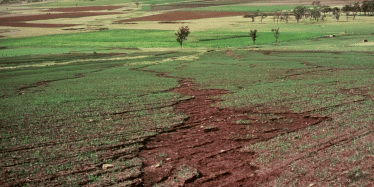
Sheet Erosion
Process of Sheet Erosion
- Sheet erosion happens in two stages - First, rainsplash dislodges small particles of the substrate and then the particles are carried away, usually short distances, by a thin and uniform layer of water known as sheetflow.
- Transport by the sheetflow is usually over small distances, meaning that sheet erosion is a low magnitude process.
- The frequency with which this occurs over time, on the other hand, may be high, compensating for the small change observed in each individual episode of sheet erosion.
- A sheet flood can be distinguished from an ordinary sheet flow by its much greater magnitude and much lesser frequency.
- Sheet floods have been linked to a variety of causes, including high-intensity rain, low relief, a lack of vegetation, low permeability of the substrate, strong weather contrast between seasons, slope form, and climate change.
- Sheet floods are typically turbulent, whereas sheet flow can be laminar or turbulent.
Causes of Sheet Erosion
- Sheet erosion is more likely in areas that receive heavy rainfall and are prone to flooding.
- Sheet erosion is also affected by the thickness of raindrops and wind force. Because of the pressure exerted on the ground by falling raindrops, thin layers of soil wash away easily with the rain.
- Soils that are uneven or loose are more prone to erosion. We must ensure that cultivated lands are not overly loose, as this causes rill and gully erosion.
- Sheet and gully erosion causes massive damage, including sidewall collapse and agricultural loss.
- A significant amount of deforestation has also resulted in soil loss due to sheet erosion.
- Because trees have a high water retention capacity, cutting them down causes soil loosening and waterlogging. As a result, rain can easily wash away the soil layers.
Prevention of Sheet Erosion
- Sheet erosion can be avoided by maintaining plant cover (which prevents splash erosion) and increasing ponded water infiltration through the preservation of soil structure and organic matter.
- Organic matter acts as a glue, stabilising pore spaces that allow surface water to penetrate deeper into the soil, reducing the volume of ponded water available for erosion.
Conclusion
Sheet erosion is a major problem in India today, affecting the country's agriculture and cultivation. Every year, the sheet erosion process devastates vast areas of cropland, resulting in vegetation loss. As a result, it not only harms the land but also impedes the cultivation process.
FAQs
Question. What is sheet erosion?
Answer: Sheet erosion is a type of water erosion where thin layers of soil are uniformly removed from the surface by rainfall or water runoff. It leads to the gradual degradation of the soil across large areas, impacting its fertility and structure.
Question. What causes sheet erosion?
Answer: Sheet erosion is caused by factors such as heavy rainfall, excessive water runoff, poor soil structure, and deforestation. These factors expose the soil surface, making it vulnerable to erosion.
Question. How does sheet erosion affect agriculture?
Answer: Sheet erosion adversely affects agriculture by:
- Removing fertile topsoil.
- Reducing soil fertility and crop yields.
- Causing soil compaction and poor water infiltration.
- Decreasing water retention capacity, especially in drought-prone areas.
Question. How can sheet erosion be controlled?
Answer: Sheet erosion can be controlled through:
- Planting vegetative cover, such as cover crops or grasses.
- Contour farming and terracing to reduce water runoff.
- Mulching to protect the soil surface.
- Agroforestry to stabilize soil and reduce erosion.
Question. What is the difference between sheet erosion and other types of erosion?
Answer: Sheet erosion involves the uniform removal of thin soil layers, whereas:
- Rill erosion forms small channels on the soil surface.
- Gully erosion creates deep channels or gullies.
- Wind erosion occurs in arid regions due to wind removing topsoil.
MCQs
- What is sheet erosion primarily caused by?
A) Wind
B) Overgrazing
C) Water runoff and rainfall
D) Deforestation
Answer: (C) See the Explanation
Sheet erosion is mainly caused by water runoff and rainfall, which remove thin layers of soil from the surface uniformly.
- How does sheet erosion affect soil fertility?
A) Increases fertility
B) Has no effect on fertility
C) Decreases fertility by removing nutrient-rich topsoil
D) Improves fertility by adding nutrients
Answer: (C) See the Explanation
Sheet erosion removes nutrient-rich topsoil, leading to decreased soil fertility and lower agricultural productivity.
- Which of the following is a method to prevent sheet erosion?
A) Irrigation
B) Planting cover crops
C) Removing vegetation
D) Increasing fertilizer use
Answer: (B) See the Explanation
Planting cover crops protects the soil from erosion by providing a protective layer that reduces the impact of rainfall and water runoff.
- Which of the following is NOT a characteristic of sheet erosion?
A) Uniform removal of soil across large areas
B) Formation of deep gullies
C) Occurs due to rainfall and water runoff
D) Leads to loss of fertile topsoil
Answer: (B) See the Explanation
Sheet erosion involves uniform removal of soil without forming deep gullies, which are characteristic of gully erosion.
- What is a common consequence of sheet erosion on agricultural land?
A) Increased soil fertility
B) Improved crop yields
C) Decreased soil fertility
D) More water retention in the soil
Answer: (C) See the Explanation
Sheet erosion results in the loss of nutrient-rich topsoil, leading to decreased soil fertility and lower crop yields.
GS Mains Questions and Model Answer
Q1: Explain the impact of sheet erosion on agricultural productivity and suggest control measures.
Answer: Sheet erosion reduces agricultural productivity by removing nutrient-rich topsoil, compacting soil, and reducing water infiltration. This leads to poor crop yields and drought vulnerability. Control measures include:
- Contour farming and terracing to reduce runoff.
- Vegetative cover and agroforestry to stabilize soil.
- Mulching to protect the soil surface.
Q2: How can farmers prevent sheet erosion in hilly areas and maintain soil fertility?
Answer: Farmers in hilly areas can use measures like:
- Terracing and contour farming to reduce water flow.
- Planting cover crops to protect the soil.
- Agroforestry to stabilize soil and improve organic matter.
These practices prevent soil loss and maintain fertility, ensuring sustainable agriculture.
Q3: Discuss the role of government policies in addressing sheet erosion and promoting sustainable agriculture.
Answer: Government policies play a critical role in mitigating sheet erosion through:
- Soil conservation programs like the National Watershed Development Program.
- Financial incentives for sustainable practices like mulching and agroforestry.
- Awareness campaigns and research into soil conservation techniques.
These measures encourage sustainable farming and reduce the impacts of sheet erosion.
Previous Year Questions on Sheet erosion
1. UPSC CSE 2021
Question: Explain the process of sheet erosion and its impact on agricultural land. What measures can be taken to prevent it?
Answer: This question focuses on the process of sheet erosion, its negative impact on agriculture, and effective prevention methods such as contour farming, terracing, and vegetative cover.
2. UPSC CSE 2020
Question: Discuss the role of conservation tillage in preventing soil erosion and maintaining soil fertility in agricultural areas.
Answer: Conservation tillage reduces soil erosion by minimizing disturbance, retaining organic matter, and improving soil structure, making it a vital practice for sustainable agriculture in erosion-prone areas.
Download the PREPP App and attempt FREE IAS Exam Mock Tests and get complete study material!

Full Test - 04: UPSC CSE Prelims CSAT (Paper-II)
Full Test - 03: UPSC CSE Prelims CSAT (Paper-II)
UPSC CSE Prelims 2026 GS Paper 1 Question Paper (24-May-2026)
UPSC CSE Prelims 2026 CSAT Paper 2 Question Paper (24-May-2026)

17 February 2025 | The Hindu Must Read Articles | Current Affairs

16 February 2026 | The Hindu Must Read Articles | Current Affairs

13 February 2026 | The Hindu Must Read Articles | Current Affairs









Comments