Schedule 9 of Indian Constitution - Indian Polity Notes
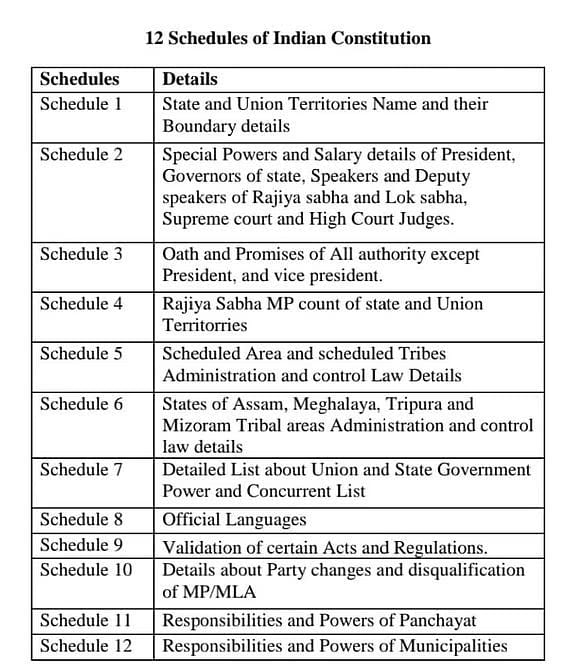
Ninth Schedule of the Indian Constitution contains a list of Central and State laws that cannot be challenged in court(legal challenge). Currently, 284 such laws are immune from judicial review. The Ninth Schedule of the Constitution was added by the First Constitutional Amendment Act of 1951. This topic is very much in the news as there was demand from some states to put their reservation quota laws in the 9th Schedule to avoid judicial scrutiny. Therefore becomes important for the upcoming UPSC Preliminary Examination 2024.
|
Table of Contents |
Objectives of the Ninth Schedule
- To implement a number of land reforms following Independence.
- To put an end to feudalism and make room for socialism to take its place, the Zamindari system must be eliminated.
- To eliminate some laws that act as roadblocks to reform and may violate fundamental rights.
- To bring the most disadvantaged sections in mainstream in order to protect their interests.
- To reduce the concentration of land in a few hands and share the land among farmers in order to fulfill the constitutional mandate of creating an egalitarian society.
Important Provisions
- The Ninth Schedule was established by the new Article 31B, which, along with 31A, was enacted by the government to protect agrarian reform laws and to abolish the Zamindari system.
- While Article 31A protects "classes" of laws, Article 31B protects specific laws or enactments.
- The First Amendment amended the Schedule by adding 13 new laws. Following amendments in 1955, 1964, 1971, 1974, 1975, 1976, 1984, 1990, 1994, and 1999, the number of protected laws increased to 284.
- Article 31B also has retrospective application, which means that if laws are inserted into the Ninth Schedule after they have been declared unconstitutional, they are considered to have been in the Schedule since their inception and thus valid.
- Although Article 31B precludes judicial review, the Supreme Court has previously stated that laws under the Ninth Schedule would be subject to scrutiny if they violated fundamental rights or the Constitution's basic structure.
- While the majority of the laws protected by the Schedule concern agriculture/land issues, the list also includes topics such as reservation.
- The Schedule includes a Tamil Nadu law that provides for 69% reservation in the state.
Criticism of 9th Schedule
- Misuse of Power: The party in power can add laws to the Ninth Schedule to protect vested interests.
- Violation of Fundamental Rights: Quota laws and Reservation legislations can violate the right to equality guaranteed by the Constitution.
- Misuse of the 9th Schedule: The primary aim of including the Ninth Schedule was to safeguard land reform laws from judicial scrutiny and delays. But over the period of time, some non-relevant laws were also added just to avoid judicial scrutiny.
- Violation of principle of Judicial review: It deprives the courts of the power to examine the constitutionality of acts. Judicial review is an essential feature of the Constitution which is asserted by the Supreme Court in its several judgements.
- Demand for putting arbitrary laws in the 9th schedule: There is growing demand from various states to put quota laws under 9th schedule.Eg.Chhattisgarh government has asked the Centre to enlist the amended reservation provisions of a state which provides for 76% reservation in the Ninth Schedule, Jharkhand's new bill which seeks to increase the reservation in government posts to 77%.
SC Judgements Regarding 9th Schedule
- Waman Rao v. Union of India (1981): The Supreme Court ruled that the amendments made after 24th April 1973 in the Ninth Schedule can be challenged on the grounds of constitutionality.
- I R Coelho v. State of Tamil Nadu (2007): The Supreme Court ruled that any law added in the Ninth Schedule after 24th April 1973 must be examined for violation of Fundamental Rights under Articles 14, 19, and 21. It stated that any act that violates the basic structure of the Constitution can be challenged.
Conclusion
The rationale for Article 31-B and the Ninth Schedule was to protect only legislation dealing with property rights.In practice, however, Article 31-B has been used to invoke protection for many laws that have nothing to do with property rights.Article 31-B is thus being used for purposes other than the socioeconomic ones for which it was enacted.It necessitates a need to relook the provisions of the 9th Schedule.
FAQs
Q1. What is the 9th Schedule of the Indian Constitution?
The 9th Schedule is a section in the Indian Constitution that protects specific laws from judicial review, even if they infringe upon fundamental rights. It was introduced to ensure smooth implementation of land reforms and socio-economic legislation.
Q2. Which Constitutional Amendment introduced the 9th Schedule?
The First Constitutional Amendment Act, 1951 introduced the 9th Schedule to safeguard land reform laws from judicial interference.
Q3. Can laws under the 9th Schedule be challenged in court?
Initially, laws under the 9th Schedule were immune from judicial review. However, the Supreme Court in the I.R. Coelho case (2007) ruled that even these laws could be challenged if they violated the basic structure of the Constitution.
Q4. What is the purpose of the 9th Schedule?
The 9th Schedule was intended to prevent legal challenges against land reforms and other socio-economic measures, ensuring quick implementation without the risk of annulment by courts.
Q5. How many laws are currently listed under the 9th Schedule?
Currently, more than 280 laws are listed under the 9th Schedule, with several related to land reforms, economic policies, and affirmative actions.
MCQs
- Which Amendment introduced the 9th Schedule to the Indian Constitution?
A) 42nd Amendment
B) 1st Amendment
C) 44th Amendment
D) 73rd Amendment
Answer: (B) See the Explanation
- What was the primary reason for including laws under the 9th Schedule?
A) Promoting industrial growth
B) Preventing judicial review of socio-economic reforms
C) Strengthening local governance
D) Protecting the Right to Information
Answer: (B) See the Explanation
- Which landmark case allowed judicial review of laws in the 9th Schedule?
A) Kesavananda Bharati Case
B) Golaknath Case
C) I.R. Coelho Case
D) Minerva Mills Case
Answer: (C) See the Explanation
- How many laws were initially placed under the 9th Schedule?
A) 30
B) 13
C) 10
D) 4
Answer: (B) See the Explanation
- What is the significance of the basic structure doctrine concerning the 9th Schedule?
A) It prevents Parliament from amending fundamental rights.
B) It limits judicial review of executive actions.
C) It allows courts to strike down unconstitutional laws even in the 9th Schedule.
D) It restricts the introduction of economic policies.
Answer: (C) See the Explanation
GS Mains Questions and Model Answers
Q1. Discuss the significance of the 9th Schedule in the context of Indian land reforms.
Answer: The introduction of the 9th Schedule through the First Amendment in 1951 played a critical role in advancing land reforms in post-independent India. It provided legal immunity to socio-economic laws from judicial review, ensuring smooth implementation of land redistribution and tenancy laws. The intent was to eliminate feudal practices and empower marginalized farmers. However, over time, the 9th Schedule was misused to protect other controversial laws, leading to criticism. The I.R. Coelho judgment (2007) reasserted judicial oversight, ensuring that laws violating the basic structure of the Constitution could not be shielded under the 9th Schedule.
Q2. How has the judiciary addressed the conflict between the 9th Schedule and fundamental rights?
Answer: Initially, the 9th Schedule was meant to shield socio-economic legislation from judicial review, even if it violated fundamental rights. However, the Supreme Court, through the I.R. Coelho case (2007), ruled that laws placed in the 9th Schedule after April 24, 1973 (Kesavananda Bharati judgment) would be subject to judicial scrutiny. This judgment ensures that while Parliament can legislate on socio-economic issues, it cannot violate the basic structure of the Constitution, including fundamental rights.
Q3. Examine the role of the 9th Schedule in balancing judicial review and parliamentary sovereignty.
Answer: The 9th Schedule highlights the complex interplay between judicial review and parliamentary sovereignty in India. While it was introduced to safeguard land reforms from legal challenges, it also raised concerns about undermining fundamental rights. The judiciary’s intervention, particularly in the I.R. Coelho case, reaffirmed that laws under the 9th Schedule cannot violate the basic structure of the Constitution. This balancing act ensures that Parliament can enact progressive laws while respecting constitutional values, maintaining the delicate balance between legislation and judicial oversight.
Previous Year Questions on Schedule 9 of Indian Constitution
1. UPSC CSE 2017
Question: "What is the significance of the Ninth Schedule of the Indian Constitution? Discuss with recent judicial pronouncements."
Answer: The Ninth Schedule was introduced through the First Amendment in 1951 to protect land reform laws from judicial review. The primary objective was to promote social and economic justice by enabling swift implementation of reforms. However, over time, the Schedule was used to shield several controversial laws. The I.R. Coelho judgment (2007) brought a turning point by ruling that laws under the 9th Schedule are not immune from judicial scrutiny if they violate the basic structure of the Constitution. This judgment ensures that the Schedule cannot be misused to curtail fundamental rights, maintaining a balance between parliamentary sovereignty and judicial review.
2. UPSC CSE 2019
Question: "Critically analyze the judicial stance on the immunity of laws under the Ninth Schedule with reference to the I.R. Coelho case."
Answer: The I.R. Coelho vs. State of Tamil Nadu (2007) judgment was a landmark ruling that redefined the judicial stance on the immunity of laws under the 9th Schedule. The court held that laws placed under the Schedule after the Kesavananda Bharati judgment (1973) would be subject to judicial review if they violated the basic structure of the Constitution. This verdict emphasized that while Parliament has the power to make laws, it cannot override fundamental rights or alter the Constitution’s core principles. The judgment curtailed potential misuse of the 9th Schedule, ensuring that laws promoting social justice do not compromise constitutional values.
*email: contactus@prepp.in
Download the PREPP App and attempt FREE IAS Exam Mock Tests and get complete study material!
UPSC IAS : CSAT - Mini Live Test

Live Test : UPSC CSE Prelims CSAT (Paper-II) (Oct 20 - 23)
Full Test - 04: UPSC CSE Prelims CSAT (Paper-II)
Full Test - 03: UPSC CSE Prelims CSAT (Paper-II)
UPSC CSE Prelims 2026 GS Paper 1 Question Paper (24-May-2026)
UPSC CSE Prelims 2026 CSAT Paper 2 Question Paper (24-May-2026)

17 February 2025 | The Hindu Must Read Articles | Current Affairs

16 February 2026 | The Hindu Must Read Articles | Current Affairs

13 February 2026 | The Hindu Must Read Articles | Current Affairs









Comments