Schedule 8 of Indian Constitution - 22 Official Languages - Indian Polity Notes
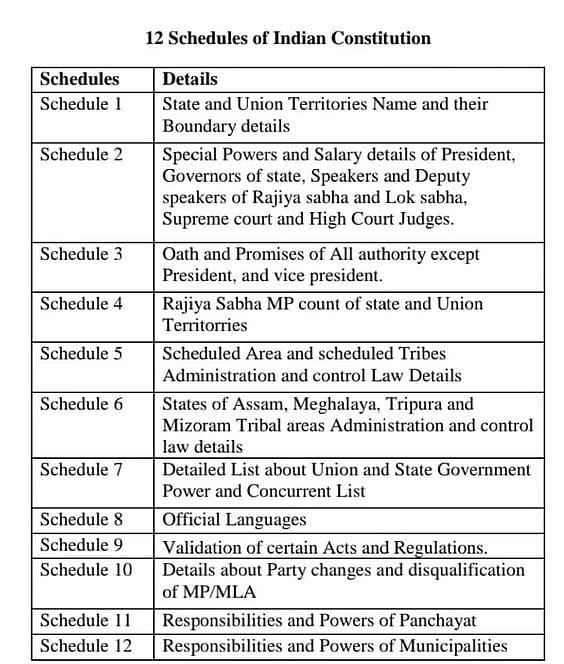
Schedule 8 of the Indian Constitution deals with the 22 official languages of India. Articles 344(1) and 351 of the Constitution contain constitutional provisions relating to the Eighth Schedule. Provisions related to languages are important for UPSC Examination.
|
Table of Contents |
Schedule 8 of Indian Constitution - Related Articles
- Article 344(1): This article calls for the President to appoint a Commission after five years from the date the Constitution takes effect.
- Article 351: According to Article 351 of the Constitution, it is the Union's duty to promote the spread of the Hindi language and develop it so that it can serve as a medium of expression for all elements of India's composite culture.
- Article 351 (1): According to Article 344(1), the President must establish a commission after five years have passed since the Constitution's inception and again after ten years.
- The commission must have a chairman and members who represent the various languages listed in the eighth schedule, and its purpose is to advise the President on the effective use of Hindi for official purposes by the Government of India.
Schedule 8 of Indian Constitution - 22 Classical Languages
- The Constitution's Eighth Schedule includes the following 22 languages:
- Assamese
- Bengali
- Gujarati
- Hindi
- Kannada
- Kashmiri
- Konkani
- Malayalam
- Manipuri
- Marathi
- Nepali
- Oriya
- Punjabi
- Sanskrit
- Sindhi
- Tamil
- Telugu
- Urdu
- Bodo
- Santhali
- Maithili and
- Dogri
- 14 of these languages were initially included in the Constitution.
- The Sindhi language was added in 1967 by the 21st Amendment Act.
- Thereafter three more languages viz., Konkani, Manipuri, and Nepali were included by 71st Amendment Act 1992.
- Following that, the 92nd Amendment Act 2003 added Bodo, Dogri, Maithili, and Santhali, which came into effect in 2004.
Schedule 8 of the Indian Constitution - Special Directives
In order to safeguard the rights of linguistic minorities and further the advancement of Hindi, the Indian Constitution includes a number of particular provisions. The following provisions apply:
- Every person who feels aggrieved has the right to make a representation for the resolution of any grievance to any officer or authority of the Union or a state in one of the languages used in the Union or the state, as the case may be. This indicates that a representation cannot be disregarded because it was written in a language other than an official one.
- Children from linguistic minority groups should have access to suitable facilities for instruction in their mother tongue at the elementary stage of education from every state and local authority in the state. The president has the authority to give the required instructions for this.
- The President should designate a special officer for linguistic minorities who would be responsible for looking into and reporting on all issues pertaining to the constitutional protections for linguistic minorities.
- All such reports should be presented to the Parliament by the president, who should also transmit a copy to the relevant star government.(bulleting changed as these are the subpoints)
Status of Classical Languages
- The Indian government made the decision to establish a new category of languages known as "classical languages" in 2004.
- It established the requirements for awarding the status of a classical language in 2006. The standards are as follows:
- A language must contain historical documents dating back between 1500 and 2000 years.
- A body of prehistoric literature or writings that are regarded as a priceless legacy by succeeding generations of speakers and a literary tradition that is unique and not appropriated from another speech community.
- Six languages have so far been designated as classical languages as of 2016.
- Odia was the most recent language to receive this designation in 2014, having received Tamil as the first language in 2004.
- Once a language has been designated as classical, it is given financial support for the establishment of a center of excellence for its study and becomes eligible for two significant awards for eminent scholars.
- Currently, there are six languages that enjoy the ‘Classical’ Status: Tamil (2004), Sanskrit (2005), Kannada (2008), Telugu (2008), Malayalam (2013), and Odia (2014).
Conclusion
The Government is aware of the sentiments and requirements for the inclusion of other languages in the Eighth Schedule and will examine the requests with these sentiments and other considerations in mind, such as dialect evolution into language, widespread use of a language, and so on.
FAQs
Question: What is Schedule 8 of the Indian Constitution?
Answer: Schedule 8 of the Indian Constitution pertains to the languages recognized by the Constitution. It lists the official languages of the Union and provides a framework for the use of these languages in various aspects of governance, administration, and education. The inclusion of languages in Schedule 8 ensures the preservation and promotion of linguistic diversity in India, which is a country with a rich tapestry of languages and dialects. The schedule currently recognizes 22 languages, including Hindi, Bengali, Telugu, Marathi, Tamil, Urdu, and others.
Question: Why was Schedule 8 added to the Constitution?
Answer: Schedule 8 was incorporated into the Constitution to acknowledge and promote the linguistic diversity of India. It aims to ensure that various languages are recognized and used in official communication, education, and cultural activities. This recognition is vital for preserving the heritage and identity of different linguistic communities and fostering national integration by acknowledging the multilingual character of Indian society. The schedule supports the rights of linguistic minorities and helps prevent discrimination based on language.
Question: How does Schedule 8 influence education in India?
Answer: Schedule 8 influences education in India by mandating the use of recognized languages in teaching and learning processes. Many states have adopted the languages listed in Schedule 8 as mediums of instruction in schools, thereby promoting mother-tongue education. This practice helps improve comprehension and retention among students, particularly in early education. Additionally, the recognition of these languages encourages the development of educational materials and curricula in various regional languages, enhancing accessibility to education for diverse linguistic groups.
Question: What are the challenges associated with the implementation of Schedule 8?
Answer: The implementation of Schedule 8 faces several challenges, including:
- Regional Disparities: Different states may prioritize certain languages over others, leading to uneven development and representation of languages.
- Lack of Resources: Inadequate educational materials and trained teachers in regional languages can hinder effective implementation.
- Language Shift: There is a tendency among younger generations to prefer dominant languages, which may undermine the use of regional languages.
- Political Factors: Language politics can lead to tensions between linguistic communities, complicating policy implementation.
Addressing these challenges requires coordinated efforts from government, educational institutions, and community organizations.
Question: How are languages added or removed from Schedule 8?
Answer: Languages can be added to or removed from Schedule 8 through an amendment to the Constitution. This process involves a proposal by the Parliament, which must be passed by a simple majority in both Houses. The decision to add or remove a language typically considers factors such as linguistic demand, cultural significance, and the number of speakers. Various stakeholders, including regional governments and linguistic communities, often advocate for changes to reflect the evolving linguistic landscape of the country.
MCQs
1. What is the primary focus of Schedule 8 of the Indian Constitution?
A) Fundamental Rights
B) Official languages
C) Financial distribution
D) Election procedures
Answer: (B) See the Explanation
Explanation: Schedule 8 focuses on the recognition of official languages in India, ensuring the preservation of linguistic diversity.
2. How many languages are currently recognized in Schedule 8?
A) 15
B) 20
C) 22
D) 25
Answer: (C) See the Explanation
Explanation: Schedule 8 currently recognizes 22 languages, reflecting India's linguistic diversity.
3. Which of the following is NOT a challenge in implementing Schedule 8?
A) Regional disparities
B) Excessive funding
C) Language shift
D) Lack of resources
Answer: (B) See the Explanation
Explanation: Excessive funding is not a challenge; rather, inadequate funding and resources are concerns in implementing Schedule 8.
4. What is required for a language to be added to Schedule 8?
A) Majority vote in the local assembly
B) Presidential decree
C) Constitutional amendment
D) Public petition
Answer: (C) See the Explanation
Explanation: A language can be added to Schedule 8 through a constitutional amendment passed by Parliament.
5. Which of the following languages is included in Schedule 8?
A) Sanskrit
B) Esperanto
C) Latin
D) Swahili
Answer: (A) See the Explanation
Explanation: Sanskrit is included in Schedule 8, recognizing its cultural and historical significance in India.
GS Mains Questions and Model Answers
Q1: Discuss the significance of Schedule 8 in promoting linguistic diversity in India.
Answer: Schedule 8 of the Indian Constitution plays a crucial role in promoting linguistic diversity by formally recognizing multiple languages and providing a framework for their use in governance, education, and culture. By listing 22 languages, Schedule 8 ensures that linguistic minorities have the right to communicate and receive services in their native languages, fostering inclusivity and representation. This recognition also encourages the development of educational materials and curricula in various languages, which helps in preserving regional languages and cultures. Furthermore, it promotes national integration by acknowledging the linguistic plurality of the country, thereby strengthening the fabric of Indian democracy. Through its provisions, Schedule 8 serves as a vital instrument for safeguarding linguistic rights and promoting cultural heritage.
Q2: Analyze the impact of regional languages on education and governance in India.
Answer: Regional languages have a profound impact on education and governance in India, facilitating better comprehension and learning outcomes for students. Using regional languages as mediums of instruction allows children to grasp concepts more effectively, particularly in early education. This approach enhances their cognitive abilities and encourages greater participation in learning. In governance, the use of regional languages ensures that governmental processes are accessible to local populations, promoting transparency and citizen engagement. It fosters a sense of belonging and empowerment among linguistic communities, which is essential for participatory democracy. However, challenges such as the dominance of a few languages and inadequate resources for teaching regional languages persist, necessitating concerted efforts to promote multilingual education and governance for effective communication and development.
Q3: Evaluate the role of government policies in supporting the implementation of Schedule 8.
Answer: Government policies play a significant role in supporting the implementation of Schedule 8 by providing the necessary infrastructure, resources, and frameworks to promote linguistic diversity. Policies focused on education ensure that schools incorporate regional languages into their curricula, promoting mother-tongue education. Financial support for language development programs and the production of teaching materials in various languages enhances accessibility to education. Additionally, government initiatives to encourage the use of regional languages in official communication and public services reinforce the importance of linguistic representation. The promotion of cultural events and festivals celebrating different languages also helps raise awareness about linguistic heritage. However, continuous evaluation and adaptation of these policies are essential to address emerging challenges and ensure the effective implementation of Schedule 8 in a rapidly changing sociolinguistic landscape.
Previous Year Questions on Schedule 8
1. UPSC CSE Prelims 2021:
Question: How many languages are included in Schedule 8 of the Indian Constitution?
A) 20
B) 22
C) 25
D) 18
Answer: (B)
Explanation: Schedule 8 includes 22 languages, recognizing the linguistic diversity of India.
2. UPSC CSE Mains 2019 (GS Paper 1):
Question: Analyze the implications of recognizing multiple languages in Schedule 8 for Indian society.
Answer: Recognizing multiple languages in Schedule 8 has profound implications for Indian society, as it reflects the country's commitment to linguistic diversity and cultural pluralism. This recognition empowers various linguistic communities by ensuring their rights to use their languages in education, governance, and public life. It fosters inclusivity, enhancing social cohesion among diverse groups and mitigating linguistic conflicts. Moreover, the acknowledgment of regional languages promotes the preservation of cultural heritage and traditions associated with these languages. However, the implementation of such provisions requires ongoing support and resources to address disparities in language development and education, ensuring that all communities can benefit equitably from their linguistic rights.
*email: contactus@prepp.in
Download the PREPP App and attempt FREE IAS Exam Mock Tests and get complete study material!

Live Test : UPSC CSE Prelims CSAT (Paper-II) (Oct 20 - 23)
Full Test - 04: UPSC CSE Prelims CSAT (Paper-II)
Full Test - 03: UPSC CSE Prelims CSAT (Paper-II)
UPSC CSE Prelims 2026 GS Paper 1 Question Paper (24-May-2026)
UPSC CSE Prelims 2026 CSAT Paper 2 Question Paper (24-May-2026)

17 February 2025 | The Hindu Must Read Articles | Current Affairs

16 February 2026 | The Hindu Must Read Articles | Current Affairs

13 February 2026 | The Hindu Must Read Articles | Current Affairs









Comments