Schedule 1 of Indian Constitution - Indian Polity Notes
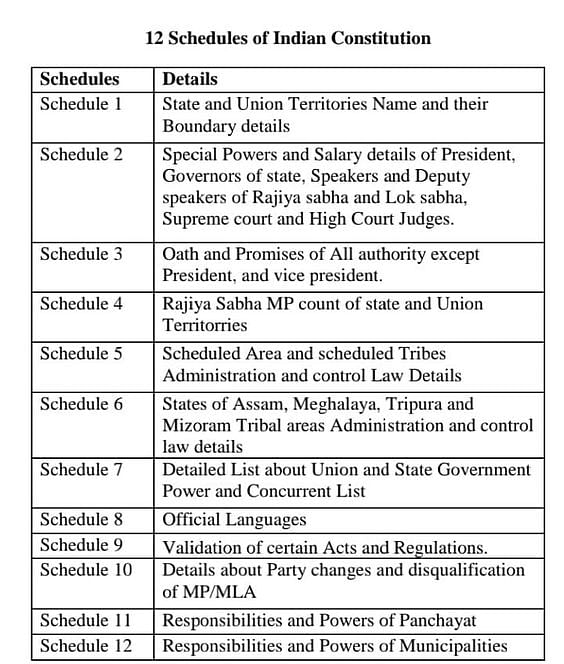
Schedules are essentially tables that contain information not found in the articles. There were initially eight schedules in the Indian Constitution. Four more schedules were added as a result of various amendments, bringing the total number of schedules to 12. Schedule 1 of the Indian constitution contains the list of states and union territories and their extent and territorial jurisdictions.
The aspirants preparing for UPSC must be aware of the contents of each Schedule of the constitution and important amendments to the Schedules.
|
Table of Contents |
Main Provisions
Schedule 1 of the Indian Constitution deals with
- Names of the States and their territorial jurisdiction.
- Names of the Union Territories and their extent.
It deals with Articles 1 and 4.
Amendment to Schedule 1
- Whenever there is a change in the territory of a state/UT or formation of a new state/UT or merger of states/UTs Schedule 1 gets amended.
- The first amendment of Schedule 1 was carried out by the 7th Constitutional Amendment 1956 with the formation of the Andhra Pradesh state.
- The recent amendment to Schedule 1 was by the Jammu and Kashmir Reorganisation Act, 2019 which deleted the Jammu and Kashmir entry from the State list and added “Jammu and Kashmir” and “Ladakh” entries in the Union Territory list of Schedule 1.

FAQs
Question: What is Schedule 1 of the Indian Constitution?
Answer: Schedule 1 lists the states and union territories of India, along with their territorial jurisdictions.
Question: How many states and union territories are listed in Schedule 1?
Answer: Schedule 1 originally listed 29 states and 7 union territories, but changes have been made over time through amendments.
Question: Which amendment reorganized the states in India?
Answer: The 7th Constitutional Amendment Act of 1956 reorganized states based on linguistic lines.
Question: What is the significance of Schedule 1?
Answer: Schedule 1 provides a legal framework for the establishment of states and union territories, specifying their boundaries and jurisdictions.
Question: Has Schedule 1 undergone any amendments?
Answer: Yes, Schedule 1 has been amended multiple times to accommodate the creation of new states and changes in territorial boundaries.
MCQs
- What is listed in Schedule 1 of the Indian Constitution?
a) Fundamental Rights
b) Official languages of India
c) States and Union Territories
d) Powers of the President
Answer: (C) See the Explanation
Schedule 1 contains a list of states and union territories along with their territorial boundaries.
- Which constitutional amendment reorganized the states based on linguistic lines?
a) 42nd Amendment
b) 44th Amendment
c) 7th Amendment
d) 1st Amendment
Answer: (C) See the Explanation
The 7th Amendment of 1956 reorganized the states along linguistic lines.
- What is the primary purpose of Schedule 1 in the Indian Constitution?
a) To list the fundamental rights of citizens
b) To define the powers of the Union
c) To list the states and union territories
d) To specify the official languages
Answer: (C) See the Explanation
Schedule 1 outlines the states and union territories of India along with their boundaries.
- How can changes be made to Schedule 1 of the Indian Constitution?
a) By a simple majority in Parliament
b) By a constitutional amendment
c) By an executive order
d) By a Supreme Court decision
Answer: (B) See the Explanation
Changes to Schedule 1 can only be made through a constitutional amendment passed by Parliament.
- Which Union Territory was last added to Schedule 1?
a) Delhi
b) Chandigarh
c) Ladakh
d) Daman and Diu
Answer: (C) See the Explanation
Ladakh was added as a Union Territory after the bifurcation of Jammu & Kashmir through the Jammu and Kashmir Reorganization Act, 2019.
GS Mains Questions and Model Answers
Q1: Examine the role of Schedule 1 in the federal structure of India.
Answer: Schedule 1 plays a critical role in India's federal structure by defining the states and union territories and their territorial boundaries. It serves as the foundation for India's political and administrative divisions, ensuring clarity in governance and jurisdictional matters. By specifying the units of the Indian Union, Schedule 1 lays the groundwork for the distribution of powers between the Union and the states as outlined in the Constitution. The schedule has been amended multiple times to accommodate changes such as the creation of new states, reflecting the dynamic nature of India's federalism.
Q2: Discuss the impact of constitutional amendments on Schedule 1 and its relevance in contemporary India.
Answer: Schedule 1 has undergone several amendments to reflect the evolving political landscape of India, particularly in response to demands for statehood and regional autonomy. Amendments such as the 7th Amendment and more recently the Jammu & Kashmir Reorganization Act, 2019, showcase its adaptability. The creation of new states like Telangana and union territories like Ladakh highlights Schedule 1's ongoing relevance in addressing regional aspirations, administrative efficiency, and federal governance. These changes ensure that the Indian Union remains flexible and responsive to the needs of its diverse population.
Analyze the importance of Schedule 1 in the reorganization of Indian states post-independence.
Answer: Schedule 1 has been instrumental in India's post-independence state reorganization, particularly through the 7th Amendment, which reorganized states based on linguistic lines. This schedule ensures that the political boundaries of the states and union territories are clearly defined, promoting effective governance and regional identity. The dynamic nature of Schedule 1 allows for the continuous reconfiguration of state boundaries to address regional demands, administrative challenges, and geopolitical considerations, making it a cornerstone of India’s evolving federal structure.
Previous Year Questions on Schedule 1 of Indian Constitution
1. UPSC CSE Prelims 2018:
Question: Schedule 1 of the Indian Constitution deals with:
A. Distribution of powers
B. Union and State Lists
C. States and Union Territories
D. Fundamental Rights
Answer: C
Explanation: Schedule 1 provides a list of the states and union territories along with their respective jurisdictions and boundaries.
2. UPSC CSE Mains 2017 (GS Paper 2):
Question: Discuss the significance of the 7th Constitutional Amendment Act of 1956 in the reorganization of states.
Answer: The 7th Constitutional Amendment Act of 1956 was a landmark in the reorganization of states based on linguistic lines. This reorganization aimed to create more coherent administrative units by aligning state boundaries with linguistic identities, addressing long-standing regional demands. It resulted in the creation of new states and the alteration of several boundaries, fostering unity and administrative efficiency. The amendment also provided a framework for future changes to state boundaries and the creation of new states, as seen with later additions to Schedule 1.
3. UPSC CSE Prelims 2017:
Question: Which constitutional schedule lists the states and union territories of India?
A. Schedule 7
B. Schedule 1
C. Schedule 3
D. Schedule 5
Answer: B
Explanation: Schedule 1 of the Indian Constitution contains the list of states and union territories along with their territorial boundaries.
*email: contactus@prepp.in
Download the PREPP App and attempt FREE IAS Exam Mock Tests and get complete study material!

Live Test : UPSC CSE Prelims CSAT (Paper-II) (Oct 20 - 23)
Full Test - 04: UPSC CSE Prelims CSAT (Paper-II)
Full Test - 03: UPSC CSE Prelims CSAT (Paper-II)
UPSC CSE Prelims 2026 GS Paper 1 Question Paper (24-May-2026)
UPSC CSE Prelims 2026 CSAT Paper 2 Question Paper (24-May-2026)

17 February 2025 | The Hindu Must Read Articles | Current Affairs

16 February 2026 | The Hindu Must Read Articles | Current Affairs

13 February 2026 | The Hindu Must Read Articles | Current Affairs









Comments