Schedule 11 of Indian Constitution - Indian Polity Notes
Schedule 11 of the Indian Constitution contains provisions that specify the Panchayats' powers, authority, and responsibilities. The Eleventh Schedule was added by the 73rd Amendment Act of 1992. It has 29 subjects such as Agriculture, Animal Husbandry, Fishery, etc.
|
Table of Contents |

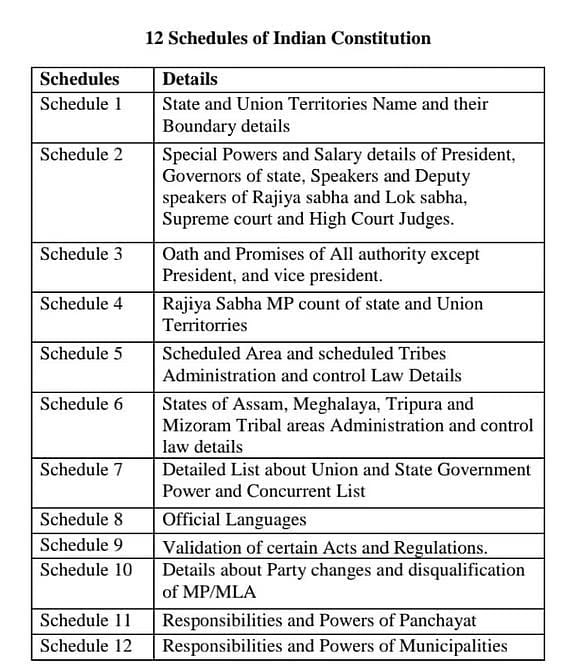
Important Provisions
- State legislatures are required to enact laws granting Panchayats powers and authority in order for them to perform local government functions.
- The distribution of powers between the State legislature and the Panchayats is enshrined in the 11th schedule.
- It includes the following 29 functional items that fall under the purview of panchayats:
- Agriculture, including agricultural extension.
- Land improvement, implementation of land reforms, land consolidation, and soil conservation.
- Minor irrigation, water management, and watershed development.
- Animal husbandry, dairying, and poultry.
- Fisheries.
- Social forestry and farm forestry.
- The minor forest produces.
- Small-scale industries, including food processing industries.
- Khadi, village, and cottage industries.
- Rural Housing.
- Drinking water.
- Fuel and fodder.
- Roads, culverts, bridges, ferries, waterways, and other means of communication.
- Rural electrification, including the distribution of electricity.
- Non-conventional energy sources.
- Poverty alleviation program.
- Education, including primary and secondary schools.
- Technical training and vocational education.
- Adult and non-formal education.
- Libraries.
- Cultural activities.
- Markets and fairs.
- Health and sanitation including hospitals, primary health centers, and dispensaries.
- Family welfare.
- Women and child development.
- Social welfare, including the welfare of the handicapped and mentally retarded.
- The welfare of the weaker sections, in particular, of the scheduled castes and the scheduled tribes.
- Public Distribution System.
- Maintenance of community assets.
Conclusion
Under the eleventh schedule, local institutions have been assigned major responsibilities. These in fact could determine the future course the country adopts and the development stance it takes, mostly in matters pertaining to sustainable development, education, and welfare of the weaker sections, etc.
FAQs
Question: What is the significance of Schedule 11 in the Indian Constitution?
Answer: Schedule 11 outlines the 29 subjects transferred to Panchayats under the 73rd Constitutional Amendment, promoting decentralization and empowering rural local governance in India.
Question: How many subjects are listed under Schedule 11 for Panchayats?
Answer: 29 subjects are listed under Schedule 11, which include areas such as agriculture, education, rural housing, drinking water, and social welfare.
Question: What was the purpose of the 73rd Constitutional Amendment Act?
Answer: The purpose of the 73rd Constitutional Amendment Act was to institutionalize Panchayati Raj as a system of local self-government, giving constitutional status to Panchayats and promoting decentralization of power.
Question: What role do Panchayats play under Schedule 11?
Answer: Panchayats are empowered to plan, implement, and monitor various schemes for economic development and social justice at the grassroots level under the 29 subjects listed in Schedule 11.
Question: How is the Panchayati Raj system structured?
Answer: The Panchayati Raj system follows a three-tier structure consisting of Gram Panchayats (village level), Panchayat Samitis (block level), and Zila Parishads (district level), each with specific functions related to local governance.
MCQs
1. Which constitutional amendment introduced Schedule 11 in the Indian Constitution?
A. 42nd Amendment
B. 44th Amendment
C. 73rd Amendment
D. 86th Amendment
Answer: (C) See the Explanation
Schedule 11 was introduced by the 73rd Constitutional Amendment Act, 1992, which provided constitutional status to Panchayats.
2. How many subjects are listed under Schedule 11 for Panchayats?
A. 12
B. 21
C. 29
D. 35
Answer: (C) See the Explanation
Schedule 11 lists 29 subjects that have been transferred to Panchayats for decentralized governance.
3. Which of the following is a subject included in Schedule 11?
A. Defense
B. Agriculture
C. Foreign Affairs
D. Railways
Answer: (B) See the Explanation
Agriculture is one of the 29 subjects listed in Schedule 11 that fall under the jurisdiction of Panchayats.
4. What is the main objective of Schedule 11?
A. Centralized planning
B. Decentralization of power to Panchayats
C. Judicial reforms
D. Corporate governance
Answer: (B) See the Explanation
The main objective of Schedule 11 is to promote decentralization by empowering Panchayats to govern at the local level.
5. Which of the following is part of the three-tier structure of the Panchayati Raj system?
A. Gram Sabha
B. Zila Parishad
C. Municipal Corporation
D. Rajya Sabha
Answer: (B) See the Explanation
Zila Parishads form the district-level tier in the three-tier structure of the Panchayati Raj system, alongside Gram Panchayats and Panchayat Samitis.
GS Mains Questions and Model Answers
Q1: Discuss the importance of Schedule 11 in promoting decentralization and local governance in India.
Answer: Schedule 11 of the Indian Constitution, introduced by the 73rd Constitutional Amendment, plays a critical role in promoting decentralization by transferring 29 subjects to Panchayats. These subjects include agriculture, rural development, drinking water, education, and sanitation, which are crucial for rural governance. By giving Panchayats the authority to plan, implement, and monitor development programs, Schedule 11 enhances the role of local governance, empowers communities, and ensures that decisions are made closer to the grassroots. It also strengthens democratic participation at the local level, contributing to more inclusive governance.
Q2: Analyze the role of Panchayats under Schedule 11 in rural development.
Answer: Under Schedule 11, Panchayats are entrusted with key responsibilities related to rural development, including areas like agriculture, rural housing, education, and public health. These local bodies play a pivotal role in the planning and execution of schemes aimed at improving the quality of life in rural areas. By managing local resources and addressing issues specific to rural communities, Panchayats ensure that development programs are tailored to the needs of the people. The decentralized approach promotes accountability, encourages participation, and leads to more effective implementation of government schemes.
Q3: Examine the challenges faced by Panchayats in implementing the provisions of Schedule 11.
Answer: While Schedule 11 empowers Panchayats with the responsibility of managing 29 key subjects, they face several challenges in effectively implementing these provisions. Lack of financial autonomy, inadequate capacity building, and political interference are significant obstacles. Panchayats often depend on state governments for funding, limiting their ability to initiate and sustain development projects. Additionally, many Panchayats lack the technical expertise and resources to manage complex developmental tasks. Strengthening financial devolution, capacity building, and ensuring political independence are essential to overcoming these challenges and enabling Panchayats to fulfill their mandate effectively.
Previous Year Questions on Schedule 11 of Indian Constitution
1. UPSC CSE Prelims 2020
Question: Schedule 11 of the Indian Constitution relates to which of the following?
A. Municipalities
B. Panchayats
C. Union Territories
D. Public Services
Answer: B
Explanation: Schedule 11 of the Indian Constitution relates to Panchayats and enumerates the 29 subjects that have been transferred to local bodies for decentralized governance.
2. UPSC CSE Mains 2019 (GS Paper 2)
Question: Evaluate the significance of the 73rd Constitutional Amendment Act in empowering rural local governance in India.
Explanation: The 73rd Constitutional Amendment Act, which introduced Schedule 11, marked a significant step in empowering rural local governance by giving constitutional status to Panchayats. By decentralizing power and transferring 29 subjects to Panchayats, the act promoted local self-governance and ensured that decisions related to rural development are made at the grassroots level. Panchayats are now responsible for managing areas such as agriculture, health, education, and public works, ensuring greater accountability and participation from local communities. However, challenges such as lack of financial autonomy and capacity constraints remain, necessitating further reforms to strengthen rural governance.
*email: contactus@prepp.in
Download the PREPP App and attempt FREE IAS Exam Mock Tests and get complete study material!
UPSC IAS : CSAT - Mini Live Test

Live Test : UPSC CSE Prelims CSAT (Paper-II) (Oct 20 - 23)
Full Test - 04: UPSC CSE Prelims CSAT (Paper-II)
Full Test - 03: UPSC CSE Prelims CSAT (Paper-II)
UPSC CSE Prelims 2026 GS Paper 1 Question Paper (24-May-2026)
UPSC CSE Prelims 2026 CSAT Paper 2 Question Paper (24-May-2026)

17 February 2025 | The Hindu Must Read Articles | Current Affairs

16 February 2026 | The Hindu Must Read Articles | Current Affairs

13 February 2026 | The Hindu Must Read Articles | Current Affairs









Comments