Schedule 2 of Indian Constitution - Indian Polity Notes
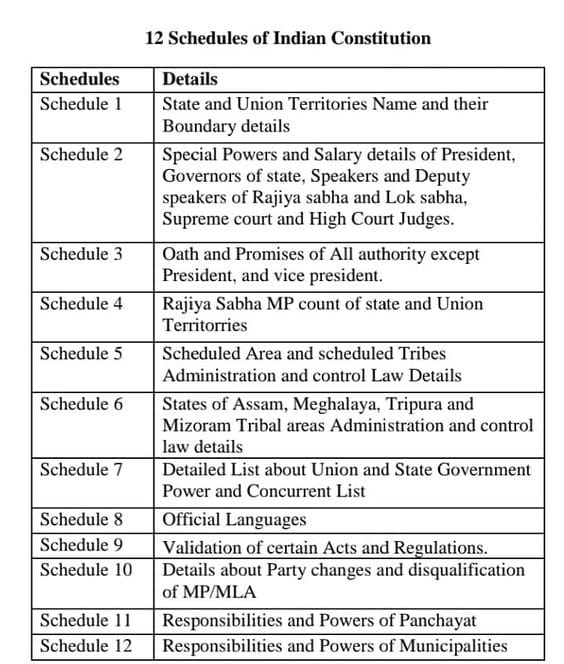
Schedule 2 of the Indian Constitution contains provisions related to the allowances, privileges, and emoluments of the President, Governors of States, Speaker and the Deputy Speaker of the House of the People, Chairman and the Deputy Chairman of the Council of States, Speaker and the Deputy Speaker of the Legislative Assembly, Chairman and the Deputy Chairman of the Legislative Council of a State, Judges of the Supreme Court and High Courts and the Comptroller and Auditor-General of India. The UPSC aspirants must remember the list of constitutional posts whose provisions are mentioned in Schedule 2.
|
Table of Contents |

Main Provisions
The entire Schedule 2 is divided into different “Parts” providing provisions relating to emoluments, allowances, and privileges. They are:
- Part A: Provisions as to the President and Governors of States (Articles - 59(3), 65(3), 158(3))
- Part C: Provisions as to the Speaker and Deputy Speaker of the House of People and Chairman and Deputy Chairman of Council of States and Speaker and Deputy Speaker of the Legislative Assembly and Chairman and Deputy Chairman of the Legislative Council of a State (Articles - 97, 186)
- Part D: Provisions as to the Judges of the Supreme Court and High Courts (Articles - 125, 221)
- Part E: Provisions as to the Comptroller and Auditor-General of India (Article - 148(3))
Note: Part B: Provisions as to the Ministers for the Union and the states in Part A and Part B of the First Schedule (Articles - 75(6), 164(5)) were omitted by the 7th Constitutional Amendment 1956
Conclusion
The rationale for placing Schedule 2 in the constitution of India is to give a detailed account of the allowances, privileges, and emoluments of the various constitutional posts which cannot be defined in the respective articles in the constitution due to its detailed nature and vastness.
FAQs
Question: What does Schedule 2 of the Constitution cover?
Answer: Schedule 2 defines the provisions for salaries, allowances, and privileges of constitutional officeholders like the President, Governors, judges, and others.
Question: Which amendment removed Part B from Schedule 2?
Answer: The 7th Constitutional Amendment in 1956 omitted Part B, which dealt with Ministers' allowances for the Union and States.
Question: Who determines the emoluments of the Comptroller and Auditor-General?
Answer: The salary and allowances of the CAG are determined under Part E of Schedule 2 as per Article 148(3).
Question: Does Schedule 2 cover allowances of the Prime Minister?
Answer: No, the Prime Minister's allowances and privileges are not specifically mentioned under Schedule 2 but are included under other statutory provisions.
Question: How are judicial salaries governed under Schedule 2?
Answer: Part D of Schedule 2 provides for the salaries, pensions, and allowances of judges of the Supreme Court and High Courts, as mentioned in Articles 125 and 221.
MCQs
1. Which part of Schedule 2 deals with the President's emoluments?
A. Part A
B. Part B
C. Part C
D. Part D
Answer: (A) See the Explanation
Explanation: Part A covers the emoluments of the President and Governors of States.
2. Which of the following was removed by the 7th Constitutional Amendment?
A. Part B
B. Part A
C. Part C
D. Part D
Answer: (A) See the Explanation
Explanation: Part B, related to Ministers' allowances, was omitted by the 7th Amendment.
3. Under which Article is the Comptroller and Auditor-General's salary mentioned?
A. Article 97
B. Article 148(3)
C. Article 125
D. Article 221
Answer: (B) See the Explanation
Explanation: Article 148(3) governs the CAG's salary, allowances, and pensions.
4. Who decides the salary of the Speaker of the Lok Sabha?
A. President
B. Prime Minister
C. Parliament
D. Governor
Answer: (C) See the Explanation
Explanation: Article 97 of the Constitution empowers Parliament to regulate the salary and allowances of the Speaker.
5. Which of the following is not part of Schedule 2?
A. High Court Judges
B. Prime Minister
C. Speaker of Lok Sabha
D. Governors of States
Answer: (B) See the Explanation
Explanation: The Prime Minister's allowances are not specifically mentioned in Schedule 2.
GS Mains Questions and Model Answers
Q1: Explain the significance of Schedule 2 of the Indian Constitution and its impact on the emoluments of constitutional posts.
Answer: Schedule 2 ensures that constitutional officeholders like the President, Governors, Judges, and Speakers are compensated fairly. By providing a detailed structure for emoluments, it removes ambiguity and guarantees transparency. The schedule, through various amendments, has kept pace with the financial needs and dignity associated with these posts.
Q2: Discuss the evolution of Schedule 2 through constitutional amendments.
Answer: Since the 7th Amendment, Schedule 2 has evolved, particularly with the removal of provisions regarding Union and State Ministers. Successive amendments have updated the emoluments for constitutional posts, ensuring their salaries reflect modern realities while maintaining constitutional principles.
Q3: Analyze the role of the judiciary in ensuring the sanctity of Schedule 2 of the Indian Constitution.
Answer: The judiciary, through cases like the Coelho case, has upheld the sanctity of constitutional schedules, including Schedule 2. The courts have ensured that any changes to salaries or allowances remain within constitutional limits, preserving the independence and dignity of high offices.
Previous Year Questions on Schedule 2 of the Indian Constitution
1. UPSC CSE Prelims
Question: Which schedule of the Indian Constitution deals with the salary and allowances of the President?
A. First
B. Second
C. Third
D. Fourth
Answer: B
Explanation: The Second Schedule provides details on the President's emoluments.
2. UPSC CSE Mains
Question: What is the main purpose of Schedule 2 of the Constitution?
A. To list states and territories
B. To provide for language policy
C. To define salaries and allowances of constitutional posts
D. To allocate powers to the Union and State Governments
Answer: C
Explanation: Schedule 2 defines the salaries, privileges, and allowances of constitutional officeholders.
*email: contactus@prepp.in
Download the PREPP App and attempt FREE IAS Exam Mock Tests and get complete study material!
UPSC IAS : CSAT - Mini Live Test

Live Test : UPSC CSE Prelims CSAT (Paper-II) (Oct 20 - 23)
Full Test - 04: UPSC CSE Prelims CSAT (Paper-II)
Full Test - 03: UPSC CSE Prelims CSAT (Paper-II)
UPSC CSE Prelims 2026 GS Paper 1 Question Paper (24-May-2026)
UPSC CSE Prelims 2026 CSAT Paper 2 Question Paper (24-May-2026)

17 February 2025 | The Hindu Must Read Articles | Current Affairs

16 February 2026 | The Hindu Must Read Articles | Current Affairs

13 February 2026 | The Hindu Must Read Articles | Current Affairs









Comments