Lok Adalats - Indian Polity Notes
Lok Adalat is a forum where cases or disputes that are currently in court or that are in the pre-litigation stage and have not yet been presented before a court are resolved amicably. It is one of the alternative dispute redressal mechanisms. NALSA and other Legal Services Institutions conduct Lok Adalats in India. The UPSC Indian Polity and Governance Syllabus include Lok Adalats which is discussed in this article.
| To Read update on this topic: |
Table of Contents

Lok Adalats – Concept
- The Supreme Court has explained the meaning of the Lok Adalat, that is, “ The Lok Adalat is an old form of adjudicating system prevalent in ancient India and its validity has not been taken away even in the modern days too.
- The word Lok Adalat means ‘ People’s Court ‘
- This system is based on the Gandhian principles.
- It is a component of the Alternative Dispute Resolution (ADR) system that provides informal, minimal, and expeditious justice to the general public.
- In Gujarat, the first Lok Adalat camp was held in 1982 as a voluntary and conciliatory institution with no statutory authority for its rulings.
- In view of growing popularity the Lok Adalat has been given statutory status under the Legal Service Authorities Act 1987.
|
“The introduction of Lok Adalats added a new chapter to the justice dispensation system of this country” |
Lok Adalats - Jurisdiction
A Lok Adalat shall have jurisdiction to determine and reach an agreement or settlement between the parties to a dispute in the following areas:
- Any case pending before any court
- Any dispute which has not been brought before any court and is likely to be filed before the court.
Any case pending before the court can be referred to the Lok Adalat for settlement if:
- The parties thereof agree to settle the dispute in the Lok Adalats
- One of the parties thereof makes an application to the court, for referring the case to the Lok Adalat.
- The court is satisfied that the matter is an appropriate one to be taken cognizance of by the Lok Adalat.
- In the case of pre-litigation dispute, the matter can be referred by the agency organizing the Lok Adalats, on receipt of an application from any one of the parties to the dispute.
- The various matters such as matrimonial/family disputes, criminal ( compoundable offenses) cases, land acquisition cases, labor disputes, bank recovery cases, etc.
- The offences which are non-compoundable under any law fall outside the purview of the Lok Adalat.
Composition
- The State/District Legal Services Authority, the Supreme Court/High Court/Taluk Legal Services Committee, or the Supreme Court/High Court/Taluk Legal Services Committee may organize Lok Adalats at such intervals and locations as it sees fit.
- Every Lok Adalat organized for a particular area should include the number of serving or retired judicial officers and other persons of the area as may be specified by the agency organizing such Lok Adalat.
- A Lok Adalat is usually chaired by a judicial officer, with members including a lawyer (advocate) and a social worker.
- National Legal Service Authority (NALSA) was established by the Legal Services Authorities Act of 1987, which took effect on November 9, 1995, to create a statewide consistent network for delivering free and competent legal services to the poor.
Power
- Under the Code of Civil Procedure (1908), the Lok Adalat will have the same powers as a Civil Court.
- A Lok Adalat shall have the authority to define its own method for resolving any dispute that comes before it.
- Every Lok Adalat shall be regarded to be a Civil Court for the purposes of the Code of Criminal Procedure(1860), and all procedures before a Lok Adalat shall be considered to be judicial proceedings within the meaning of the Indian Penal Code (1973).
- Under the Legal Services Authorities Act, 1987, The decision of the Lok Adalats is considered a civil court verdict and is binding on all parties.
- There is no provision for an appeal if the parties are dissatisfied with the verdict of Lok Adalat.
- However, they are free to initiate litigation by approaching the court of appropriate jurisdiction by filing a case, in exercise of their right to litigate.
Lok Adalat - Benefits
According to the Supreme Court, the benefits under Lok Adalat are :
- Procedural flexibility and speedy trial of the disputes.
- No court fee payable when a matter is filed in a Lok Adalat
- The parties to the dispute can directly interact with the judge through their counsel which is not possible in regular courts of law.
- The award given by the Lok Adalat is no-appealable, therefore it avoids the delay in the settlement of disputes finally.
Lok Adalat - Types
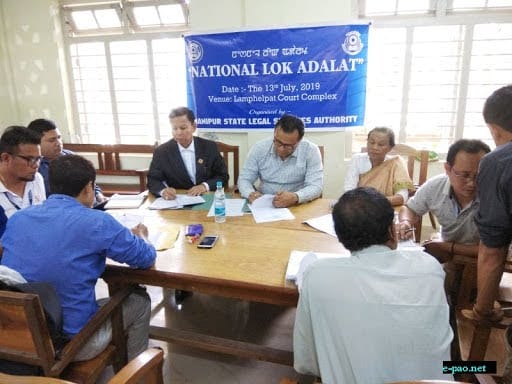
National Lok Adalat
- National Level Lok Adalats are held at regular intervals where on a single day Lok Adalats are conducted throughout the country, in all the courts right from the Supreme Court till the Taluk Levels wherein cases are disposed off in huge numbers.
- From 2015, National Lok Adalats are being held on a specific subject matter every month.
Permanent Lok Adalat
- Permanent Lok Adalat are organized under Section 22-B of The Legal Services Authorities Act, 1987.
- They are permanent bodies with a Chairman and two members for providing for settlement of cases relating to Public Utility Services like transport, postal, telegraph etc.
- Here one thing we should keep in mind that they have jurisdiction over pre-litigation matters only. (Lok Adalats have jurisdiction over pending and pre-litigation matters.)
- The award of the Permanent Lok Adalat is final and binding on all the parties.
- The jurisdiction of the Permanent Lok Adalats is up to Rs. One Crore.
Mobile Lok Adalat
- Mobile Lok Adalats are also organized in various parts of the country.
- Which moves from one area to another to resolve disputes in order to make the process of resolving disputes easier.
e-Lok Adalats
- During the COVID pandemic, to make justice accessible to people, NALSA started a virtual platform, better known as e-Lok Adalats.
- Since e-Lok Adalats are organized simultaneously along with regular Lok Adalats, benches are constituted on the basis of volume of cases referred by various courts or tribunals and institutions for pre-litigation cases.
- First e-Lok Adalat was held in Madhya Pradesh in 2020.
- Certain steps have been taken by Legal Services Authorities to promote e-Lok Adalats like
- Standard Operating Procedure for the conduct of e-Lok Adalat
- Technical training through System officers to the Court Staff
- Whatsapp groups for litigants, advocates and respondents to convey them relevant information/links for attending e-Lok Adalats.
Concerns
- Litigants are usually confronted against entities with vast pockets, such as electricity boards, insurance firms, banks, and other financial institutions.
- Compromises are frequently forced onto the destitute, who have no choice, except to accept them.
- Compromise is its foundation, there is concern that in the pursuit of rapid resolution of disputes, it will erode the concept of justice.
- The Supreme Court of India declared in State of Punjab vs Jalour Singh (2008) that a Lok Adalat is solely conciliatory and does not have any adjudicatory or judicial powers.
- Similarly, under the state's so-called "harmony ideology," poor women are practically forced by family courts to settle matrimonial conflicts based on a romanticised image of marriage.
- The proceedings of Lok Adalat are held in the open court and any person can witness these proceedings. Thus, the element of confidentiality is also lacking.
- Lok Adalats may not always be able to provide the full range of remedies available through traditional judicial processes. For instance, they may not be able to grant certain types of injunctive relief or award damages beyond a certain limit.
Conclusion
While Lok Adalats serve as a vital alternative dispute resolution mechanism in India, their efficacy depends upon addressing the identified limitations, ensuring wider awareness, enhancing accessibility, and fostering greater cooperation among stakeholders. With continued efforts to refine their processes and expand their reach, Lok Adalats can play a pivotal role in delivering swift and accessible justice to all segments of society.
FAQs
Question: What are Lok Adalats?
Answer: Lok Adalats, or "People's Courts," are alternative dispute resolution mechanisms established in India to provide a faster and more cost-effective way to resolve legal disputes. They aim to ensure access to justice for all, particularly for the underprivileged and marginalized sections of society. Lok Adalats are presided over by a panel of judges or legal experts, and they facilitate amicable settlements between parties without the need for a formal trial.
Question: What types of cases can be resolved in Lok Adalats?
Answer: Lok Adalats can resolve a wide range of civil and criminal cases, including family disputes, property disputes, cheque bouncing cases, and matters related to labor and consumer issues. However, cases that have already been taken up by the court and are pending trial may not be referred to Lok Adalats, as they primarily deal with disputes that are mutually agreed upon by the parties involved.
Question: What are the benefits of using Lok Adalats?
Answer: The benefits of using Lok Adalats include: 1. Speed - Cases are resolved quickly, often on the same day. 2. Cost-effective - There are no court fees, making it financially accessible. 3. Simplicity - The process is less formal than traditional courts, making it user-friendly. 4. Confidentiality - Proceedings are private, which can encourage more open dialogue between parties. 5. Settlement-oriented - Lok Adalats focus on amicable resolutions rather than punitive measures, promoting reconciliation.
Question: How are Lok Adalats organized?
Answer: Lok Adalats are organized by the National Legal Services Authority (NALSA) at the national level, and by state legal services authorities at the state level. They conduct regular sessions in various locations, including courts, community centers, and educational institutions, to ensure that people have access to these services. Awareness campaigns are also conducted to educate the public about Lok Adalats and their benefits.
Question: What role does the judiciary play in Lok Adalats?
Answer: The judiciary plays a crucial role in Lok Adalats by providing the judges or legal experts who preside over the proceedings. These judges facilitate discussions, guide parties through the negotiation process, and ensure that any settlement reached is fair and just. The involvement of the judiciary helps maintain the integrity of the process and ensures adherence to legal principles.
MCQs
1. What is the primary objective of Lok Adalats?
A) To conduct formal trials
B) To provide an alternative dispute resolution mechanism
C) To enforce judicial decisions
D) To issue criminal penalties
Answer: (B) See the Explanation
Explanation: The primary objective of Lok Adalats is to provide an alternative dispute resolution mechanism that is faster and more cost-effective than traditional court proceedings.
2. Who can preside over Lok Adalats?
A) Only retired judges
B) Legal experts and judges
C) Any citizen
D) Government officials
Answer: (B) See the Explanation
Explanation: Lok Adalats are presided over by a panel that may include judges and legal experts who facilitate the resolution of disputes.
3. What types of disputes are commonly resolved in Lok Adalats?
A) Only civil cases
B) Only criminal cases
C) Civil and criminal cases
D) None of the above
Answer: (C) See the Explanation
Explanation: Lok Adalats can resolve a variety of disputes, including both civil and criminal cases, depending on the nature of the disagreement.
4. Which authority organizes Lok Adalats at the national level?
A) Supreme Court
B) High Court
C) National Legal Services Authority (NALSA)
D) Ministry of Law
Answer: (C) See the Explanation
Explanation: The National Legal Services Authority (NALSA) is responsible for organizing Lok Adalats at the national level.
5. What is a significant advantage of Lok Adalats compared to regular courts?
A) Longer proceedings
B) Higher costs
C) Focus on punitive measures
D) Faster resolution of disputes
Answer: (D) See the Explanation
Explanation: A significant advantage of Lok Adalats is their ability to provide a faster resolution of disputes compared to regular court proceedings.
GS Mains Questions and Model Answers
Q1: Evaluate the significance of Lok Adalats in enhancing access to justice in India.
Answer: Lok Adalats play a crucial role in enhancing access to justice in India by providing an alternative dispute resolution mechanism that is both efficient and cost-effective. They cater to the needs of marginalized and economically disadvantaged groups who may otherwise face barriers to accessing the formal judicial system. By facilitating quick and amicable settlements, Lok Adalats reduce the burden on traditional courts, which are often overcrowded and slow-moving. The informal setting of Lok Adalats encourages participation and engagement from all parties involved, promoting a sense of community in resolving disputes. Furthermore, Lok Adalats contribute to the overall goal of legal empowerment, making the justice system more accessible and user-friendly for the common citizen.
Q2: Discuss the challenges faced by Lok Adalats in India.
Answer: Despite their effectiveness, Lok Adalats face several challenges in India, including limited public awareness and understanding of their functions. Many individuals remain unaware of the benefits of using Lok Adalats, leading to underutilization of this alternative dispute resolution mechanism. Additionally, the lack of trained mediators and legal professionals can hinder the effectiveness of proceedings, impacting the quality of settlements reached. Another challenge is ensuring the enforceability of decisions made in Lok Adalats, as not all agreements may hold legal weight. Addressing these challenges requires targeted awareness campaigns, training programs for mediators, and a legislative framework to strengthen the authority of Lok Adalat decisions.
Q3: Analyze the impact of Lok Adalats on the traditional judicial system in India.
Answer: Lok Adalats have had a significant impact on the traditional judicial system in India by alleviating the backlog of cases in courts and providing an efficient alternative for dispute resolution. By offering a quicker and less formal means of settling disputes, Lok Adalats help reduce the pressure on the judiciary, allowing judges to focus on more complex cases that require formal adjudication. Moreover, the emphasis on amicable settlements in Lok Adalats fosters a culture of collaboration and negotiation, which can lead to more sustainable resolutions for parties involved. As Lok Adalats gain popularity and credibility, they are likely to continue shaping the landscape of dispute resolution in India, promoting a more efficient and accessible legal system for all.
Previous Year Questions on Lok Adalats
1. UPSC CSE Prelims 2021:
Question: Which of the following statements about Lok Adalats is incorrect?
A) They are conducted by legal services authorities.
B) They can resolve both civil and criminal cases.
C) There are court fees involved.
D) They aim to promote amicable settlements.
Answer: (C)
Explanation: Lok Adalats do not involve court fees, making them a cost-effective alternative for dispute resolution.
2. UPSC CSE Mains 2020 (GS Paper 3):
Question: "Discuss the importance of Lok Adalats in the Indian judicial system."
Answer: Lok Adalats are significant in the Indian judicial system as they help in reducing the burden on formal courts by providing an alternative mechanism for dispute resolution. They are particularly beneficial for those who may not have the means to access traditional judicial processes. By focusing on settlement rather than adversarial proceedings, Lok Adalats foster a collaborative approach to justice, promoting harmony within communities and ensuring that disputes are resolved amicably.
*email: contactus@prepp.in
Download the PREPP App and attempt FREE IAS Exam Mock Tests and get complete study material!

Full Test - 04: UPSC CSE Prelims CSAT (Paper-II)
Full Test - 03: UPSC CSE Prelims CSAT (Paper-II)
UPSC CSE Prelims 2026 GS Paper 1 Question Paper (24-May-2026)
UPSC CSE Prelims 2026 CSAT Paper 2 Question Paper (24-May-2026)

17 February 2025 | The Hindu Must Read Articles | Current Affairs

16 February 2026 | The Hindu Must Read Articles | Current Affairs

13 February 2026 | The Hindu Must Read Articles | Current Affairs









Comments