Alternative Dispute Redressal Mechanism - Indian Polity Notes
Alternative Dispute Resolution (ADR) mechanisms refer to a set of processes or techniques used to resolve disputes or conflicts outside of the traditional litigation system. ADR typically involves the participation of neutral third parties who assist the disputing parties in reaching mutually acceptable resolutions. They are widely used in various contexts, including commercial disputes, family matters, employment conflicts, and international disputes.
There have been questions about the Alternative Dispute Redressal Mechanism (ADR) in the UPSC exams earlier. This article explains the Alternative Dispute Redressal Mechanism (ADR), Types and Advantages that are useful for Prelims 2024 preparation and UPSC Mains 2024 as well.
Table of Contents
- Alternative Dispute Redressal Mechanism
- Need for Alternative Dispute Redressal Mechanism
- Key Objectives of Alternative Dispute Redressal Mechanism
- Types of Alternative Dispute Redressal Mechanism
- Advantages of Alternative Dispute Resolution Mechanism
- Limitations of Alternative Dispute Redressal Mechanism
- Conclusion
- FAQs
- MCQs
Alternative Dispute Redressal Mechanism
- Alternative Dispute Resolution (ADR) mechanisms like arbitration, conciliation and mediation etc. offer better and timely solution for resolution of a dispute. They are less adversarial and are capable of providing an amicable outcome in comparison to conventional methods of resolving disputes.
- Internationally, the United Nations Commission on International Trade Law (UNCITRAL) Model Law on International Commercial Arbitration was adopted in 1985. Its purpose is to ensure uniformity in arbitration related statues, enacted by the Member Countries.
- Based on the UNCITRAL Model Law, India enacted the Arbitration and Conciliation Act, 1996.
|
“ADR typically involves the participation of neutral third parties who assist the disputing parties in reaching mutually acceptable resolutions.” |

|
|
|
|---|---|
| Jurisdiction of Supreme Court | Public Interest Litigation |
| Judicial Review | Judicial Activism & Judicial Overreach |
| NALSA & SLSA | Lok Adalats |
| Independence of Judiciary | Gram Nyayalayas |
Need for Alternative Dispute Redressal Mechanism
- Overburdened Judiciary:Traditional litigation often leads to unnecessary delays in dispensing justice and overburdens the judiciary. By utilizing ADR mechanisms, the burden on the judicial system can be alleviated, allowing courts to focus on cases that require their intervention.
- Lengthy and expensive judicial processes: A key motivation for adopting Alternative Dispute Resolution (ADR) mechanisms is the need for quick and affordable justice dispensation. ADR processes such as arbitration, conciliation, and mediation offer timely resolution of disputes, saving valuable time and money for all parties involved.
- Globalization and Foreign Investment: With the globalization and liberalization of economies, there has been an influx of foreign investments into countries like India. Foreign investors seek a vibrant and reliable ADR mechanism to resolve contractual disputes efficiently and cost-effectively.
- Important for Ease of Doing Business: Early resolution of disputes through ADR mechanisms promotes an environment conducive to the enforcement of contracts. This encourages parties to abide by their contractual obligations, thereby fostering trust and confidence in business dealings.
Key Objectives of Alternative Dispute Redressal Mechanism
As emphasised in the Arbitration and Conciliation Act, 1996
- Reducing Court intervention
- Providing for speedy disposal of the disputes.
- Amicable, swift and cost-efficient settlement of disputes.
- Ensuring that arbitration proceedings are conducted in a just, fair and effective manner.
- Comprehensively dealing with international commercial arbitration and conciliation as also domestic arbitration and conciliation.
- Facilitating arbitrator to resort to mediation, conciliation or other procedure during the arbitral proceedings to encourage settlement of disputes.
- Provide that every arbitral award is enforced in the same manner as if it were a decree of the court.
Types of Alternative Dispute Redressal Mechanism
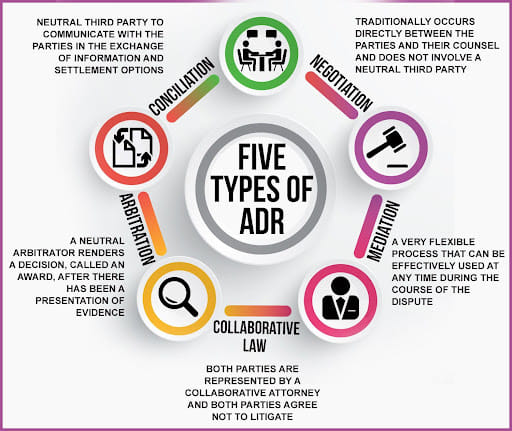
Alternative Dispute Resolution is usually divided into the following categories:
- Arbitration
- Conciliation
- Mediation
- Negotiations
- Lok Adalats
- Plea Bargaining
Arbitration
- Arbitration is a quasi-judicial proceeding, where the parties in dispute appoint an arbitrator by agreement to adjudicate the dispute.
- Arbitration & Conciliation, 1996 Act 1996 governs the procedure and decision.
- The award in an arbitration is binding on the parties
- The India International Arbitration Centre Act, 2019 provides for establishment of an independent and autonomous centre for institutional arbitration. It aims to develop it as a preferred seat for domestic and international commercial arbitration. Under this act New Delhi International Arbitration Centre (NDIAC) has been established.
Mediation
- In mediation, a neutral third party, known as a mediator, assists the parties in reaching a mutually acceptable agreement.
- The mediator does not impose a decision but facilitates communication and helps the parties explore options for resolution.
- Mediation Act, 2023 aims to promote the use of mediation as an effective means of dispute resolution, providing parties with a voluntary and efficient alternative to traditional litigation.
Conciliation
- It is a process by which resolution of disputes is achieved by compromise or voluntary agreement.
- Here parties to a disagreement are assisted by an impartial third party, the Conciliator, in finding a mutually satisfactory agreed settlement of the dispute.
- The Conciliator is an active participant in the conciliation process, participating in discussions, negotiations, and reaching an acceptable settlement.
- The parties have the option of accepting or rejecting the conciliator's recommendations. However, if both parties accept the conciliator's settlement agreement, it will be final and binding on both parties.
- The process of conciliation is governed by Arbitration and Conciliation Act, 1996.
Negotiations
- It is the most frequently utilized alternative dispute resolution method.
- A non-binding procedure in which the parties commence negotiations without the involvement of a third party with the objective of obtaining a negotiated settlement of the issue.
- Negotiation occurs in a variety of settings, including business, non-profit organizations, government branches, legal proceedings, international relations, and personal circumstances such as marriage, divorce, parenting, and everyday life.
Lok Adalats
- Lok Adalats is an Alternative Dispute Redressal Mechanisms (ADRM)
- Established under Legal Services Authorities Act of 1987
- It is a forum where disputes/cases pending in the court of law or at pre-litigation stage are settled amicably. Lok Adalat combines conciliation and negotiation to resolve conflicts.
- No court fee charged in case of Lok Adalat.
- The award by Lok Adalat has a status of civil court decree.
- There is no strict application of procedural laws like Civil Procedure Code and Evidence Act but follows the principles of natural justice.
Plea Bargaining
- In criminal law, plea bargaining is also considered as an alternative dispute resolution mechanism.
- It is a pre-trial agreement between the prosecution and the accused.
- A plea bargain is an arrangement between the prosecution and defence in a criminal case about the accused's plea.
- In the presence of the judge, the defendant changes his plea from not guilty to guilty and accepts the prosecution's offer to reduce his sentence in exchange for a guilty plea.
Advantages of Alternative Dispute Resolution Mechanism
- Cost-effective: ADR methods are often more affordable than litigation. They usually involve fewer procedural steps, lower attorney fees, and reduced administrative expenses. This is particularly beneficial for individuals and small businesses with limited financial resources.
- Time-efficient: ADR processes typically resolve disputes more quickly than litigation. Parties can schedule hearings and negotiations at their convenience rather than being subject to court schedules.
- Flexible and Informal: ADR methods are generally less formal and flexible therefore helps to reach at customized solutions that address the underlying interests of both parties.
- Confidentiality: Many ADR processes, such as mediation and arbitration, offer confidentiality protections. This allows parties to discuss sensitive issues and explore potential solutions without fear of public disclosure.
- Expertise and Neutrality: ADR often involves the use of neutral third-party facilitators, mediators, or arbitrators who possess specialized knowledge and skills in conflict resolution. These professionals can help parties navigate complex legal issues, facilitate communication, and guide them toward mutually acceptable solutions.
Limitations of Alternative Dispute Redressal Mechanism
- No Appeals: The scope of appeal in awards is limited or non-existent. If there is a fault with the reward, there is no way to challenge or amend it.
- Different Rules: It is tough to pick between numerous guidelines and multiple institutions offering arbitration services.
- Different Statutes: Because domestic and international arbitration have different statutes, it is difficult to determine the application of international arbitration laws.
- The Language Barrier Across Cultures: Due to differences in language and culture between the two areas, it is difficult to bridge the gap and reach a common answer.
- Unfamiliarity and lack of awareness: The majority of individuals still prefer the traditional technique of coming to court and are also unaware of these possibilities and the process.
Conclusion
Incorporating ADR into dispute resolution frameworks can enhance access to justice, promote efficiency, and alleviate the strain on traditional judicial systems. By embracing ADR alongside traditional litigation options, stakeholders can cultivate a more diverse and effective toolkit for resolving conflicts and fostering constructive outcomes in diverse contexts.
FAQs
Q1: What is Alternative Dispute Redressal (ADR)?
Answer: ADR refers to methods of resolving disputes without litigation, including arbitration, mediation, and conciliation.
Q2: How does ADR benefit the legal system?
Answer: ADR reduces the burden on courts, offers quicker resolutions, and can be less expensive than traditional litigation.
Q3: Which legislation governs ADR in India?
Answer: The Arbitration and Conciliation Act, 1996, governs ADR procedures in India.
Q4: What are the types of ADR mechanisms?
Answer: The primary types of ADR are arbitration, mediation, conciliation, and negotiation.
Q5: Why is ADR gaining popularity in India?
Answer: ADR provides quicker resolutions, reduces costs, and promotes a more flexible approach to dispute resolution.
MCQs
- What does ADR stand for?
a) Alternative Dispute Resolution
b) Additional Dispute Resolution
c) Arbitration Dispute Resolution
d) Alternative Dispute Review
Answer: (a) See the Explanation
- Which of the following is NOT a type of ADR?
a) Arbitration
b) Mediation
c) Litigation
d) Conciliation
Answer: (c) See the Explanation
- Which Indian act governs arbitration and conciliation?
a) Civil Procedure Code, 1908
b) Arbitration and Conciliation Act, 1996
c) Indian Contract Act, 1872
d) Constitution of India
Answer: (b) See the Explanation
- What is the role of a mediator in ADR?
a) To decide the outcome of the dispute
b) To act as a neutral third party to facilitate discussion
c) To represent one of the parties
d) To impose a legal judgment
Answer: (b) See the Explanation
- Which of the following is a key advantage of ADR?
a) Lengthy court proceedings
b) High costs of litigation
c) Fast resolution of disputes
d) Limited party involvement
Answer: (c) See the Explanation
GS Mains Questions and Model Answers
Q1: Discuss the advantages of Alternative Dispute Redressal (ADR) over traditional litigation in India.
Answer: ADR offers numerous advantages over traditional litigation, including faster resolution of disputes, lower costs, and a more flexible, informal approach. It alleviates the pressure on the judiciary by reducing the number of pending cases. ADR methods such as arbitration and mediation encourage parties to reach mutually agreed-upon solutions, thus preserving relationships. Additionally, ADR allows for confidentiality, unlike the public nature of court proceedings. These benefits make ADR a preferred option in India’s legal framework, especially in commercial and family disputes.
Q2: How does the Arbitration and Conciliation Act, 1996, facilitate the ADR process in India?
Answer: The Arbitration and Conciliation Act, 1996, provides the legal framework for arbitration and conciliation in India. It ensures that arbitration awards are enforceable under Indian law and provides a clear process for the appointment of arbitrators, conduct of proceedings, and enforcement of decisions. The Act also recognizes international arbitration agreements and ensures their compatibility with Indian laws. Through this legislation, India has created a robust mechanism that enhances the efficacy of ADR by offering a structured, legal process for resolving disputes outside of court.
Q3: Evaluate the impact of ADR on the Indian judicial system.
Answer: ADR has significantly reduced the burden on India’s judicial system by offering an alternative to formal court proceedings. With the increasing number of pending cases, ADR provides timely resolution, which otherwise would have taken years in courts. By promoting mechanisms like arbitration, mediation, and conciliation, ADR ensures that disputes are settled efficiently and amicably. The adoption of ADR has also contributed to reducing legal costs and promoting a collaborative, rather than adversarial, approach to resolving conflicts.
Previous Year Questions on Alternative Dispute Redressal Mechanism
1. UPSC 2017 Mains
Question: “The growing significance of Alternative Dispute Resolution (ADR) in India has revolutionized the way disputes are resolved outside the courtroom.” Critically analyze.
Answer: ADR mechanisms, including arbitration, mediation, and conciliation, have indeed revolutionized dispute resolution in India by offering quicker and more cost-effective alternatives to traditional litigation. These processes not only relieve the overwhelmed judicial system but also ensure more flexible solutions that suit the parties involved. However, challenges remain, such as the enforcement of awards, the lack of awareness in rural areas, and the inconsistency in the quality of arbitrators. Despite these, the growth of ADR offers hope for an efficient and modern dispute resolution system in India.
2. UPSC 2019 Mains
Question: Discuss the role of ADR in promoting access to justice in India.
Answer: ADR mechanisms have played a crucial role in promoting access to justice by making legal solutions more affordable, accessible, and faster. With the backlog of cases in Indian courts, ADR offers an alternative that reduces delays and costs associated with litigation. It helps people who otherwise may not have had the resources to pursue lengthy court cases, particularly in family disputes, small claims, and commercial matters. Moreover, ADR encourages amicable settlements, thus fostering social harmony and reducing adversarial confrontations.
*email: contactus@prepp.in
Download the PREPP App and attempt FREE IAS Exam Mock Tests and get complete study material!

Full Test - 04: UPSC CSE Prelims CSAT (Paper-II)
Full Test - 03: UPSC CSE Prelims CSAT (Paper-II)
UPSC CSE Prelims 2026 GS Paper 1 Question Paper (24-May-2026)
UPSC CSE Prelims 2026 CSAT Paper 2 Question Paper (24-May-2026)

17 February 2025 | The Hindu Must Read Articles | Current Affairs

16 February 2026 | The Hindu Must Read Articles | Current Affairs

13 February 2026 | The Hindu Must Read Articles | Current Affairs









Comments