Subordinate Courts - Indian Polity Notes
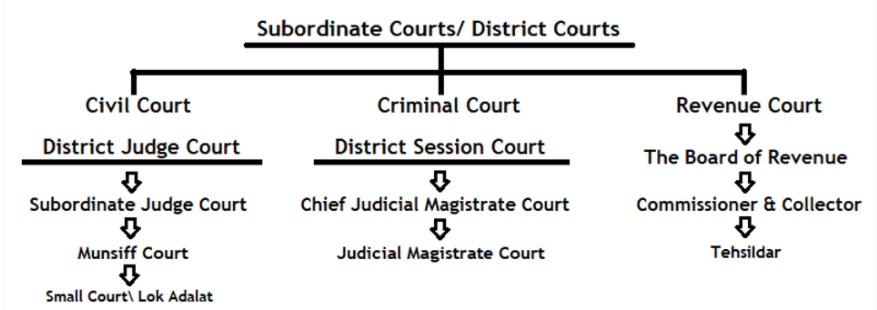
Subordinate Courts represent the lowermost tier of India’s Integrated judiciary. At district level, there are various types of subordinate courts. They are civil courts, criminal courts and revenue courts. These courts hear civil cases, criminal cases and revenue cases, respectively. They function below and under the high court at district and lower levels. The topic “Subordinate Courts” is an important topic under Polity and Governance section of the UPSC/IAS Exam Syllabus which is discussed in this article in detail.
| To Read update on this topic: |
Table of Contents
- Subordinate Courts - Constitutional Provisions
- Appointment of District Judges
- Appointment of Judges other than the District Judges
- Control over Subordinate Courts
- Interpretation of the Terms
- Subordinate Courts- Structure and Jurisdiction
- District Judge
- Lower Courts
- Nyaya Panchayats
- Issues Faced by Subordinate Courts
- Articles Related to Subordinate Courts
- Conclusion
- FAQs
- MCQs
Subordinate Courts - Constitutional Provisions
Articles 233 to 237 in Part VI of the Constitution deal with the provisions related to organisation and regulation of the subordinate courts and to ensure their independence from the executive.
Appointment of District Judges
- The appointment, posting and promotion of the district judges in a state are made by the Governor of the State in consultation with the high court.
- The following qualifications are required for a person to be appointed as a district judge:
- He/she should not already be in the service of the Central or the State Government.
- He/she should have been an advocate or a pleader for seven years.
- He/she should be recommended by the High Court for the appointment.
|
"Subordinate courts are the bedrock of justice, where the weight of the law meets the needs of the people." |
Appointment of Judges other than the District Judges
The Governor of the State appoints people (other than district judges) to the State's judicial service after consulting with the State Public Service Commission and the High Court.
Control over Subordinate Courts
The High Court has jurisdiction over district courts and other subordinate courts, including the posting, promotion, and leave of personnel in the state's judicial service who occupy any office lower than that of the district judge.
Interpretation of the Terms
- Under Article 236, the expression ‘district judge’ includes judge of a city civil court, additional district judge, joint district judge, assistant district judge, chief judge of a small cause court, chief presidency magistrate, additional chief presidency magistrate, sessions judge, additional sessions judge, and assistant sessions judge.
- The term "judicial service" refers to a service consisting exclusively of persons intended to fill the post of district judge and other civil judicial posts inferior to the post of district judge.
- The Governor may direct that any class or classes of magistrates in the state be subject to the above-mentioned provisions relating to people in the state judicial service.
Subordinate Courts - Structure and Jurisdiction
- The States define the subordinate judiciary's organizational structure, jurisdiction, and terminology. As a result, they vary slightly from State to State. Generally, underneath the High Court, there are three tiers of civil and criminal courts.
District Judge
- The district judge is also the sessions judge. When he/she deals with the civil cases, designated as the district judge whereas when he/she hears the criminal cases, designated as sessions judge.
- District judge have both judicial and administrative powers. He also has supervisory powers over all the subordinate courts in the districts. Appeals against his/her orders and judgements lie to the high court.
- The session judge can also impose any sentence including life imprisonment and capital punishment (death sentence). However, the death sentence imposed by him/her needs confirmation from the High Court whether there is an appeal or not.
Lower Courts
- On the civil side, the Subordinate Judge’s Court is located below the District and Sessions Court, while on the criminal side, the Chief Judicial Magistrate’s Court is located beneath the District and Sessions Court.
- In civil cases, the subordinate judge has unrestricted pecuniary jurisdiction while the chief judicial magistrate rules on criminal matters that carry a maximum sentence of seven years in jail.
- The Court of Munsiff, on the civil side, and the Court of Judicial Magistrate, on the criminal side, are the lowest levels.
- The munsiff has limited jurisdiction and only decides minor civil issues of the low monetary stake while a judicial magistrate is a person who hears criminal proceedings which are punishable by a sentence of up to three years in jail.
- On the civil side, there are city civil courts (chief judges) in various metropolitan cities, and on the criminal side, there are courts of metropolitan magistrates.
- Small Causes Courts have been established in several States and presidential towns. These courts make quick decisions in civil matters with low stakes. Their decisions are final, although the High Court can overturn them.
- Panchayat Courts hear petty civil and criminal cases in several states. Nyaya Panchayat, Gram Kutchery, Adalati Panchayat, Panchayat Adalat, and so on are some of the names given to them.
Nyaya Panchayats
- The judicial components of the panchayat system, which is the lowest rung of our judiciary, are Nyaya Panchayats. They are designed to administer justice at the local or rural level. The Nyaya Panchayat was established for the following reasons:
- Democratic decentralization.
- Easy access to justice.
- Speedy disposal of cases.
- Inexpensive justice system.
- Revival of traditional village community life.
- Combination of the judicial system and local self-government.
- Reduction in pressure on Civil Courts.
Issues Faced by Subordinate Courts
- High Caseload and Backlog: Subordinate courts in India grapple with an overwhelming number of pending cases, comprising about 87.54% of the total judicial workload. The sheer volume of cases creates significant challenges in managing and adjudicating them in a timely manner.
- Shortage of Judges: There is a chronic shortage of judges in subordinate courts, with only 79% of the sanctioned strength being filled. This shortage exacerbates the burden on existing judges and contributes to delays in case disposal.
- Low Case Clearance Rate: Despite efforts to resolve cases, the case clearance rate (CCR) for subordinate courts stands at 89%, indicating that cases are being disposed of at a slower pace than they are being filed. This leads to a continuous accumulation of pending cases.
- Vacancies and Recruitment Issues: Vacancies remain unfilled due to delays in calling for applications, conducting recruitment examinations, and declaring results.
Articles Related to Subordinate Courts
| Article | Provision |
|---|---|
| Article 233 | Appointment of district judges |
| Article 233A | Validation of appointments of, and judgments, etc., delivered by certain district judges |
| Article 234 | Recruitment of persons other than district judges to the judicial service |
| Article 235 | Control over subordinate courts |
| Article 236 | Interpretation |
| Article 237 | Application of the provisions of this Chapter to certain class or classes of Magistrates |
Conclusion
Subordinate Courts form an important part of the Indian Judicial System. They are helpful in the speedy justice delivery for the large population of the country. Thus, the makers of the Constitution have given an important role for Subordinate Courts.
FAQs
Question: What are subordinate courts in India?
Answer: Subordinate courts are the lowest level of courts in India’s judicial hierarchy, operating below the High Courts. They handle civil, criminal, and revenue cases within their jurisdiction. Examples include District Courts, Sessions Courts, and various local courts such as Magistrate Courts.
Question: Which articles in the Indian Constitution relate to subordinate courts?
Answer: Articles 233 to 237 in Part VI of the Indian Constitution outline the establishment, appointment, and control of subordinate courts. These provisions ensure that subordinate courts function under the jurisdiction and control of the High Court to maintain judicial independence.
Question: Who appoints district judges in India?
Answer: The Governor of a state appoints district judges in consultation with the High Court. Candidates must be advocates or pleaders with at least seven years of experience or belong to the judicial service of the state or central government.
Question: What is the role of district judges in subordinate courts?
Answer: District judges preside over the highest court in a district for both civil and criminal cases. They act as the Sessions Judge in criminal cases and have the authority to impose life imprisonment or even a death sentence, which requires confirmation from the High Court.
Question: What challenges do subordinate courts in India face?
Answer: Subordinate courts face challenges such as high caseloads, a shortage of judges, slow case clearance rates, and inadequate infrastructure. These issues contribute to case backlogs, delaying justice delivery for the public.
MCQs
1. Which article of the Constitution gives control over subordinate courts to the High Court?
A) Article 233
B) Article 235
C) Article 237
D) Article 234
Answer: (B) See the Explanation
Explanation: Article 235 vests control over subordinate courts with the High Court, covering posting, promotion, and leave of judicial personnel below the level of district judge.
2. Who appoints district judges in India?
A) Chief Minister
B) Governor
C) President
D) Chief Justice of India
Answer: (B) See the Explanation
Explanation: District judges are appointed by the Governor of the state in consultation with the respective High Court to ensure qualified individuals serve at this judicial level.
3. What is the highest criminal court in a district?
A) High Court
B) Civil Court
C) Sessions Court
D) Nyaya Panchayat
Answer: (C) See the Explanation
Explanation: The Sessions Court, presided over by the Sessions Judge, is the highest criminal court in a district with the authority to impose severe sentences, including life imprisonment and death.
4. Which of the following courts has original jurisdiction in both civil and criminal matters?
A) District Court
B) Nyaya Panchayat
C) High Court
D) Gram Nyayalaya
Answer: (A) See the Explanation
Explanation: District Courts have original jurisdiction over both civil and criminal matters, allowing them to adjudicate cases at the district level.
5. What is the main function of Nyaya Panchayats?
A) Handle high-stake civil cases
B) Resolve minor civil and criminal disputes
C) Appoint district judges
D) Supervise the High Courts
Answer: (B) See the Explanation
Explanation: Nyaya Panchayats are local judicial bodies designed to resolve minor civil and criminal cases, especially in rural areas, facilitating quicker and more accessible justice.
GS Mains Questions and Model Answers
Q1: Discuss the constitutional provisions and importance of subordinate courts in India’s judicial system.
Answer: The Constitution of India dedicates Articles 233 to 237 to subordinate courts, ensuring judicial independence at the grassroots level. Subordinate courts address civil and criminal matters across districts and play a crucial role in decentralizing justice, thus making it accessible to all. These courts operate under the supervision of the High Courts, which control appointments and postings, as per Article 235. By resolving over 85% of the total caseload in India, subordinate courts form the backbone of the judicial system and support the swift administration of justice.
Q2: Analyze the major challenges faced by subordinate courts in India and the measures needed to address them.
Answer: Subordinate courts face multiple challenges, including high case backlogs, limited resources, and a shortage of judges. Case backlogs are exacerbated by a low case clearance rate and inadequate technological support. To address these issues, measures like increasing judicial appointments, enhancing digital infrastructure through e-courts, and introducing case management reforms are crucial. Simplifying recruitment and investing in court resources are essential to improve case disposal rates and enhance access to timely justice at the grassroots level.
Q3: Examine the role of district judges in maintaining the efficiency and integrity of subordinate courts.
Answer: District judges, being the senior-most judicial officers in a district, play a pivotal role in overseeing subordinate courts and maintaining judicial integrity. Their responsibilities encompass civil and criminal jurisdiction, supervising case flow, and ensuring timely judgments. District judges also act as mentors to junior judges and maintain high standards in judicial conduct. Their supervisory powers, granted under Article 235, ensure that subordinate courts adhere to fair practices, making district judges key to upholding judicial efficiency and public trust.
Previous Year Questions on Subordinate Courts
1. UPSC CSE Prelims 2021:
Question: Under which Article does the High Court have control over the subordinate courts in a state?
A) Article 226
B) Article 231
C) Article 235
D) Article 237
Answer: (C)
Explanation: Article 235 grants the High Court control over subordinate courts, including the power to make decisions on appointments, postings, and leave of the judicial officers below the district judge level.
2. UPSC CSE Mains 2020 (GS Paper 2):
Question: "Analyze the structure and significance of subordinate courts in India’s judiciary. How do these courts contribute to accessible justice?"
Answer: Subordinate courts, forming the base of India’s judiciary, include District Courts and various lower courts handling civil, criminal, and revenue matters. They are essential for accessible justice, especially in rural areas, and contribute to over 85% of case disposal. Under High Court supervision, these courts bridge the gap between the common citizen and the judicial system, addressing disputes at the local level and ensuring judicial reach to all strata of society.
*email: contactus@prepp.in
Download the PREPP App and attempt FREE IAS Exam Mock Tests and get complete study material!

Full Test - 04: UPSC CSE Prelims CSAT (Paper-II)
Full Test - 03: UPSC CSE Prelims CSAT (Paper-II)
UPSC CSE Prelims 2026 GS Paper 1 Question Paper (24-May-2026)
UPSC CSE Prelims 2026 CSAT Paper 2 Question Paper (24-May-2026)

17 February 2025 | The Hindu Must Read Articles | Current Affairs

16 February 2026 | The Hindu Must Read Articles | Current Affairs

13 February 2026 | The Hindu Must Read Articles | Current Affairs









Comments