Hit Jobs On Foreign Soil Not India’s Policy: Jaishankar
Relevance: GS2 - Effect of policies and politics of developed and developing countries on India’s interests, Indian diaspora
(Source: The Hindu, 09/28/2023)
Click here for Daily Current Affairs
Why in the news?
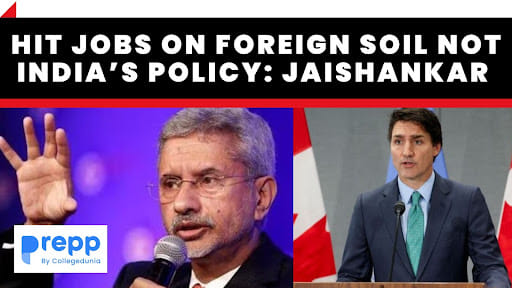
- Recently, Indian Foreign Affairs Minister S.Jaishankar claimed at a Council on Foreign Relations event that it was not Indian policy to conduct hit jobs on foreign soil and denied any involvement in the death of the Khalistani separatist leader Hardeep Singh Nijjar.
- He also discussed the India-U.S.A. relationship and military tensions with China at the event.
Table of Contents
What did the Foreign Affairs Minister say at the Council on Foreign Relations event?
On the Canadian allegations
- He rejected Canada’s allegations about India’s involvement in the murder of Khalistani separatist Hardeep Singh Nijjar.
- It was not the policy of the Indian Government to conduct such attacks.
- He also claimed that the Indian government was open to looking at any evidence that Canada could provide in support of its allegations.
On organized crime
- According to the Minister, Canada had a “very permissive” environment concerning secessionist activity.
- This meant that there is a large amount of organized crime relating to secessionist forces including India-related secessionist movements like the Khalistani movement.
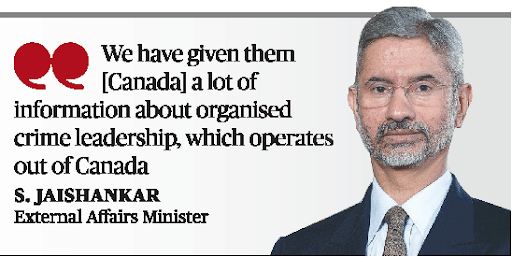
- India had provided information about the leadership of the organized crime groups in Canada and had made several extradition requests.
- He also raised India’s concerns such as
- Threats and attacks faced by its diplomats and consulates
- Interference in India’s politics
On U.S.A
- He highlighted the need to adopt a positive approach in which the India-U.S. relationship is viewed in terms of its possibilities rather than its limits.
- The bilateral relationship between the two countries had enormous possibilities in which convergences exceeded divergences.
- The evolving relationship covers sectors such as technology, people-to-people ties, security, economics, and politics, with technology, defense, and politics identified as the top priorities.
- The technology partnership could also improve synergies in the defense and security sectors.
- He emphasized India’s role as a vital link between the U.S.A. and the Global South and the readjusted approach in which fluid partnerships like QUAD (which has two treaty allies and a non-treaty ally as its members.
On China
- He claimed that India-China relations have been in a very abnormal state since the border clashes in 2020.
- The India-China problem was not a short or medium-term issue but a long-term issue as it was not possible to have normal bilateral relations with another country that had amassed a large amount of troops at the border in violation of several border agreements.
- He added that the countries’ troops have been trying to disengage and that seven or eight of the ten forward deployments had been resolved.
QUAD
|
(*Click this link to read prelims specific weekly current affairs articles)
FAQs
Question: What is the Council on Foreign Relations?
Answer:
The Council on Foreign Relations (CFR) is a U.S.-based independent and non-partisan think tank that aims to help citizens, media persons, students, organizations, and governments understand the world and foreign policy strategies.
Question: What is extradition?
Answer:
Extradition refers to the process in which one state implements the return of a person on the request of another state for a crime that is punishable by the laws of the requesting state and committed outside the state of refuge. The Indian Extradition Act, 1962 covers the extradition of persons to and from India.
UPSC Mains Practice Question:
|
MCQs
Question: Which of the following principles related to extradition are correctly matched
(a) Reciprocity - Benefits or penalties bestowed by a country on the citizens of another country should be returned to its citizens as well.
(b) Double jeopardy - the act for which the accused is requested to be extradited must be a crime in the territorial state as well.
(c) Double criminality - a person already tried and punished can not be extradited for the same crime.
(d) Specialty - Extraditing states can punish the offender for all crimes considered necessary.
Answer: (a) See the Explanation
- The four major principles of extradition are:
- Principle of Reciprocity: It provides that every act of favor, respect, benefit, or penalty bestowed by a country on the citizens or legal entities of another country, should be returned (reciprocated) in the same manner. Hence pair (a) is correct.
- Principle of Double Criminality: It states that the act for which the accused person or convict is requested to be extradited by the requesting state must be a crime in the territorial state as well. Hence pair (b) is incorrect.
- Principle of Double Jeopardy: It states that a person who has already been tried and punished can not be extradited if the request is related to the same crime. Hence pair (c) is incorrect.
- Principle of Speciality: The requesting state is bound to try or punish the extradited offender only for the offense for which he is extradited. Hence pair (d) is incorrect.
Therefore, option (a) is the correct answer.
Download the PREPP App and attempt FREE IAS Exam Mock Tests and get complete study material!

Full Test - 04: UPSC CSE Prelims CSAT (Paper-II)
Full Test - 03: UPSC CSE Prelims CSAT (Paper-II)
UPSC CSE Prelims 2026 GS Paper 1 Question Paper (24-May-2026)
UPSC CSE Prelims 2026 CSAT Paper 2 Question Paper (24-May-2026)

17 February 2025 | The Hindu Must Read Articles | Current Affairs

16 February 2026 | The Hindu Must Read Articles | Current Affairs

13 February 2026 | The Hindu Must Read Articles | Current Affairs









Comments