Joint Efforts Of India And Bangladesh To Protect Sundarbans
Relevance: GS3- Conservation, environmental pollution and degradation, environmental impact assessment
(Source: DTE, 09/27/2023)
Click here for Daily Current Affairs
Why in the news?
- Recently officials and experts from India and Bangladesh had a high level meeting at Kolkata and discussed the increasing impact on the largest delta of the world, Sundarbans, due to climate change.
- Both countries have decided to raise this issue in the upcoming UNFCCC COP-28 in Dubai.
- In this article we will further take insight about the Sundarbans, impact of climate change and the joint efforts of India and Bangladesh on the same.
Table of Contents

What are Sundarbans?
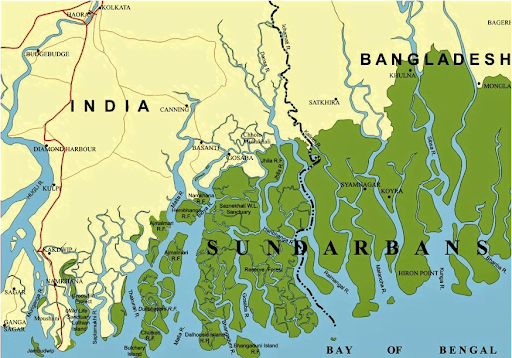
- The Sundarbans is a mangrove area in the delta region which is formed by depositional activity of three great rivers: the Ganges, Brahmaputra, and Meghna while merging into the Bay of Bengal. It is the largest delta and mangrove forest of the world.
- Sundari trees can be found in large numbers all over the forest which gives them their name.
- Sundarbans has been designated as UNESCO World Heritage Sites(1987), Wetland of International Importance under Ramsar Convention(2019), Biosphere Reserve by UNESCO under Man and Biosphere Program(2001).
Biodiversity - Flora and Fauna in Sundarbans
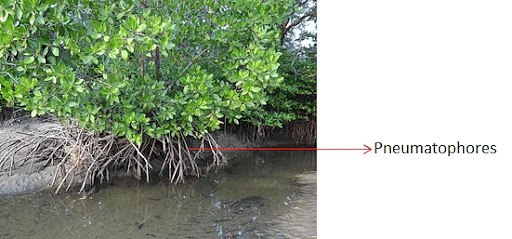
- The vegetation is predominantly mangrove in nature and includes a wide range of plants such as trees, shrubs, grasses, epiphytes, and lianas.
- To survive in such high saline and waterlogged region, vegetation over here goes under Physiological adaptations which includes - pneumatophores roots(image below), stilt roots, aerial roots, adventitious roots, secretion of salt through evapotranspiration and viviparous mode of reproduction.
![Biodiversity - Flora and Fauna in Sundarbans]()
- The Sundarbans are home to a wide range of wildlife which includes roughly 50 species of mammals, 320 species of inland and migratory birds, 50 species of reptiles, 8 species of amphibians, and 400 species of fish in forest settings.
- Major species of animals found here are: Royal Bengal Tiger, Estuarine crocodile, Spotted deer, Barking deer, Rhesus macaque, Jungle cat, Leopard cat, Indian porcupine, Otter, and wild boar.
- But due to the impact of climate change this biodiversity landscape of the Sundarbans is changing continuously.
How Climate Change is Affecting the Sundarbans?
- It noted that the transboundary Sundarbans are one of the global hotspots of climate change with increasing high intensity cyclones.
- Sea level rise here is observed more than double the global average.
- These mangroves used to be safe havens of diverse molluscs and crustaceans, but these are also disappearing due to the polluted discharges and breeding activities of these species.
- High degree of erosion due to intensification of waves action leading to large- scale forced migration of people.
- With frequent storms over the years, the salinity of water of most of the rivers and ponds has increased in almost all areas of the Sundarbans, which resulted in reducing the productivity of fishponds and farmland, resulting in even lower incomes for poor and vulnerable households.
- It is estimated that the Indian Sundarbans lost 210 square kilometres of land due to sea level rise in the last six decades and the area will notice rapid increase in temperature, increased frequency of cyclones and flooding by 2050.
- It is stated that at least one-fourth of the eight million people living in and around the Sundarbans stand at the doorstep of climate-triggered disasters.
What are the recent initiatives taken by the government of India and Bangladesh to protect the Sundarbans?
- According to the officials from India and Bangladesh, the Sundarbans’ climate change impacts should be seen as a global concern not just a regional issue.
- To address this issue at global level, India and Bangladesh will be submitting a joint document on the matter at COP 28 of UNFCCC at Dubai in December 2023.
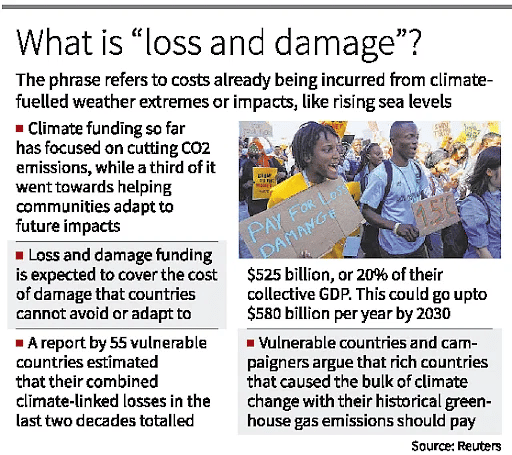
- The purpose of this step is to get Loss and Damage support in an immediate manner and the funds for protection.
What is UNFCCC?
The United Nations Framework Convention on Climate Change (UNFCCC) is an international environmental convention that aims to lower atmospheric concentrations of greenhouse gases in order to prevent dangerous anthropogenic interference with the earth's climate system. The United Nations Framework Convention on Climate Change (UNFCCC), commonly known as the Earth Summit, the Rio Summit, or the Rio Conference, was ratified in 1992. What is the concept of Loss and Damage?
|
(*Click this link to read prelims specific weekly current affairs articles)
FAQs
Question: What is meant by loss and damage due to climate change?
Answer:
Loss & Damage due to climate change refers to impacts of climate change that cannot be avoided by mitigation (cutting greenhouse gas emissions) or adaptation (modifying practices to buffer against climate change impacts).
Question: Recently which countries have decided to raise the concern of the impact of climate change on Sundarbans to discuss at COP 28 of UNFCCC?
Answer:
India and Bangladesh
MCQs
Question: Which of the following includes Loss & Damage due to climate change:
- Impacts of climate change that cannot be avoided by mitigation or adaptation.
- Economic damage to property.
- Destruction of biodiversity and sites that have cultural importance.
Which of the above statements is/are correct?
(a) 1 and 2 only
(b) 2 and 3 only
(c) 1 and 3 only
(d) 1,2 and 3
Answer: (d) See the Explanation
- L&D refers to impacts of climate change that cannot be avoided either by mitigation (cutting greenhouse gas emissions) or adaptation (modifying practices to buffer against climate change impacts).
- They also include not only economic damage to property but also loss of livelihoods, and the destruction of biodiversity and sites that have cultural importance. This broadens the scope for affected nations to claim compensation.
- Therefore, option (d) is the correct answer.
Download the PREPP App and attempt FREE IAS Exam Mock Tests and get complete study material!

Full Test - 04: UPSC CSE Prelims CSAT (Paper-II)
Full Test - 03: UPSC CSE Prelims CSAT (Paper-II)
UPSC CSE Prelims 2026 GS Paper 1 Question Paper (24-May-2026)
UPSC CSE Prelims 2026 CSAT Paper 2 Question Paper (24-May-2026)

17 February 2025 | The Hindu Must Read Articles | Current Affairs

16 February 2026 | The Hindu Must Read Articles | Current Affairs

13 February 2026 | The Hindu Must Read Articles | Current Affairs









Comments