India Ageing,Elderly To Make Up 20% Of Population By 2050: UNFPA Report
Relevance: GS1 - Population and Associated Issues; GS2 - Important International institutions
(Source: The Hindu, 09/28/2023)
Click here for Daily Current Affairs
Why in the news?
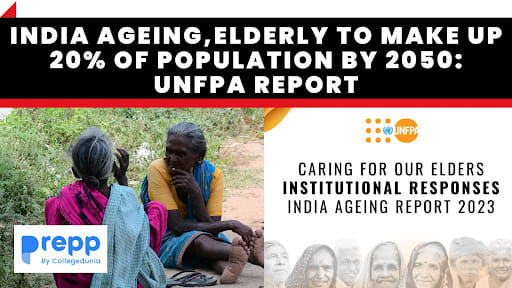
- Recently, the India Ageing Report 2023 was released by the International Institute for Population Sciences (IIPS) and the United Nations Population Fund (UNFPA).
- It was highlighted that the percentage of the elderly in India has been increasing rapidly in recent years and this trend is likely to continue in the coming decades as well.
- The report used data from the 2011 Census, the 2017-18 Longitudinal Ageing Survey in India (LASI) conducted by the Health Ministry, population projections of the Government of India and the World Population Projection 2022 report, etc.
Table of Contents
Findings of the Report
- Elderly Population Growth: Due to the rapidly increasing elderly population in India, projected to double to over 20% of the total population by 2050, there is a strong possibility that by 2046, the number of elderly individuals will exceed the population of children aged 0 to 15 years in the country.
- As of July 1, 2022, the number of people above 60 years of age, that is, the elderly, in India was 149 million, which was 10.5% of India’s population. By 2050, 20.8% or 347 million Indians will be senior citizens. This number will reach over 36% by century-end.
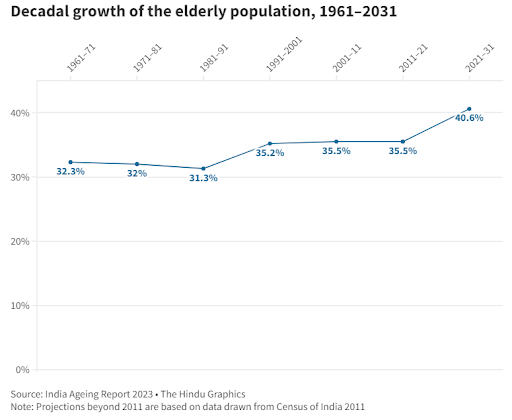
- Decadal growth rate: This demographic shift is driven by a decadal growth rate of 41% among the elderly population in India.
- Higher life expectancy of women: The data showed that women, on average, had higher life expectancy at the age of 60 and at the 80, when compared to men with variations across States and Union Territories.
- State variation in absolute levels and growth of the elderly population: Most States in the southern region and some northern States such as Himachal Pradesh and Punjab reported a higher share of the elderly population than the national average in 2021. This gap is expected to widen by 2036.
- States reporting higher fertility rates and lagging in demographic transition, including Bihar and Uttar Pradesh, expect to see an increase in the share of the elderly population between 2021 and 2036.
- Compared with southern and western India, central and northeastern regions have the younger group of States as indicated by the ageing index.
Changing Sex Ratios
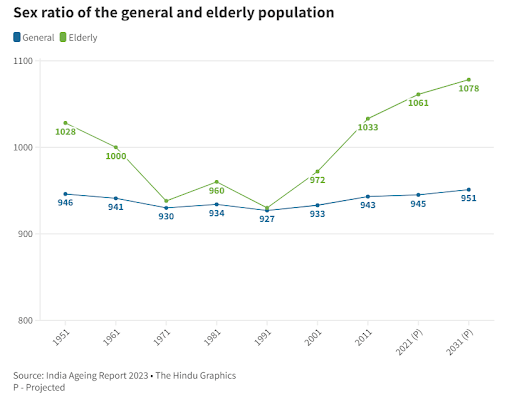
- The report observed that in 1991, there were 930 elderly women per 1,000 men. After this, the ratio started to change and will continue to do so. The report hence, estimates that by 2031, there will be 951 men for 1,078 women.
- The sex ratio (females per 1,000 males) among the elderly has been climbing steadily since 1991, with the ratio in the general population stagnating.
- Between 2011 and 2021, the ratio increased in India as a whole and across all regions, barring the Union Territories and western India.
- In the northeast and the east, while the sex ratio of the elderly increased, it remained below 1,000 in both years, indicating that men still outnumber the women in these regions even at 60-plus years.
- In central India, the sex ratio went from 973 in 2011 to 1,053 in 2021, implying that the women caught up with and outperformed the men in survival after 60 years over the decade.
What are the concerns?
- Poverty Among the Elderly: More than 40% of the elderly in India belong to the poorest wealth quintile, with about 18.7% of them living without any income. This high level of poverty can negatively impact their quality of life and healthcare utilization.
- Increasing Number of Widowed Women: With women expected to live longer than men, there is a growing concern about the increasing number of widowed women in India. This demographic shift may result in a significant proportion of elderly women living without their spouses.
- State-Level Variation: The report mentions variations in life expectancy between states, with women in certain states expected to outlive men by a greater margin. This highlights the importance of targeted regional policies to address the specific challenges faced by elderly women in different parts of the country.
- For instance: In India, a man aged 60 years can live another 18.3 years, while women can live 19 years. Apart from this, it also depends on the different life expectancy of the states. In Kerala and Himachal Pradesh, women can have up to 4 years more than men.
- Dependency and Caregiving: As the elderly population increases, there may be a higher demand for caregiving services, especially for elderly women who may require assistance in their later years. This could strain existing healthcare and social support systems and necessitate planning for caregiving infrastructure.
About UNFPA
Functions of UNFPAUNFPA funds assistance, research, and advocacy programs in three major areas:
International Institute for Population Sciences (IIPS)
|
What are the suggestions?
- Include Elderly-Related Questions in Data Collection: The report recommends including questions related to older persons in upcoming data collection exercises such as the National Sample Survey, the National Family Health Survey, and the Census of India. This is to gather more credible data on elderly issues.
- Increase Awareness About Schemes: The government should work on increasing awareness about existing schemes and programs designed for older persons. This would ensure that eligible individuals are aware of and can benefit from these initiatives.
- Regulate Old Age Homes: Bring all Old Age Homes under regulatory purview to ensure the well-being and rights of elderly residents are protected.
- Promote In-Situ Ageing: Encourage elderly people to age in their own homes as much as possible. This can be facilitated by creating short-term care facilities like creches or day-care facilities to support families in caring for their elderly members.
- Support Elderly Self-Help Groups: Encourage the creation and running of self-help groups among the elderly. These groups can provide social support, share resources, and promote well-being among older persons.
- Promote Multigenerational Households: Emphasize the importance of having elderly people live in multigenerational households. This arrangement can provide emotional and practical support to older family members.
Government Schemes for the Elderly
- National Policy on Older Persons (NPOP)
- National Social Assistance Programme (NSAP)
- Pradhan Mantri Vaya Vandana Yojana (PMVVY)
- Integrated Program for Older Persons (IPOP)
- Rashtriya Vayoshree Yojana
- SAMPANN Project
- SACRED Portal for Elderly
- Seniorcare Ageing Growth Engine(SAGE)
(*Click this link to read prelims specific weekly current affairs articles)
FAQs
Question: What is UNFPA?
Answer:
The United Nations Population Fund (UNFPA), formerly the United Nations Fund for Population Activities, is a UN agency and a trust fund under the jurisdiction of the United Nations Development Programme (UNDP).
Question: Who released the India Ageing Report 2023?
Answer:
The India Ageing Report 2023 was released by the International Institute for Population Sciences (IIPS) and the United Nations Population Fund (UNFPA).
Question: What is the meaning of old?
Answer:
Population statistics usually refer to the population aged 60 or 65 years and above as ‘old’.
UPSC Mains Practice Question:
|
Download the PREPP App and attempt FREE IAS Exam Mock Tests and get complete study material!

Full Test - 04: UPSC CSE Prelims CSAT (Paper-II)
Full Test - 03: UPSC CSE Prelims CSAT (Paper-II)
UPSC CSE Prelims 2026 GS Paper 1 Question Paper (24-May-2026)
UPSC CSE Prelims 2026 CSAT Paper 2 Question Paper (24-May-2026)

17 February 2025 | The Hindu Must Read Articles | Current Affairs

16 February 2026 | The Hindu Must Read Articles | Current Affairs

13 February 2026 | The Hindu Must Read Articles | Current Affairs









Comments