Why Are Tigers Dying In Nilgiris District?
Relevance: GS3 - Conservation, environmental pollution and degradation, environmental impact assessment GS1 - Changes in critical geographical features (including water-bodies and ice-caps) and in flora and fauna and the effects of such changes.
(Source: The Hindu, 09/28/2023)
Click here for Daily Current Affairs
Why in the news?
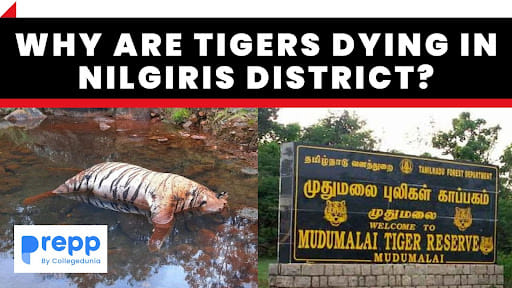
- Recently, ten tigers including six cubs and four adults in the Nilgiri hills died.
- Conservationists have expressed concern about the welfare of the animals in the region.
Table of Contents
How did the tigers die?
- Postmortems conducted on the remains of the two-week-old cubs from Mudumalai Tiger Reserve (MTR) in Siriyur indicated that they could have died of starvation or umbilical infection.
- Officials suspect that injuries suffered while fighting with other animals caused the death of an adult tigress in the Naduvattam Range in the Nilgiris forest division, an adult tigress in the Kargudi forest range of MTR, and a sub-adult tiger in the Udhagai South Range near Avalanche in the Nilgiris Forest Division.
- Another large male tiger died due to consuming a poisoned carcass of a cow in Udhagai South Range.
- In September, four tiger cubs were found dead in Kadanad in the Nilgiris North Range, but the reasons behind their death have not been ascertained.
Why are conservationists concerned?
- Inefficiency of forest department: Conservationists have raised concerns about the welfare of tigers in the region as forest officials have been unable to locate the two mothers of the six cubs that died at Siriyur and Kadanad.
- Camera traps and tiger trackers have also been unsuccessful in locating the tigers.
- Poaching: Poachers had been arrested earlier near Emerald Dam which is close to where the tigers were found dead, raising concerns about illegal hunting and exploitation of tigers in the region.
What are the reasons for the deaths?
- High density: The high density of tigers in the Mudumalai-Bandipur-Nagarhole complex of the Nilgiri Biosphere is causing them to stray into the Mukurthi National Park, Nilgiris, and Gudalur forest divisions.
- This could lead to more fights and competition between animals, which could result in more animal deaths in the region.
- Human-animal conflict: The Nilgiri forest division has around 54 tigers with tigers being regularly sighted in Udhagamandalam town recently.
- This could increase the chances of negative human-animal interactions as animals stray into human habitations due to the shortage of prey as a result of habitat degradation.
- Environmentalists have recommended recolonizing these degraded habitats with tiger prey species such as Sambar, spotted deer, and the Indian gaur.
How are officials responding?
- Anti-poaching camps: The forest department has planned to set up anti-poaching camps in six forest ranges around the Mukurthi National Park.
- Monitoring: It will also conduct regular monitoring of the population size, range of individual animals, and other parameters of tiger species in the Nilgiri to ensure better species management.
- Perambulation: Patrols will be intensified around key tiger habitats such as Mudumulai and Mukurthi.
Mudumalai Tiger Reserve
To learn more about tiger reserves in India, click the link. |
(*Click this link to read prelims specific weekly current affairs articles)
FAQs
Question: Where is the Nilgiri Biosphere Reserve located?
Answer:
The Nilgiri Biosphere Reserve is a UNESCO-designated biosphere reserve in the Western Ghats that spans parts of Tamil Nadu, Karnataka, and Kerala. Its vegetation consists of montane forests, grasslands, wetlands, and Shola forests. It was the first Biosphere Reserve in India and was established in 1986.
Question: What is a critical tiger habitat?
Answer:
According to the Forest Rights Act, 2000, critical tiger habitats are wildlife habitats within National Parks and Sanctuaries that must be protected in perpetuity for the purpose of wildlife conservation. They fall under the purview of the Wildlife Protection Act of 1972 and are notified by the MoEFCC after an open consultation process by an Expert Committee.
UPSC Mains Practice Question:
|
MCQs
Question: Among the following Tiger Reserves, which one has the largest area under “Critical Tiger Habitat”? (UPSC CSE 2020)
(a) Corbett
(b) Ranthambore
(c) Nagarjunsagar-Srisailam
(d) Sunderbans
Answer: (c) See the Explanation
- The Core/ Critical Tiger Habitat of Nagarjunsagar-Srisailam is 3721 Sq. Km.
- It is the largest tiger reserve in India and has the largest area under Critical tiger habitat in India.
Therefore, option (c) is the correct answer.
Question: Which one of the following is not a Biosphere reserve? (UPSC CSE 2005)
(a) Agasthyamalai
(b) Nallamalai
(c) Nilgiri
(d) Panchmarhi
Answer: (b) See the Explanation
- Nallamalai is not a biosphere reserve but hills in the Eastern Ghats.
- The Niligiri Biosphere Reserve was established in 1986, the Panchmarhi Biosphere Reserve in 1999, and the Agasthyamalai Biosphere Reserve in 2001.
- Therefore, option (b) is the correct answer.
Download the PREPP App and attempt FREE IAS Exam Mock Tests and get complete study material!

Full Test - 04: UPSC CSE Prelims CSAT (Paper-II)
Full Test - 03: UPSC CSE Prelims CSAT (Paper-II)
UPSC CSE Prelims 2026 GS Paper 1 Question Paper (24-May-2026)
UPSC CSE Prelims 2026 CSAT Paper 2 Question Paper (24-May-2026)

17 February 2025 | The Hindu Must Read Articles | Current Affairs

16 February 2026 | The Hindu Must Read Articles | Current Affairs

13 February 2026 | The Hindu Must Read Articles | Current Affairs









Comments