‘Methane Emissions in Livestock and Rice Systems’ : A Report Published by FAO
Relevance: GS3- GS3- Conservation, environmental pollution and degradation, environmental impact assessment
(Source: DTE, 09/27/2023)
Click here for Daily Current Affairs
Why in the news?
- ‘Methane emissions in livestock and rice systems: Sources, quantification, mitigation and metrics’ report was published by FAO recently.
- The report gave the information about the sources and sinks of methane gas, outlines how emissions can be measured, describes a broad sampling of mitigation strategies and evaluates the kind of metrics that can be used to measure both emissions and their mitigation on the climate system.
Table of Contents
Key observations of the report
- About 32 per cent of global anthropogenic methane emissions result from microbial processes that occur during the enteric fermentation of ruminant livestock and manure management systems, while another 8 per cent comes from rice paddies.
- Among ruminants, the highest daily emitters on a per animal basis are cattle, followed by sheep, goats and buffalo.
- Methane emissions from anthropogenic activities currently contribute about 0.5 degrees Celsius to observed global warming.
- Besides agrifood systems, other human activities that generate methane emissions include landfills, oil and natural gas systems, coal mines and more.
- Report has focused on the 2 main sources i.e Ruminants and Paddy fields.
About Methane
|
How do cows and other animals are responsible for methane emission?
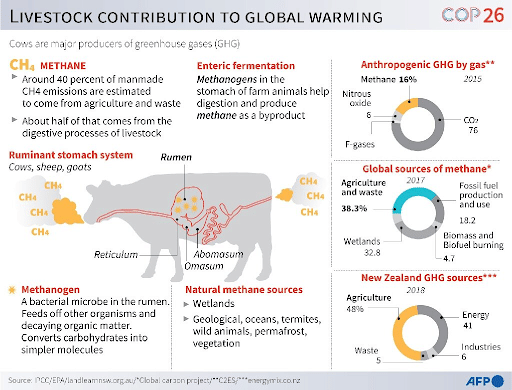
- Ruminant animals such as cows, sheep, goats, and buffaloes release this methane mainly through burping.
- They have a special type of digestive system that allows them to break down and digest food that non-ruminant species would be unable to digest.
- Stomachs of ruminant animals have four compartments, one of which, the rumen, helps them to store partially digested food and let it ferment.
- This partially digested and fermented food is regurgitated by the animals who chew through it again and finish the digestive process.
- However, as grass and other vegetation ferments in the rumen, it generates methane, a potent greenhouse gas.
- The entire process can be seen in following diagram.
How are rice fields responsible for methane emission?
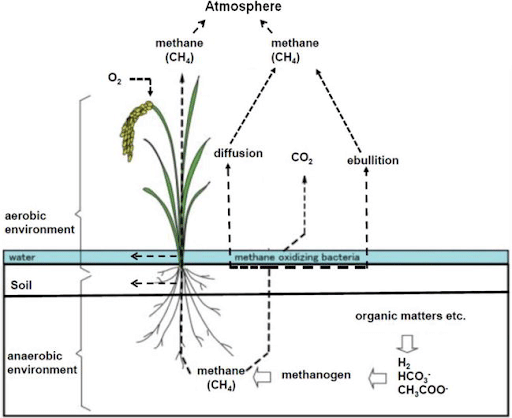
- As in a natural wetland, flooding a rice field cuts off the oxygen supply from the atmosphere to the soil, which results in anaerobic fermentation of soil organic matter. Methane is a major end product of anaerobic fermentation.
- Methane is exclusively produced by methanogenic bacteria that can metabolise only in the strict absence of free oxygen. And such waterlogged paddy field help to provide suitable condition.
- The entire process can be seen in the following diagram.
Other sources of methane emission
Natural sources
- Termites, oceans, sediments, volcanoes, and wildfires are examples of smaller sources.
- Termites for digestion produce around 23 million tonnes of methane per year.
- Volcanoes also produce methane when they erupt.
- Microbes in the ocean that produce methane contribute significantly to methane emissions. Oceans emit 19 million tonnes of methane each year on a global level.
- Methane hydrate deposits found along continental margins below Antarctic ice are also a natural source of methane.
Anthropogenic Sources
- CH4 is also produced when animal manure is stored or managed in lagoons or holding tanks.
- Natural gas is primarily composed of methane. Methane is released into the atmosphere during natural gas production, processing, storage, transmission, and distribution, as well as crude oil production, refinement, transportation, and storage.
- Coal mining also contributes to CH4 emissions.
- Methane is produced in landfills as waste decomposes and in wastewater treatment.
- Biomass burning - According to reports, it emits 38 million tonnes of methane every year.
Efforts to curb methane emissionGlobal Initiatives to Reduce Methane Emissions
Initiatives Taken by India to Reduce Methane Emissions
|
(*Click this link to read prelims specific weekly current affairs articles)
FAQs
Question: How does methane act as a greenhouse gas?
Answer:
When methane is released into the atmosphere, it reacts in a variety of dangerous ways. For one thing, methane primarily exits the atmosphere via oxidation, producing water vapour and carbon dioxide. As a result, methane not only directly contributes to global warming but also indirectly through the release of carbon dioxide.
MCQs
Question: Which of the following statements is not correct about the Global Methane Pledge?
(a) The Global Methane Pledge was launched at COP 26 to catalyse action to reduce methane emissions.
(b) It was led by the United States and the European Union.
(c) India is a part of the Global Methane Pledge.
(d) By joining the Pledge, countries commit to work together in order to collectively reduce methane emissions by at least 30% below 2020 levels by 2030.
Answer: (a) See the Explanation
- The Global Methane Pledge was launched at COP (Conference of Parties) 26 in November 2021 to catalyse action to reduce methane emissions.
- It was led by the United States and the European Union.
- It has 111 country participants who together are responsible for 45% of global human-caused methane emissions.
- India, which is not a part of the Global Methane Pledge, is among the top five methane emitters globally. Most emissions can be traced back to agriculture.
- By joining the Pledge, countries commit to work together in order to collectively reduce methane emissions by at least 30% below 2020 levels by 2030.
Download the PREPP App and attempt FREE IAS Exam Mock Tests and get complete study material!

Full Test - 04: UPSC CSE Prelims CSAT (Paper-II)
Full Test - 03: UPSC CSE Prelims CSAT (Paper-II)
UPSC CSE Prelims 2026 GS Paper 1 Question Paper (24-May-2026)
UPSC CSE Prelims 2026 CSAT Paper 2 Question Paper (24-May-2026)

17 February 2025 | The Hindu Must Read Articles | Current Affairs

16 February 2026 | The Hindu Must Read Articles | Current Affairs

13 February 2026 | The Hindu Must Read Articles | Current Affairs









Comments