Stop Using Newspapers For Packaging Food Items: FSSAI
Relevance: GS2 - Issues relating to development and management of Social Sector or Services relating to Health, Education, Human Resources; GS3 - Food Security
(Source: The Hindu, 09/28/2023)
Click here for Daily Current Affairs
Why in the news?
Recently, the Food Safety and Standards Authority of India (FSSAI) has “strongly urged” consumers and food vendors across the country to stop using newspapers for packing, serving or and storing items.
Table of Contents
Key Points
- According to the Food Safety and Standards (Packaging) Regulations, 2018, use of newspapers or similar materials for storing and wrapping food is strictly prohibited.
- Use of newspapers for wrapping, packing and serving food is a common practice in India, and however, this is a food safety hazard.
- Indians are being slowly poisoned due to newspapers being widely used as food packaging material by small hotels, vendors and also in homes in lieu of absorbent paper.
Why restrict the use of newspaper as food packaging material?
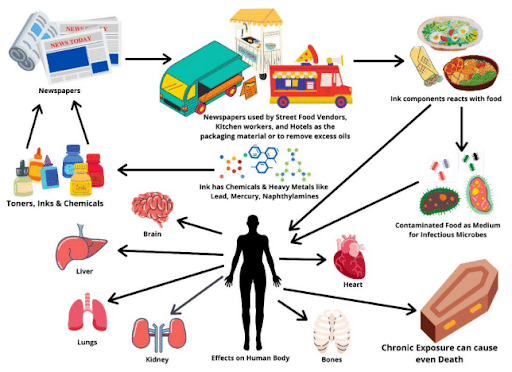
- The Food Safety and Standards Authority of India (FSSAI) had earlier warned that the printing ink contains cancer-causing agents that can cause severe health issues.
- The ink used in newspapers contains various bioactive materials with known negative health effects, which can contaminate food and lead to health issues when ingested.
- Additionally, printing inks may contain chemicals including lead and heavy metals that can leach into the food, posing serious health risks over time.
- Printing inks also contain harmful colours, pigments, binders, additives, and preservatives. Besides, chemical contaminants, presence of pathogenic microorganisms in used newspapers also pose potential risk to human health.
- Newspapers and recycled papers may have mettalic contaminants like mineral oils and harmful chemicals like phthalates which can cause digestive problems and also lead to severe toxicity.
What are the alternative materials for food packaging?
- Bamboo: It is very important to use biodegradable and biotic material to be used as packaging material. Bamboo is one of the best alternatives to newspaper and plastic packaging. Bamboo can cultivate much quicker and spread about dual the height of a human in 4 years. It can be made into fibers and thin sheets, which helps make a good alternative for food packaging material.
- Seaweed-based packaging: It is as an eco-friendly replacement for plastic is quite feasible. Seaweed can grow in both seawater and freshwater, is inert, and doesn’t require any additional media for its growth. It is also packed with a plethora of vitamins, fiber, and minerals, allowing the possibility of producing edible packaging.
- Stainless steel: Stainless steel has been reported to be the most used alloy, used for cutlery and kitchen purposes. Stainless steel is a common material for food packing in developing nations. The unique characteristic of steel is that it can be modified into varied structures as per customers' needs. It is malleable and ductile, making it suitable to be used as containers.
- Coir and Bagasse: Coir, which is made from coconut husk, can be used to make packaging for food items such as fruits and vegetables. Bagasse, which is a by-product of sugarcane, can be used to make plates, bowls, and other food containers.
- Rice and wheat bran, which are waste products from the production of rice and wheat, can be used to make biodegradable packaging.
Some Initiatives of Indian States
- In 2019, officials in Chennai prohibited the storage, distribution and sale of food items packaged in printed newspapers.
- Owing to the harmful effect of newspaper ink, Madhya Pradesh has banned the use of newspapers to serve snacks.
- An awareness campaign called ‘Akhbar mein khane ko boliye na’ (Say no to eating in newspapers) was also launched.
About FSSAI
|
(*Click this link to read prelims specific weekly current affairs articles)
FAQs
Question: Why is the use of newspapers in food packaging harmful?
Answer:
The ink used in newspapers contains various bioactive materials with known negative health effects, which can contaminate food and lead to health issues when ingested.
Question: What is Food Security?
Answer:
Food security, as defined by the United Nations Committee on World Food Security, means that all people have physical, social, and economic access to sufficient, safe, and nutritious food that meets their food preferences and dietary needs for an active and healthy life at all times.
Question: What is FSSAI
Answer:
Food Safety and Standards Authority of India (FSSAI) is a statutory body established under the Ministry of Health & Family Welfare, Government of India.
MCQ
Question: Consider the following statements: (UPSC 2018)
- The Food Safety and Standards Act, 2006 replaced the Prevention of Food Adulteration Act, 1954.
- The Food Safety and Standards Authority of India (FSSAI) is under the charge of Director General of Health Services in the Union Ministry of Health and Family Welfare.
Which of the statements given above is/are correct?
(a) 1 only
(b) 2 only
(c) Both 1 and 2
(d) Neither 1 nor 2
Answer: (a) See the Explanation
- The Food Safety and Standards (FSS) Act, 2006 consolidated various acts and orders that had earlier handled food related issues in various ministries and departments. Prevention of Food Adulteration Act, 1954 was repealed after commencement of FCC act, 2006. Hence, statement 1 is correct.
- FSSAI is an autonomous statutory body established under the Food Safety and Standards Act, 2006. The Ministry of Health and family welfare Government of India is the administrative ministry for the implementation of FSSAI. Before the formation of fssai, from 1954 onwards prevention of food adulteration was part of the directorate general of health services. After having detached from the direct administrative control of the health ministry this authority is holding independent authority and has attained a special status. Hence, statement 2 is not correct
Therefore, option (a) is the correct answer.
Download the PREPP App and attempt FREE IAS Exam Mock Tests and get complete study material!

Full Test - 04: UPSC CSE Prelims CSAT (Paper-II)
Full Test - 03: UPSC CSE Prelims CSAT (Paper-II)
UPSC CSE Prelims 2026 GS Paper 1 Question Paper (24-May-2026)
UPSC CSE Prelims 2026 CSAT Paper 2 Question Paper (24-May-2026)

17 February 2025 | The Hindu Must Read Articles | Current Affairs

16 February 2026 | The Hindu Must Read Articles | Current Affairs

13 February 2026 | The Hindu Must Read Articles | Current Affairs









Comments