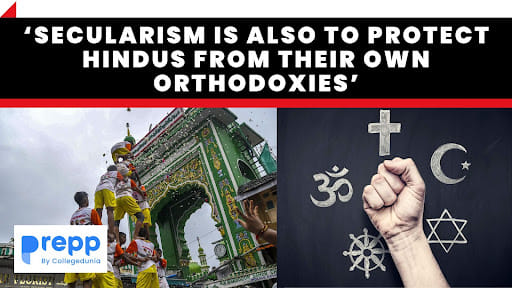
‘Secularism Is Also To Protect Hindus From Their Own Orthodoxies’
Relevance: GS1 - Secularism; GS2 - Indian Constitution; Comparison of the Indian constitutional scheme with that of other countries.
(Source: The Hindu, 09/28/2023)
Click here for Daily Current Affairs
Why in the news?
- Rajeev Bhargava, a prominent political theorist and the author of "Reimagining Indian Secularism" (published in 2023), has critically examined both the merits and shortcomings of India's unique form of secularism.
- It was argued that secularism should not be seen as a project only for minorities.
Table of Contents
India’s Unique Form of Secularism
- India's constitutional secularism is distinct from other models found in countries like in the U.S. there is mutual exclusion and in France, a one-sided exclusion.
- In India, exclusion of religion from the state is not feasible due to the country's religious diversity. Instead, the state maintains a "principled distance" from religion, intervening as necessary to ensure equality, freedom, and fraternity.
- European secularism began against religious homogeneity and now faces diversity, while Indian secularism was born in response to India's own remarkable diversity.
What is Secularism?
- Secularism means separation of religion from political, economic, social and cultural aspects of life, religion being treated as a purely personal matter.
- It entails the idea that religious institutions and beliefs should not have a direct role in the affairs of the state, and conversely, the government should not favor or endorse any particular religion.
- Instead, secularism promotes the idea that public institutions and policies should be neutral and impartial with regard to religious matters.
- The Vedic idea of 'Dharma Nirapekshata,' or the state's indifference to religion, is similar to secularism, and its ideology advocates for the separation of state and religion.
Challenges to Indian Secularism
- Hindu nationalism: The challenges faced by Indian secularism, is particularly due to the growth of Hindu nationalism. Some Hindu nationalists seek preferential treatment for Hindus, which contradicts the principles of equality and impartiality. As Hindu nationalism gained ground, the original concept of secularism in India began to transform.
- Misinterpretation: Indian secularists sometimes misinterpret secularism, believing that religion should remain solely in the private domain. Yet, given India's public religious expressions like Muharram and Kumbh Mela, a more practical secular approach is to separate official public spaces from religious practices.
- Brahmanical orthodoxy: Uttar Pradesh (U.P.) and its surrounding regions have significantly shaped the national narrative and response to secularism in a diverse India. The dominance of Brahmanical orthodoxy and the persistence of the caste system in this area have posed ongoing challenges to secularism.
- While movements against these orthodoxies began in southern India in the 20th century, similar shifts in the northern states, including U.P., have taken nearly a century to materialize, and even then, they have faced resistance.
- U.P. 's influence on the national narrative is evident in key inflection points, such as Indira Gandhi's use of the Hindu card in the 1980s and issues like Shah Bano and Babri Masjid, which became national concerns.
Provisions Related to Secularism in Indian Constitution
| Article | Provisions |
|---|---|
| Article 14 and 15 | The former ensures that everyone has equal access to the law and equal protection under the law, but the latter broadens the definition of secularism by outlawing discrimination on the basis of religion, race, caste, sex, or place of birth. |
| Article 16 (1) | In regards to public employment, all citizens are given equal opportunity and no discrimination is made on the basis of religion, race, caste, sex, descent, place of birth, or residency. |
| Article 25 | ‘Freedom of Conscience' means that everyone has the same right to freely proclaim, practice, and spread religion. |
| Article 26 | Every religious group or individual has the right to create and maintain religious and philanthropic institutions, as well as to administer their own religious affairs. |
| Article 27 | The state shall not compel any person to pay taxes in order to promote or maintain any religion or any institution. |
| Article 28 | enables religious instruction to be taught at educational institutions run by diverse religious groups. |
| Article 29 and 30 | Minorities' cultural and educational rights are protected. |
| Article 51 A | All people are obligated to foster unity and the sense of shared brotherhood, as well as to cherish and preserve our composite culture's rich legacy. |
Reimagining Indian Secularism: A Holistic Approach
- Acknowledging the gap: To reimagine Indian secularism effectively, it is crucial to bridge the gap between inter-religious and intra-religious dynamics. Focusing solely on defending minority rights can inadvertently lead to the perception that secularism primarily benefits minorities, which may alienate Hindus.
- Intra-religious challenges: In Indian secularism, it's important to tackle domination within religions, just like European secularism aimed to protect people from controlling social groups and church interference in the state. Caste system in India limits people's freedom and allows one caste to control others. To create a fair and equal society, we need to put an end to this caste-based system.
- Collaboration for a reimagined secularism: For a reimagined secularism, those fighting against inter-religious and intra-religious domination should collaborate.
- Expanding the scope of secularism: Reducing secularism to only defending the rights of minorities, particularly Muslims and Christians, can lead to the misconception that it does not apply to Hindus or even works against them.
- In reality, secularism also serves to shield Hindus from their own extremists, fanatics, caste divisions, and orthodoxies.
- A reimagined and inclusive secularism should encompass efforts to address caste and gender-based domination, fostering a more equitable and just society.
Difference between Western Secularism and Indian Secularism
| Western Secularism | Indian Secularism |
|---|---|
| In the West, all religious institutions and organizations are distinct from the operation of the state. | Secularism in India means that the state is neutral to all religious groups but not necessarily separate |
| The state thinks that religion should be free of all interference. If religion is interfering with the state's ability to function, the state has the authority to limit citizens' rights. | The concept is not limited to the topic of how religious groups should be treated in India. The essence of secularism, on the other hand, is the creation of constructive interaction between the state and religion. |
| Secularism in the Western sense opposes open displays of religion, with the exception of places of worship. | In India, all forms of religion are tolerated and supported by the government. |
| The line between state and religion is obvious and unmistakable. | In India, there is no obvious boundary between state and religion. |
| The concept of secularism originated in mid-eighteenth-century Enlightenment ideas, which were first incorporated in the French Constitution following the French Revolution (5 May 1789 – 9 November 1799). | The term ‘secularism' was established in the Indian Constitution with the 42nd Amendment Act, 1976, notwithstanding the fact that the concept of secularism was rudimentary in ancient and medieval India. |
| All religions are treated equally by the state. It does not provide financial assistance to religious organizations or levy taxes on them. | A religious institution receives financial assistance from the state and is also taxed. |
| Regardless of religious affiliation, a single standard rule of law is employed to administer justice. | Although the law is the same for all residents, each town has its own set of personal laws regarding marriage and property rights. However, under the Indian Penal Code, they are all treated equally. |
(*Click this link to read prelims specific weekly current affairs articles)
FAQs
Question: What is secularism in India?
Answer:
Secularism in India means that the state is neutral to all religious groups but not necessarily separate.
Question: What is article 51A?
Answer:
Article 51A, or Fundamental Duties, requires all citizens to foster unity and the sense of fraternal brotherhood, as well as to cherish and conserve our composite culture's rich heritage.
MCQ
Question: The words "Secular" was added to the Preamble of the Constitution of India by:
(a) 38th amendment
(b) 39th amendment
(c) 40th amendment
(d) 42nd amendment
Answer: (d) See the Explanation
- The 42nd Constitutional Amendment Act added the words 'Socialist, 'Secular' and 'Integrity.
- The 42nd amendment sought to modify the fundamental framework of the Indian Constitution.
- The Indian National Congress, led by Indira Gandhi at the time, enacted it. This legislation is also known as the "Mini-Constitution" because of the enormous number of revisions it made to the Indian Constitution.
- The '42nd Amendment Act,' commonly known as The Constitution Act.
Therefore option (d) is the correct answer.
Download the PREPP App and attempt FREE IAS Exam Mock Tests and get complete study material!

Full Test - 04: UPSC CSE Prelims CSAT (Paper-II)
Full Test - 03: UPSC CSE Prelims CSAT (Paper-II)
UPSC CSE Prelims 2026 GS Paper 1 Question Paper (24-May-2026)
UPSC CSE Prelims 2026 CSAT Paper 2 Question Paper (24-May-2026)

17 February 2025 | The Hindu Must Read Articles | Current Affairs

16 February 2026 | The Hindu Must Read Articles | Current Affairs

13 February 2026 | The Hindu Must Read Articles | Current Affairs









Comments