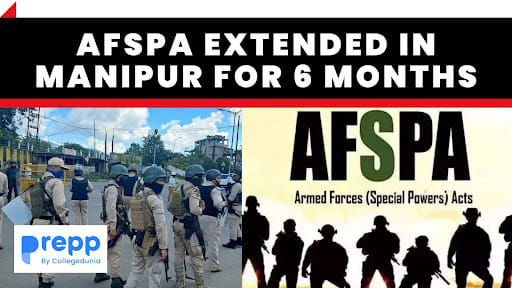
AFSPA extended in Manipur for 6 months
(Source: The Hindu, 09/28/2023)
Click here for Daily Current Affairs
Why in the news?
- The Manipur government on 27th September extended the imposition of the Armed Forces (Special Powers) Act (AFSPA) in the whole State.
- The “disturbed area” status under the Act will remain applicable in all the hill districts, which are dominated by tribal communities.
Table of Contents
About AFSPA
- Armed Forces (Special Powers) Act (AFSPA) 1958 is a parliamentary act that gives armed forces the power to maintain public order in “disturbed areas”.
- AFSPA is presently applicable in 31 districts across four Northeast states, and only partially in another 12 for example Jammu and Kashmir, Nagaland, Assam, Arunachal Pradesh, Manipur.
Major provision under the act
- Both the State and Union governments can issue notifications regarding AFSPA.
- The Act empowers the army, state and police forces to shoot to kill, search homes, and demolish any property that is "likely" to be utilised by insurgents in regions designated by the home ministry as "disturbed."
- Section (3) of the AFSPA states that the Central government has the right to deploy military forces to assist civilian authorities if the governor of a state submits an official announcement in the Gazette of India.
- Section (4) of the AFSPA, army officers in troubled areas have extraordinary authority to fire (even if it kills) anyone who breaks the law or is suspected of breaking the law (this includes gatherings of five or more persons, carrying weapons, and so on). The sole need is that the officer issue a warning before firing.
- Security forces can detain anyone without a warrant and conduct searches without permission.
Disturbed Area
|
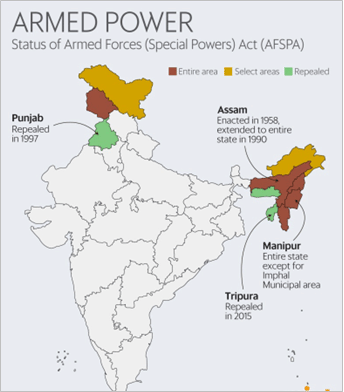
AFSPA in various states
Assam
- Assam was the first state to come under the AFSPA in 1958. The entire state of Assam was under the Act since November 1990; this was necessitated due to the rise of ULFA’s activities in the region which was at its peak during the 1990s.
- This was necessary because of the expansion of ULFA's activity in the region, which peaked in the 1990s.
Jammu & kashmir
- AFSPA, which empowers security forces to conduct operations anywhere and arrest anyone without a warrant, is in force in J&K since July 5, 1990.
- After the erstwhile state of J&K became a Union Territory; Disturbed Area Act was not revoked, nor AFSPA was abolished.
Tripura
- The AFSPA was initially implemented in Tripura in 1997, at a time when terrorism was at its apex in the border state, which shares an 856-kilometre border with Bangladesh.
- After 18 years, AFSPA was lifted from Tripura in May 2015 due to a sustained drop in insurgent activity.
Manipur
- The state of Manipur was first given ‘disturbed area’ status in 1980. This was done to combat four insurgent groups that were active in the state at that time.
Arunachal pradesh
- Three districts and 16 police station boundaries in the state have been designated as 'disturbed zones' under Section 3 of the AFSPA.
- In March 2022, the government extended the Armed Forces (Special Powers) Act in three Arunachal Pradesh districts from April 1 to September 30, 2022.
Meghalaya
- In 2018, due to a decrease in insurgency-related incidents in the state, AFSPA was withdrawn from Meghalaya with effect from March 31, 2018.
Mizoram
- The Mizoram insurgency ended with the signing of the Mizoram Peace Accord in 1986. Mizoram has been a peaceful state since then.
Nagaland
- The AFSPA has been in force in Nagaland for several decades and has been applicable to the entire state of Nagaland.
- The AFSPA will be phased down from April 1, 2022. The withdrawal affects around 25% of the state's overall land area.
Criticism of AFSPA
- The use of force to overcome popular movements has further alienated people of the north-east.
- Security personnel operating in AFSPA areas work parallel to the state security forces. Their actions sometimes encroach upon the jurisdiction of state security agencies.
- The power of arbitrary arrest and detention given to the armed forces goes against the fundamental right vested in Article 22, which provides safeguards for preventive and punitive detentions.
- The Universal Declaration of Human Rights (UDHR), the International Covenant on Civil and Political Rights (ICCPR), and the Convention Against Torture are all violated by the AFSPA often.
Committees’ recommendations on the AFSPAThe Justice Verma Committee:
The Justice Jeevan Reddy Committee (2004):
Justice Santosh Hegde Commission(2013):
|
(*Click this link to read prelims specific weekly current affairs articles)
FAQs
Question: What is Disturbed Area?
Answer:
A disturbed area is one that has been declared by notice under Section 3 of the AFSPA. Disagreements or disagreements between members of various religious, ethnic, linguistic, or regional groups, castes, or communities can cause havoc in a community. The Central Government, the Governor of the State, or the Administrator of the Union Territory may declare the entire or a portion of the State or Union Territory to be a disturbed region.
Question: What is AFSPA?
Answer:
Armed Force Special Powers Act 1958 ( AFSPA ), empowers the army, state and police forces to shoot to kill, search homes, and demolish any property that is "likely" to be utilised by insurgents in regions designated by the home ministry as "disturbed."
MCQs
Question: Consider the following with respect to Armed Forces Special Powers Act (AFSPA)
- It is applicable in all the bordering states of India.2. It was enacted in 1948, just after independence.3. It gives armed forces the power to maintain public order in “disturbed areas”.
Which of the statement/s given above is/are correct?
(a) 1 and 2 only
(b) 2 and 3 only
(c) 3 only
(d) 1, 2 and 3
Answer: (c) See the Explanation
Armed Forces (Special Powers) Act (AFSPA) 1958 is a parliamentary act that gives armed forces the power to maintain public order in “disturbed areas”.AFSPA is presently applicable in 31 districts across four Northeast states, and only partially in another 12 for example Jammu and Kashmir, Nagaland,Assam, Arunachal Pradesh, Manipur not all the border states.
Download the PREPP App and attempt FREE IAS Exam Mock Tests and get complete study material!

Full Test - 04: UPSC CSE Prelims CSAT (Paper-II)
Full Test - 03: UPSC CSE Prelims CSAT (Paper-II)
UPSC CSE Prelims 2026 GS Paper 1 Question Paper (24-May-2026)
UPSC CSE Prelims 2026 CSAT Paper 2 Question Paper (24-May-2026)

17 February 2025 | The Hindu Must Read Articles | Current Affairs

16 February 2026 | The Hindu Must Read Articles | Current Affairs

13 February 2026 | The Hindu Must Read Articles | Current Affairs









Comments